

Fish and Marine Mammal Response to Offshore Wind Farms – Moray Firth
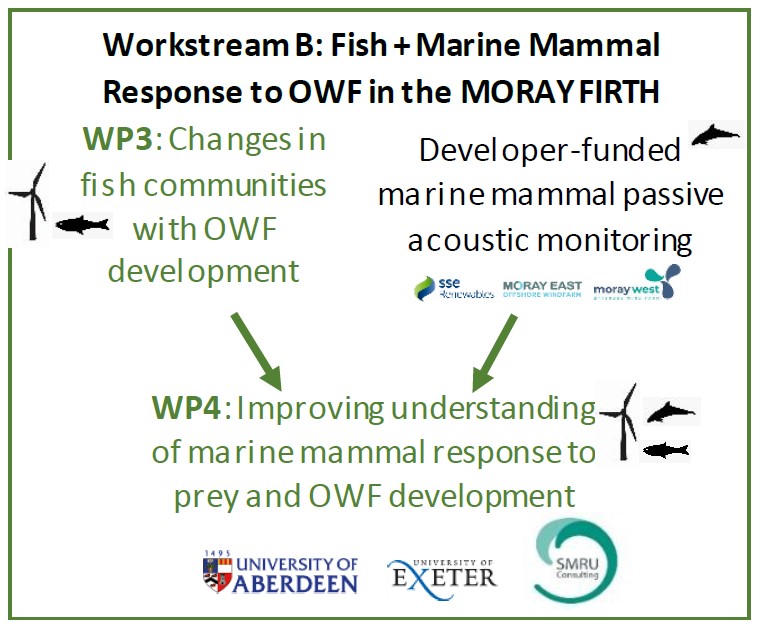
Workpackage 3: Changes in fish communities with OWF construction and operation in the Moray Firth
During 2022-24, broad- and fine-scale surveys of fish in the Moray Firth will be carried out using similar methods to fish surveys in the Firth of Forth.
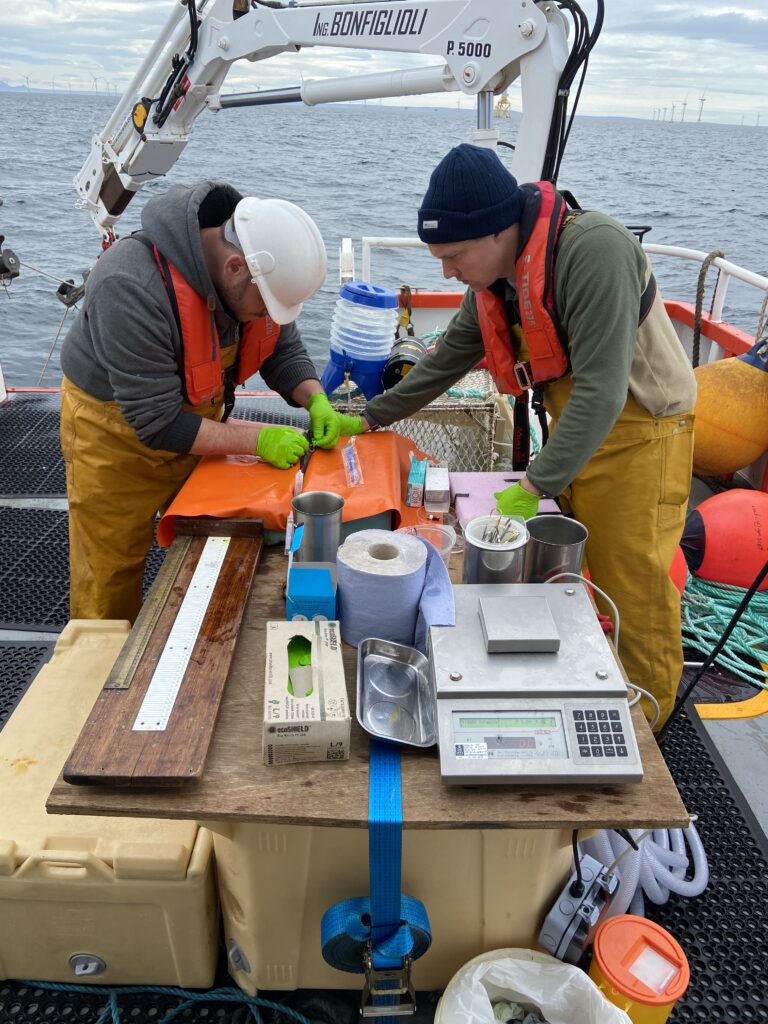
Sampling will take place in and around the Beatrice and Moray East OWFs to assess changes in bentho-pelagic prey abundance, distribution, diversity and biomass in relation to presence and age of OWF (Task 3.1).
‘Reef effects’ created by OWF structures will be investigated, providing insight into whether introducing hard structures to the marine environment provides a place for fish biomass aggregation/refuges or increased biomass production (Task 3.2).
Behaviour and movement of fish will be studied by tagging fish and tracking their movement with an array of acoustic receivers (Task 3.3). This will provide data on fish use of space in relation to wind turbines, aggregation behaviour and individual residency/fidelity, which will affect their spatiotemporal availability as food to marine top predators.
Task 3.1 – Large-scale fish distribution in Moray Firth
Led by Dr Anthony Bicknell from University of Exeter.
Broad-scale assessment of fish: How do abundance, diversity, assemblage and biomass patterns of fish vary with OWF construction and operation?
Task 3.2 – Fine-scale fish distribution in Moray Firth
Led by Dr Anthony Bicknell from University of Exeter.
Fine-scale assessment of fish: how does the presence, age and design of turbine structures affect fish abundance/biomass, assemblages and diversity?
Task 3.3 – Fish acoustic telemetry in Moray Firth
Led by Dr Matthew Witt from University of Exeter.
Prey connectivity: how does a network of wind turbines influence the behaviour and movement of fish?
Workpackage 4: Improving understanding and modelling of marine mammal response to OWF development in the Moray Firth
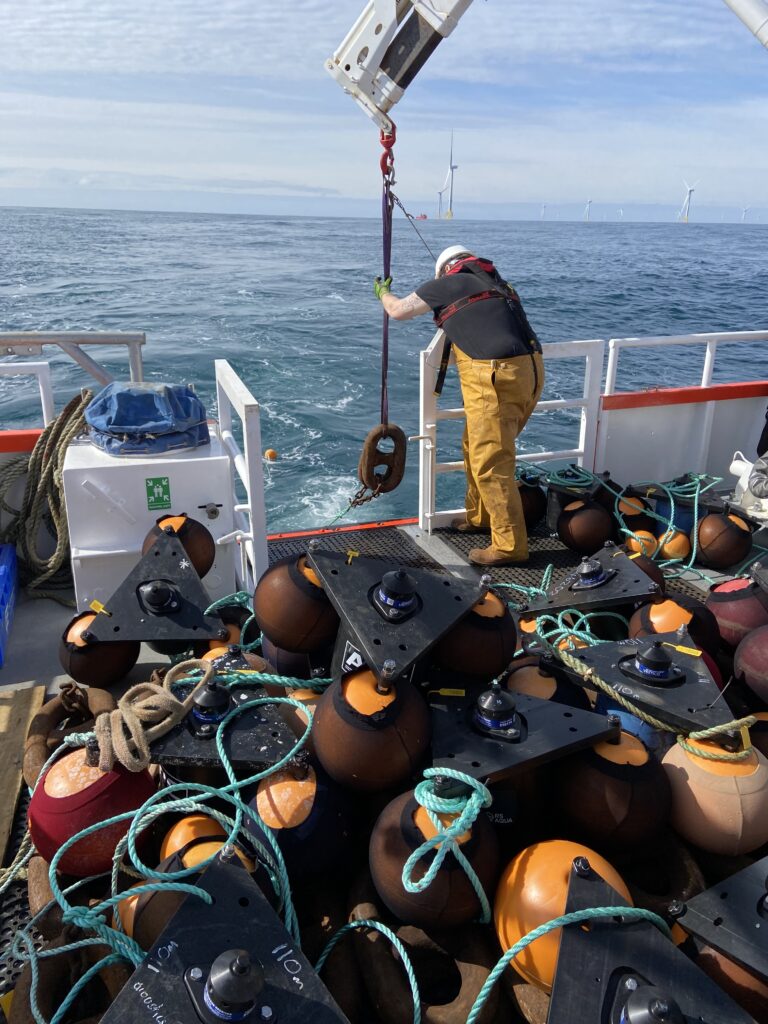
Concurrent to prey data collection, marine mammal distribution and behaviour will be monitored using passive acoustic monitoring, funded by developers (SSER and Ocean Winds).
These data, along with fish data from WP3, will allow assessment of the roles of OWF construction/operation, prey and environment, as drivers of marine mammal spatial distribution (Task 4.1).
The fine-scale prey data will be used to understand how prey drives variation in marine mammal abundance and foraging, close to and between turbines of different ages (Task 4.2).
Dose-response models obtained at the Beatrice OWF will be extended to incorporate new data on prey fields and reef effects to provide context-specific dose-response curves, characterising disturbance from both pile-driving and vessel traffic (Task 4.3).
Finally, fish samples will be collected during surveys of the Moray Firth and Firth of Forth which will be subsequently analysed for prey quality (species, size, nutritional content) and how that changes through time and space and in relation to construction and operation of OWF (Task 4.4).
These findings will be integrated with the seabird and marine mammal energetics models (iPCoD, DEPONS, SeabORD).
Task 4.1 – Drivers of broadscale marine mammal distribution in Moray
Led by Prof. Paul Thompson from University of Aberdeen.
Assessment of broad scale distribution of marine mammals in relation to habitat and prey fields and OWF development in the Moray Firth
Task 4.2 – Finescale marine mammal distribution in response to OWF and prey fields in Moray Firth
Led by Dr Aude Benhemma-Le Gall from University of Aberdeen.
How does windfarm presence affect fine-scale distribution of prey and marine mammal foraging behaviour?
Task 4.3 – Dose response curves in Moray Firth
Led by Prof. Paul Thompson from University of Aberdeen.
How does windfarm presence affect marine mammal responses to pile-driving & vessel disturbance?
Task 4.4 – Fish nutritional value
Led by Dr Gordon Hastie and Philippa Wright from University of St Andrews (SMRU).
Nutritional information on key prey species over time and space for informing impact assessment tools