PrePARED logoMenu

May 2026

In May the PrePARED team released several outputs!

Reports

PrePARED Report 12: A framework for parameterising simulations of seabird foraging trips

Colleagues from BioSS and UKCEH have released Report 12 presenting a framework for paramaterising simulations of individual seabird foraging trips to be used as inputs to Individual Based Models (IBMs).

Please read the report here.


Peer-Reviewed Published Papers

Following PrePARED team presentations at The Effects of Noise on Aquatic Life Conference in Prague 2025, two papers have now been released.

Acoustic Array Configurations for Dose-Response Studies: Impact Gradient Designs Influence Predictions of Noise Impacts on Cetaceans 

Gordon D. Hastie, Madalina Matei, Aude Benhemma-Le Gall, Alex Brown, Isla Graham, Paul Thompson & Cormac Booth


Preprints

In order to provide stakeholders with research findings as soon as possible, the team have released papers on preprint servers whilst they are being reviewed for journal publications.

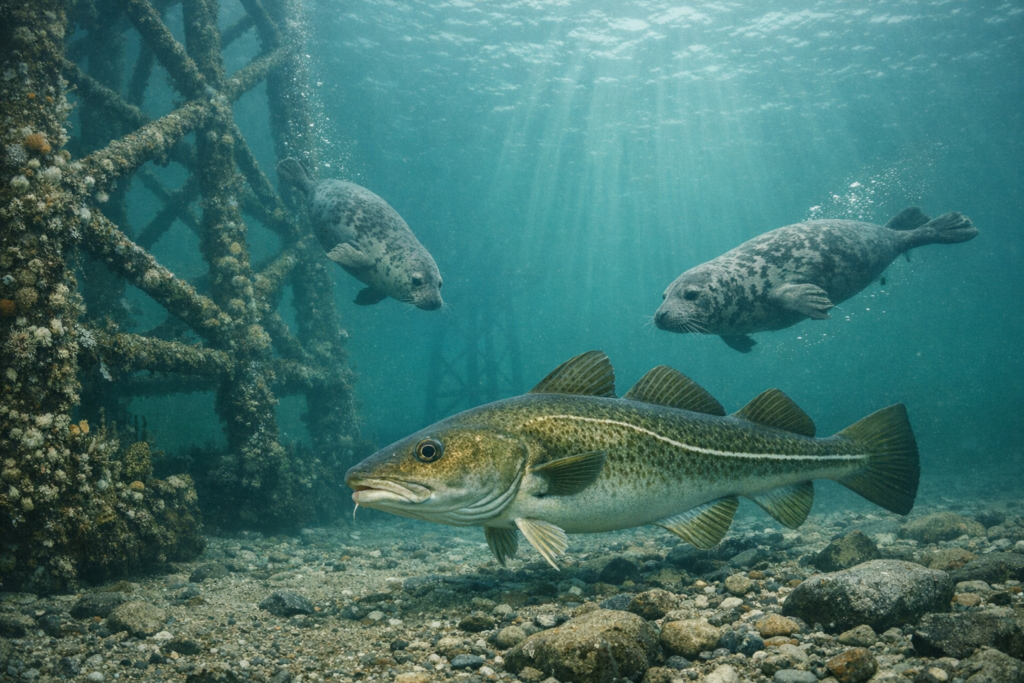
Evidence of predation events by marine mammals at offshore wind farms

This paper is currently under review at Scientific Reports.

You can view all of the PrePARED outputs on our webpage here.
March 2026

Outputs

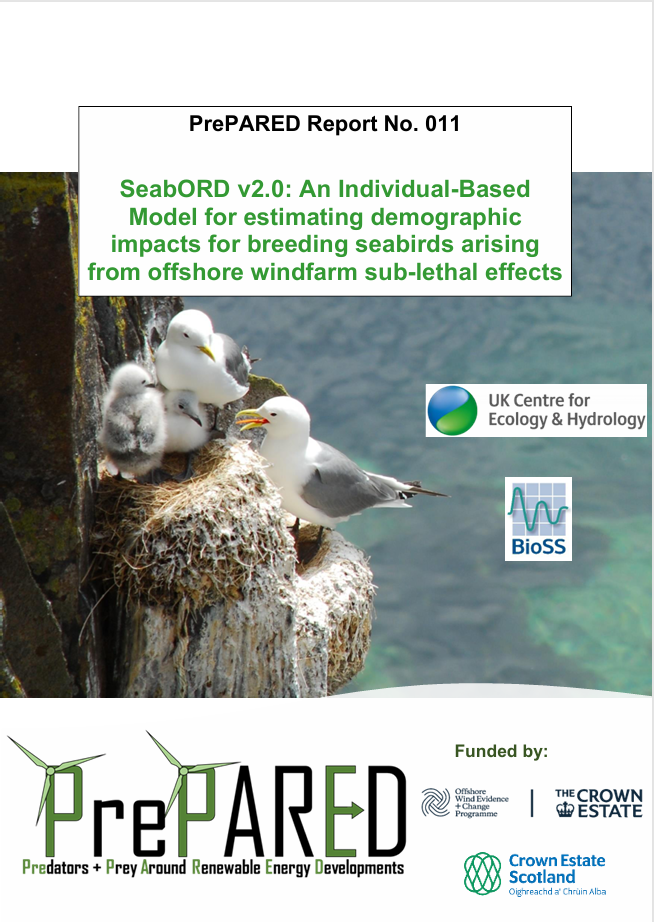
Report 011: SeabORD v 2.0

This report summarises the updates and key developments in version 2.0 of the Individual-Based Model (IBM) SeabORD. Read the report here.
A pre-print is also available for an under peer-review manuscript demonstrating the application of SeabORD v2.0 to understand cumulative impacts.

A webinar has been scheduled for Wednesday 6th May at 12pm – sign up here to hear a summary of the report and ask any questions about SeabORD v2.0


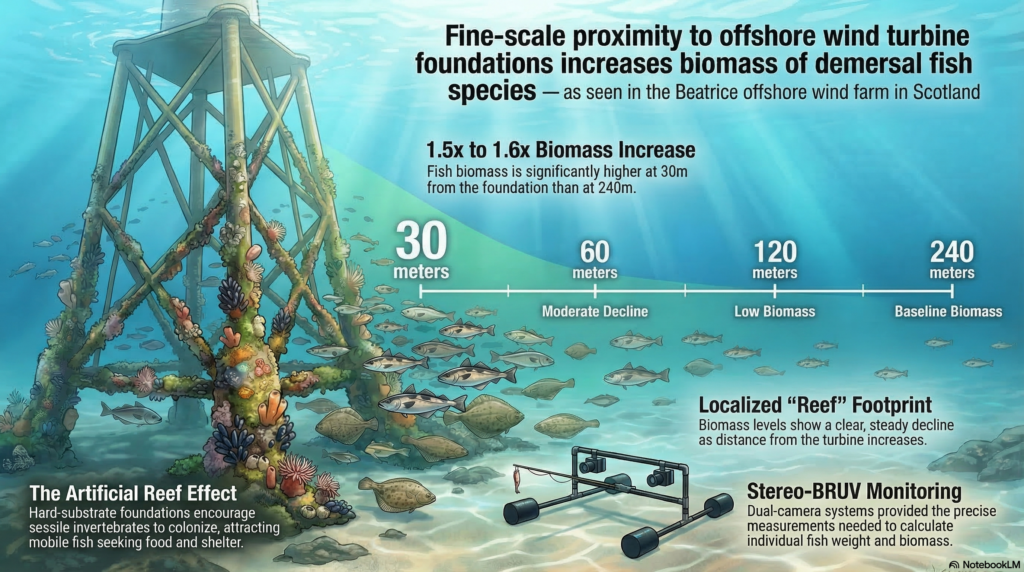
“Fine-scale proximity to offshore wind turbine foundations increases biomass of benthic fish species”

The University of Exeter team have submitted this research paper for review at Frontiers in Marine Science. The paper investigates fish abundance and biomass around Beatrice Offshore Wind Farm in the Moray Firth.

You can read this paper now as a preprint here.

Conferences

Some of the team will be presenting at the EIMR conference which is taking place from 13-17th April in Oban, Scotland.

There will also be attendees presenting a posted at the European Cetacean Society 37th Annual Conference from 22-24th April in Dundee, Scotland.

January 2026

The PrePARED team are looking forward to releasing findings throughout 2026 as we near the end of the project in March 2027.

Two reports have already been released with many more to follow!


PrePARED 2025 Annual Report

The team have created an annual progress report summarising all activities, outputs and impact delivered by PrePARED in 2025.

The annual report also provides details on targets for 2026.

You can read the 2025 annual report here under progress reports, where you can also find the 2022, 2023 and 2024 annual reports.


New paper – preprint available

The University of Exeter have written a paper titled ‘Fine-scale proximity to offshore wind turbines foundations increases biomass of benthic fish species’.

This paper is currently in review at a journal but is available for public viewing as a preprint.

You can read the paper here now, and the team will announce when this is published.

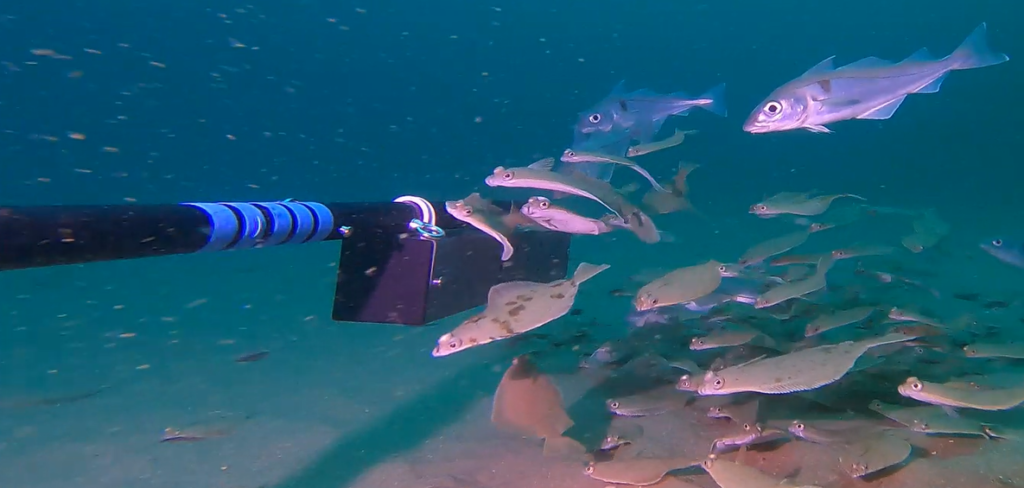
Haddock and flatfish around Baited Remote Underwater Video system

November 2025

New report!

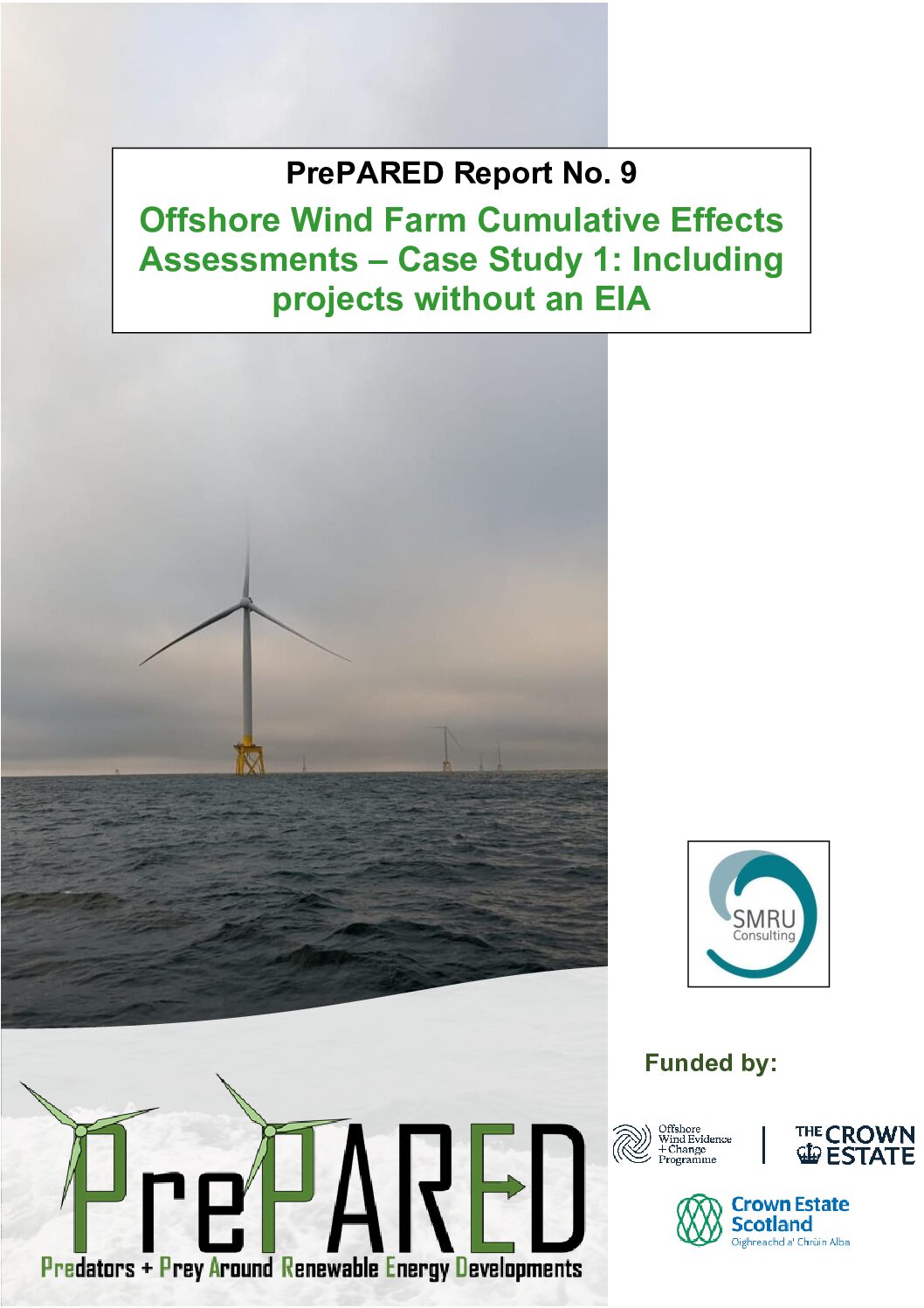
In November PrePARED released Report 9: “Offshore Wind Farm Cumulative Effects Assessments – Case Study 1: Including projects without an EIA”

The purpose of this case study was to demonstrate (using iPCoD population modelling) the difference in a quantitative CEA depending on whether projects without an Environmental Impact Assessment (EIA) are included in the assessment or not.

Please see the full report here – this will be followed by Case Study 2 alongside a live webinar to summarise and discuss the findings of both reports.


Output Summaries

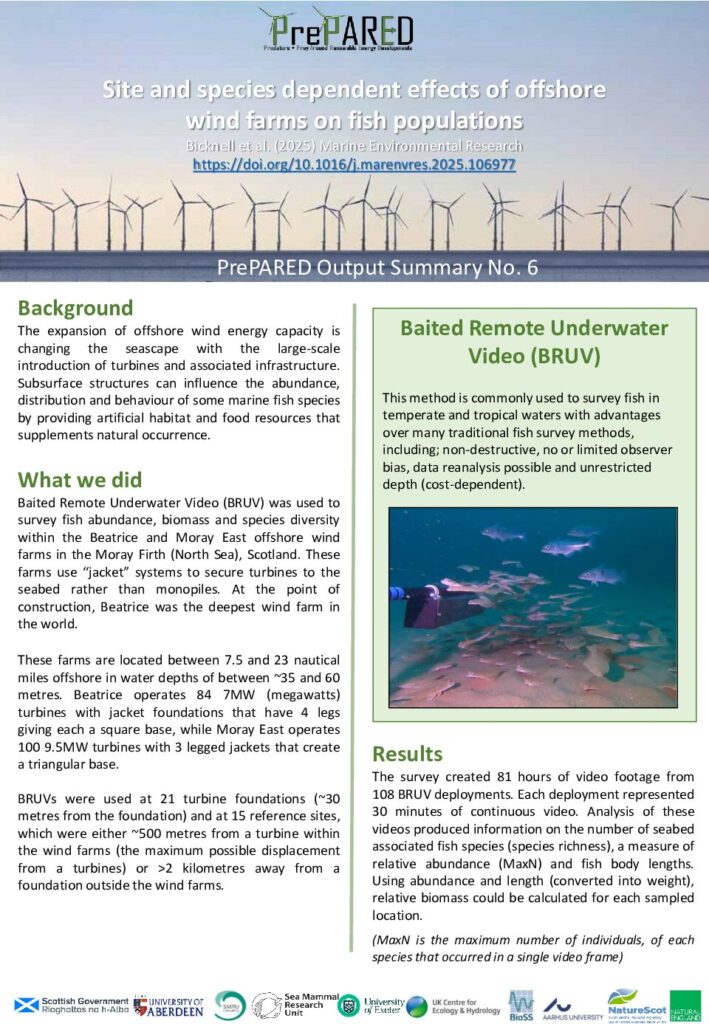
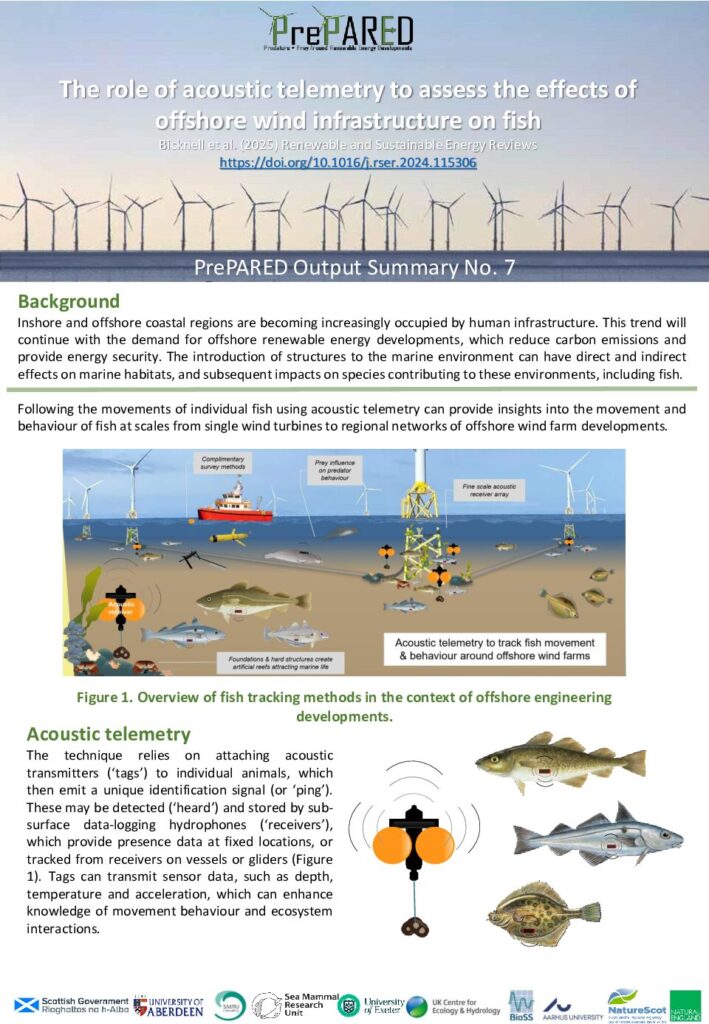
In 2025, project partner University of Exeter published 2 peer-reviewed papers on the effects of offshore wind farms on fish.

These papers are listed on our Outputs page under ‘Peer-reviewed’.

The team have kindly now created 2-page outputs summaries for these papers which summarise the key findings for those who may not have time to read the full papers.

These can be found on our Outputs page under ‘Output Summaries’ as summaries 6 and 7.


MASTS Annual Science Meeting 2025

PrePARED team members attended MASTS in Glasgow from 18th-20th November to share PrePARED updates including a presentation by Charlie Cooper (SG Marine Directorate) “Integrating predator-prey distributions in marine spatial planning”

Members of the team including Philippa Wright and Gordon Hastie (University of St Andrews) and Katherine Whyte and Phil Bouchet (BioSS) also attended a workshop on the topic of “Migration and prey energyscapes in changing oceans: Advancing observations, models, and synthesis”.

The aim was to bring together scientists working on the same food chains but with opposite perspectives: from top predators looking down, from lower trophic levels looking up.

Katherine Whyte presented on PrePARED work as part of the workshop: “Movement modelling of top predators to understand predator-prey interactions at multiple scales”


Upcoming reports

A number of reports are currently being drafted for release in December or early January. If you wish to be notified directly when these are released please contact us at PrePARED@gov.scot and ask to be added to our distribution list.

September 2025

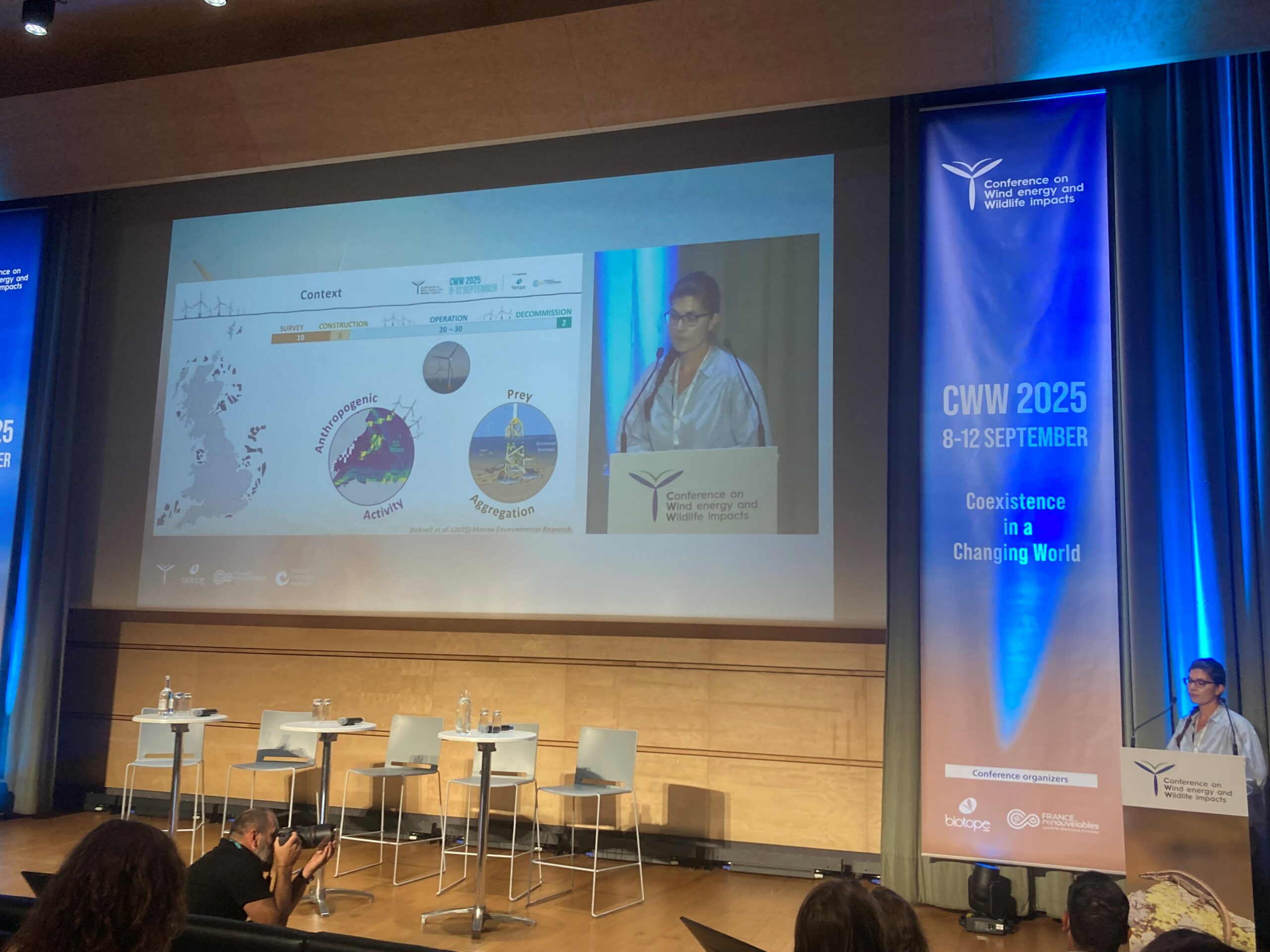
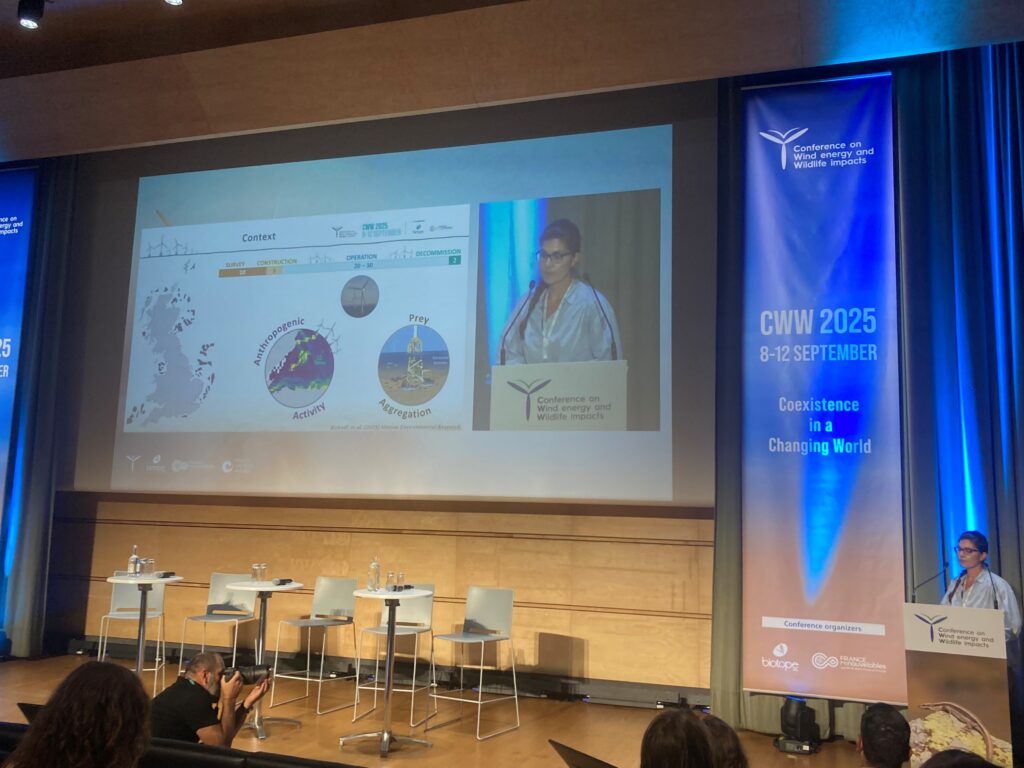
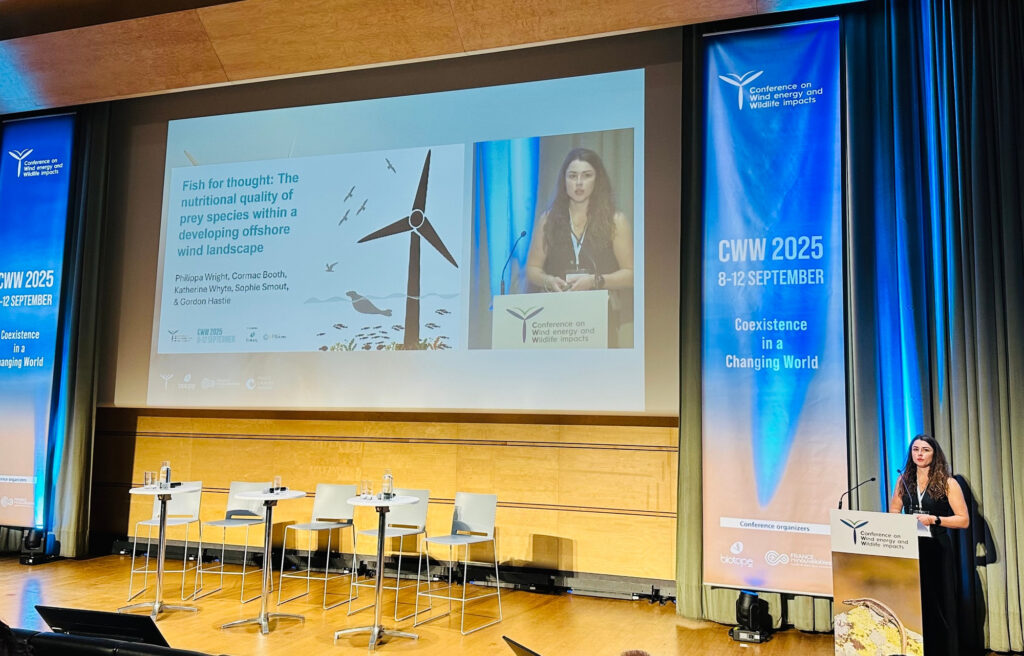
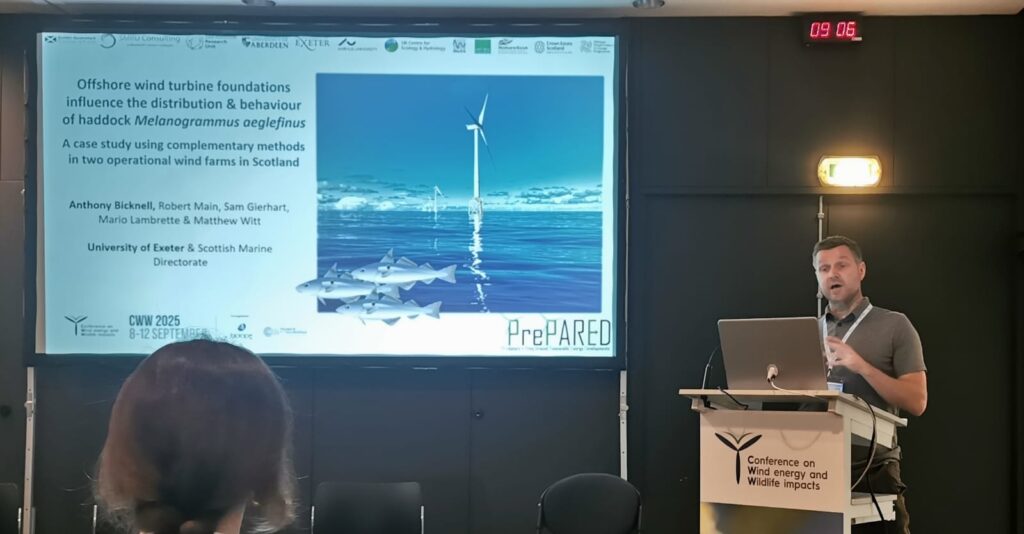
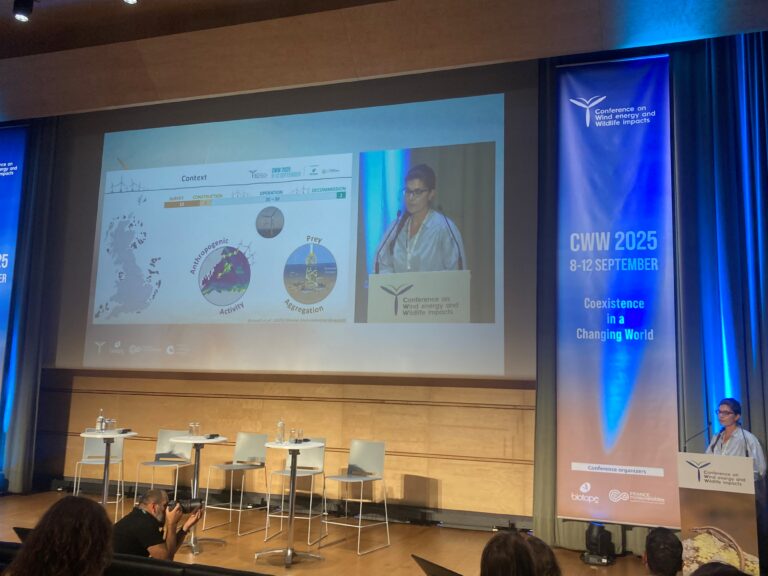
Conference on Wind energy & Wildlife impacts (CWW) 2025

The PrePARED team attended CWW2025 and presented recent PrePARED findings including:

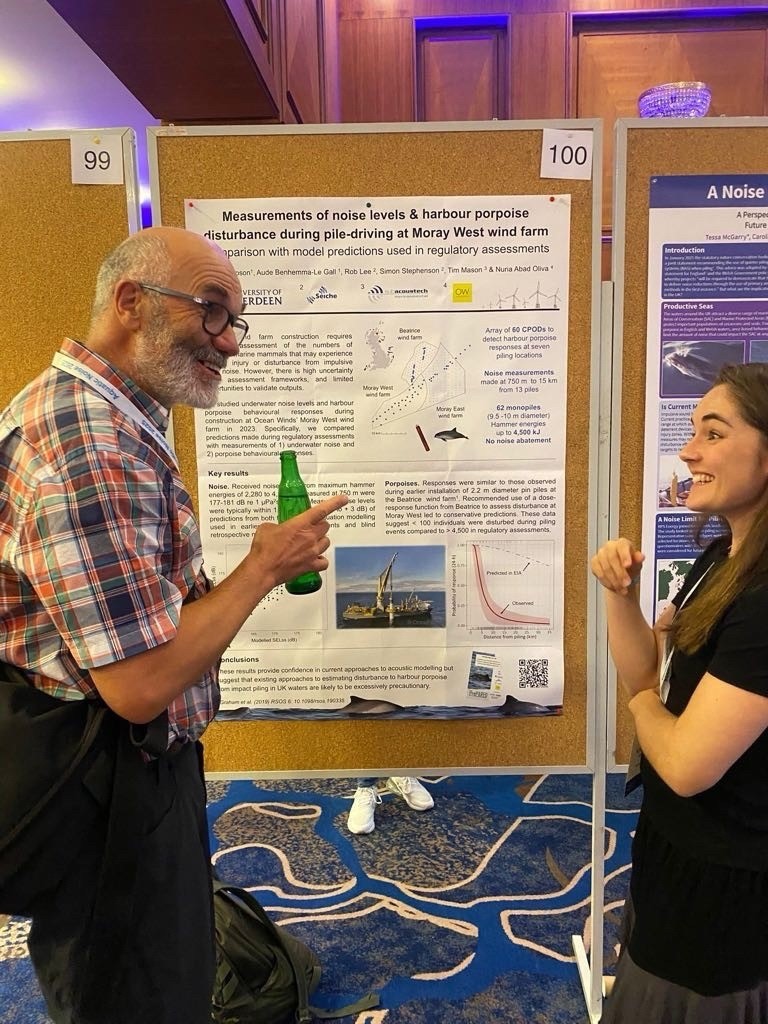
  • ‘Measurements of noise levels and porpoise disturbance during pile-driving at Moray West Offshore Windfarm; comparison with model predictions used in regulatory assessments’ – Paul Thompson (University of Aberdeen)
  • ‘Marine mammal foraging activity at an offshore windfarm site: Do changes in prey fields influence marine mammal response to disturbance?’ – Aude Benhemma-Le Gall (University of Aberdeen)
  • ‘Effects of acoustic logger array design on studies of cetacean responses to offshore wind farms’ – Gordon Hastie (University of St Andrews)
  • ‘Fish for thought: The nutritional quality of prey species within a developing offshore wind landscape’ – Philippa Wright (University of St Andrews)
  • ‘Seabirds and fish distributions and behaviour: understanding predator-prey interactions to build evidence for cumulative impact assessment’ – Esther Jones (BioSS)
  • ‘Offshore wind turbine foundations influence the distribution & behaviour of haddock Melanogrammus aeglefinus. – A case study using complementary methods in two operational wind farms in Scotland’ – Anthony Bicknell (University of Exeter)
  • POSTER ‘Cumulative effects using SeabORD’ – Christopher Pollock (UKCEH)
Anthony Bicknell

Summary of summer fieldwork

The team are starting to analyse the final PrePARED survey data which includes 41 demersal tows, 30 CTD casts, 15 acoustic and seabird at sea transects counting 23,641 seabirds across 17 species and 5 pelagic tows.

This data will be analysed and used to improve pelagic fish/seabird distribution models, improve environmental co-variate resolution and allow the team to look at the drivers of pelagic fish distributions.

A manuscript using findings from this is being drafted and the team plan to present initial results at MASTS Annual Science Meeting in Glasgow, 18-20 November.


Upcoming…

  • The team will be presenting at MASTS Annual Science Meeting, Glasgow, 18-20th November
  • 4 papers will be submitted for peer review including;
    • Paper using 2024 BRUV data to consider finescale effect of distance to offshore wind turbines for prey
    • Paper on predation of tagged Cod using acoustic telemetry data
    • Paper on the effects of acoustic array designs on dose-response relationships for porpoises to pile driving
    • Paper on the SeabORD tool for predicting impacts of offshore windfarms on seabirds.
  • Release of SeabORD 2.0
  • Report on Offshore Wind Farm Cumulative Effects Assessments

If you have an interest in any of the above, or wish to find out more information, please let us know at PrePARED@gov.scot

July 2025

Effects of Noise on Aquatic Life

Several PrePARED researchers attended the Seventh International Conference on the “Effects of Noise on Aquatic Life” which was held in Prague between June 29th and July 4th 2025. 

Paul Thompson (University of Aberdeen) presented key findings from the recent PrePARED Report 008 in a speed talk and poster, comparing construction monitoring outputs from the Moray West Offshore Wind Farm with predictions of noise levels and behavioural disturbance that had been used within earlier regulatory assessments.

Gordon Hastie (University of St Andrews) presented a talk on recent analyses which draw upon archive Moray Firth passive acoustic data to optimise the design of future monitoring studies. These simulations highlighted how sample sizes and spatial extent of array design can affect the ability of PAM studies to estimate behavioural response used to inform EIA.

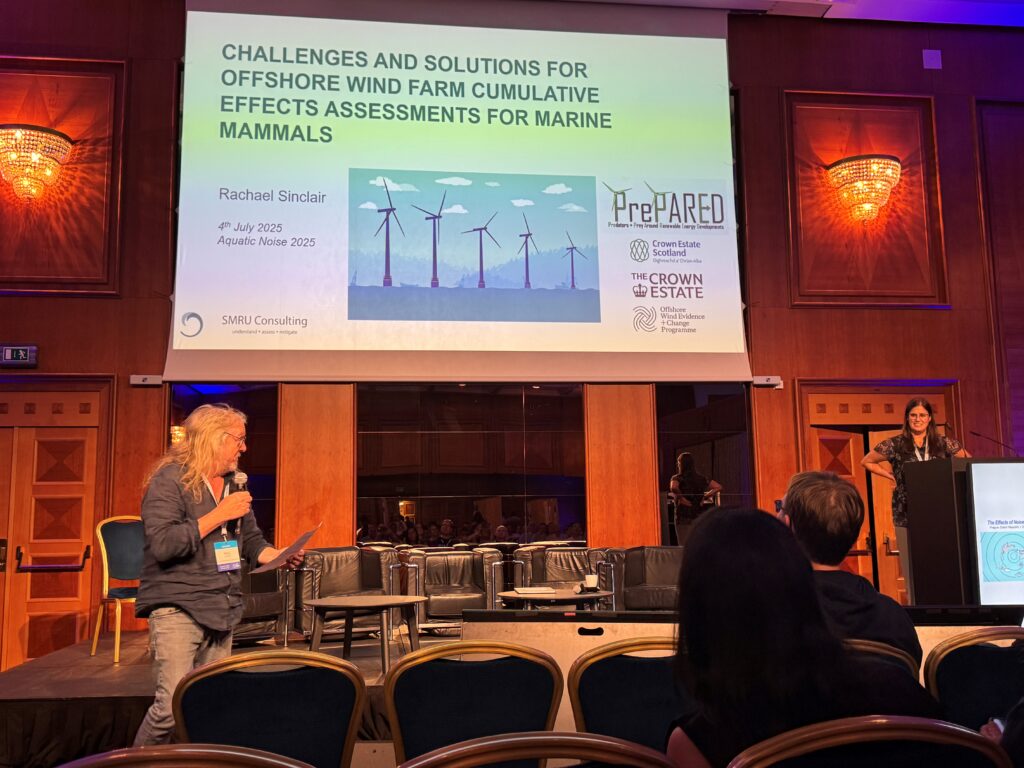
Finally, Rachael Sinclair (SMRU Consulting) brought the conference to a close with a presentation that drew upon her experience supporting consent applications for numerous UK offshore wind projects. Building on the analyses she presented in PrePARED Report 007, she highlighted the need for clearer guidance on the approaches that developers should use within cumulative impact assessment.


Webinar Success

We were pleased to welcome key stakeholders from industry, SNCBs, government and consultancies to our webinar presented by Rachael Sinclair (SMRU Consulting) summarising Report 007 and answering audience questions.

A recording of the presentation will be available on the website soon, and those who registered for the event will be notified of this via email.


Fieldwork 2025

In July the final PrePARED survey took place!

Between the 23rd June – 8th July acoustic transects in the Firth of Forth and Moray Firth were completed.

Alongside these, the team measured fish across 6 species and recorded seabird numbers across 17 species.

We thank the scientific team at SG Marine Directorate, and the crew and captain of the Alba na Mara.

June 2025

1 year extension

We are pleased to announce that the PrePARED project has been granted a 1 year extension, and will now end in March 2027.

This allows the project to complete an additional year of seabird/prey data collection, analyses and modelling.

The request for an additional year of data collection followed a series of external factors including avian flu, marine heatwave and delayed wind farm construction. Further data collection will allow the project to reduce uncertainty, introduced by external shocks, in PrePARED outputs and improve transferability of results in space and time.

Following this extension, fieldwork is being carried out in June and July 2025 with broad-scale fisheries acoustic surveys to be combined with industry funded seabird GPS tracking in the Forth & Tay region.

The first of these surveys have now been completed.


Outputs

Report 008

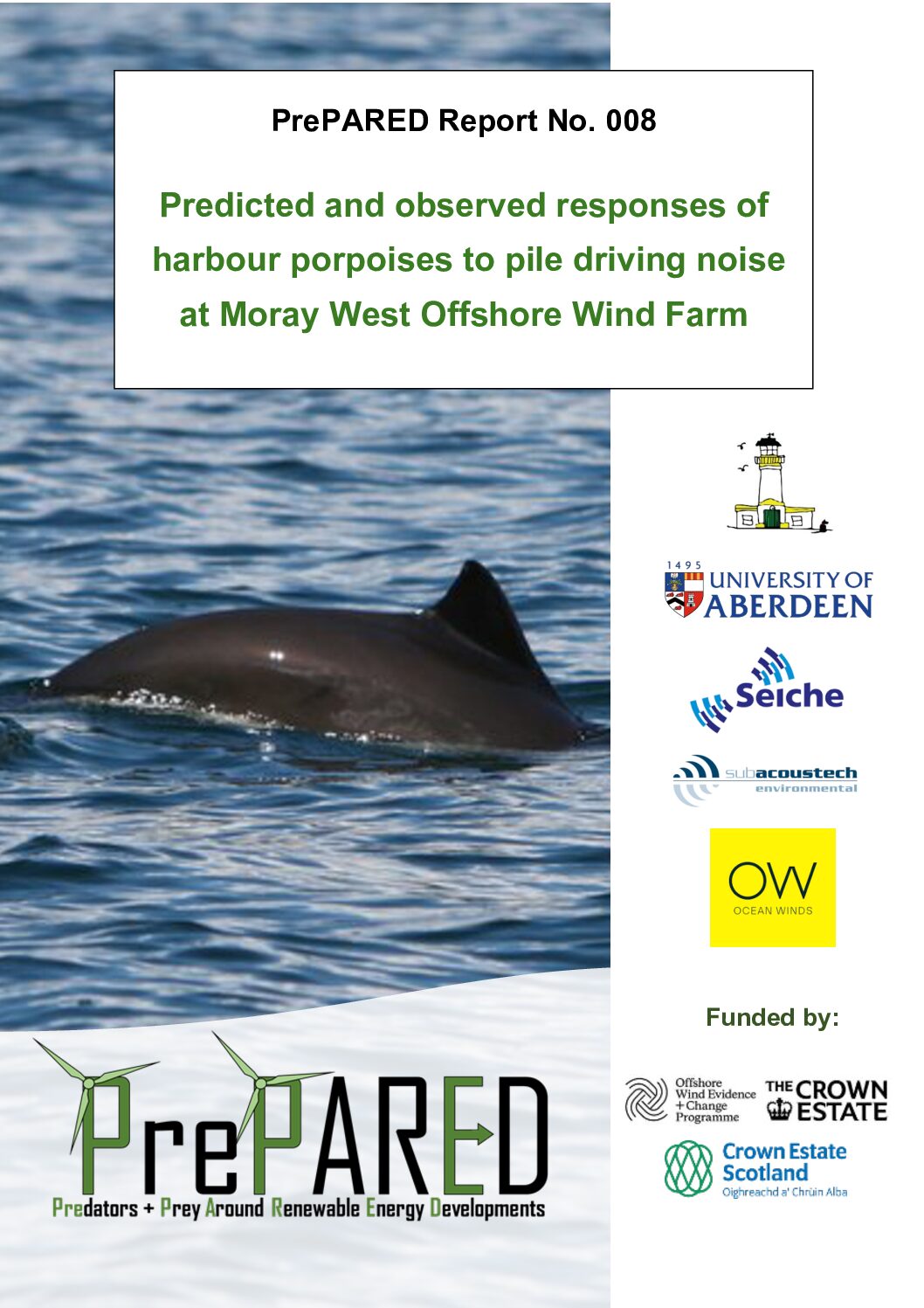
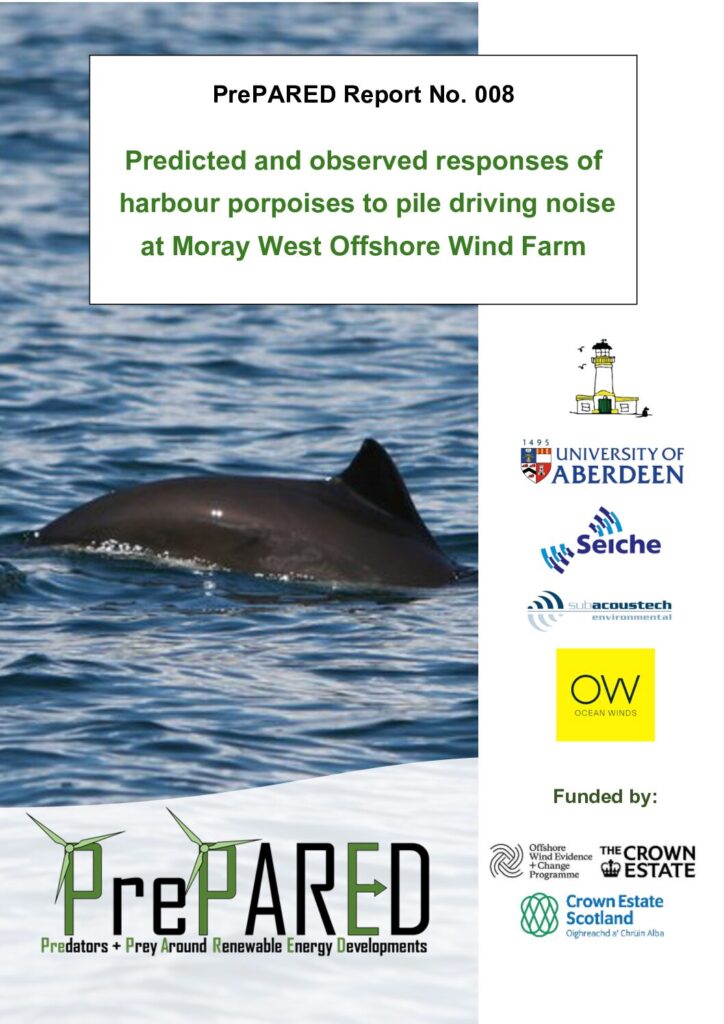
We have released a new report on predicted and observed responses of harbour porpoises to pile driving noise at Moray West Offshore Wind Farm.

You can read the report here


Coming up…

  • Following release of Report 007: Challenges and Solutions for Offshore Wind Farm Cumulative Effects Assessments for Marine Mammals, SMRU Consulting colleagues will host a webinar to summarise the report and answer questions from key stakeholders. If you wish to join us on 15th July, you can register here.
  • The PrePARED team will present on PrePARED findings at The Effects of Noise on Aquatic Life conference in Prague from 29th June – 4th July.
  • The team have also been successful in obtaining a number of presentation slots at the Conference on Wind Energy and Wildlife Impacts (CWW 2025) in Montpellier, France from 8th – 12th September.

April 2025

New reports

Report 007: Challenges and Solutions for Offshore Wind Farm Cumulative Effects Assessments for Marine Mammals

We are pleased to confirm that the most recent PrePARED report is available to read here.
This report from SMRUc highlights the key challenges with CEAs and recommends solutions.


2024 Annual Report

The PrePARED 2024 annual report is now available to read here under Progress Reports.

The report outlines all PrePARED activities from January – December 2024 including surveys, data processing, outputs such as reports, presentations and meetings.

Table 11 in the report also outlines targets for 2025.


Q1 Progress Report

The progress report for Q1 (January – March 2025) is now available to read here under Progress Reports.

This reports summarises all PrePARED activity that has taken place since January.


Webinar

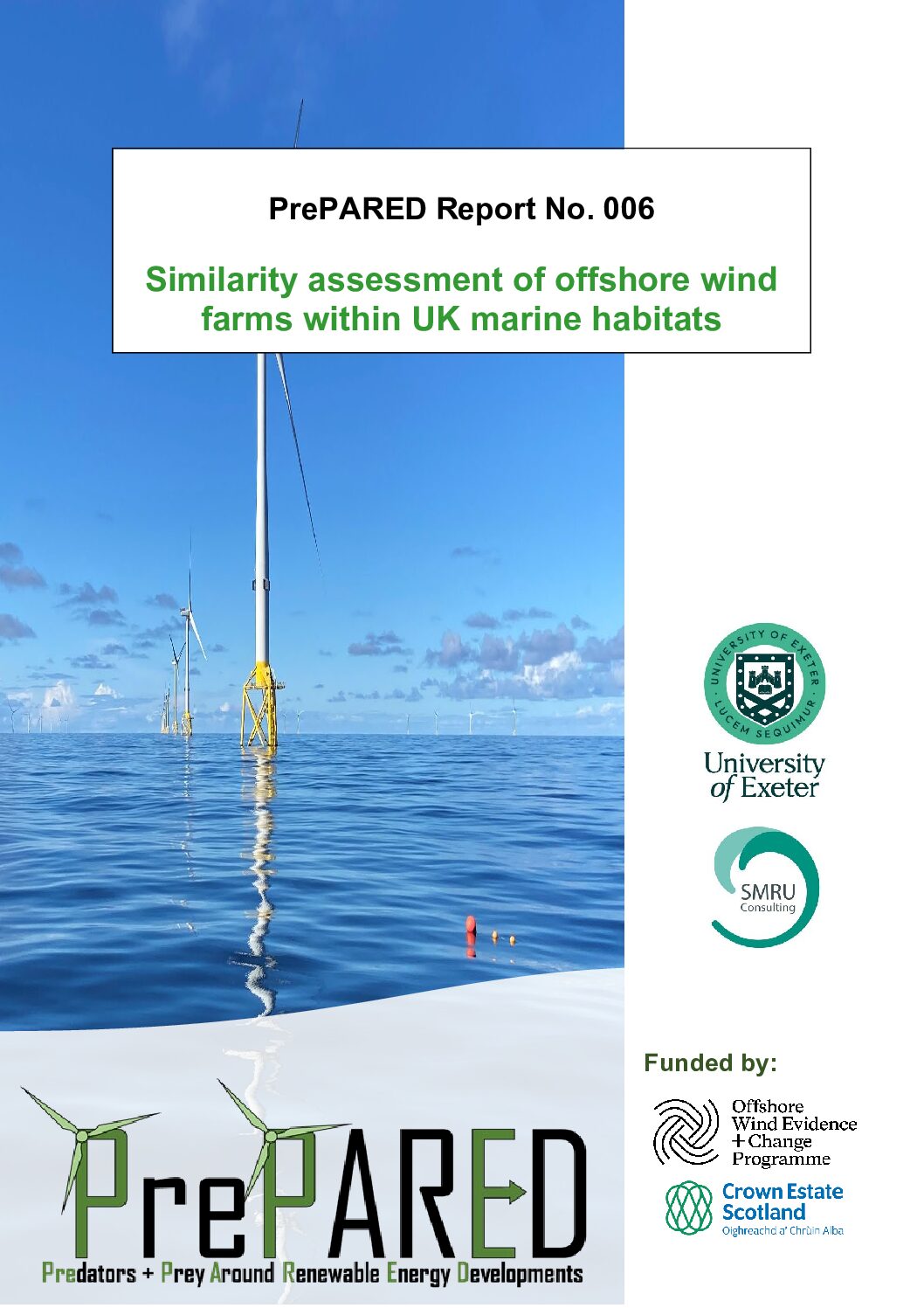
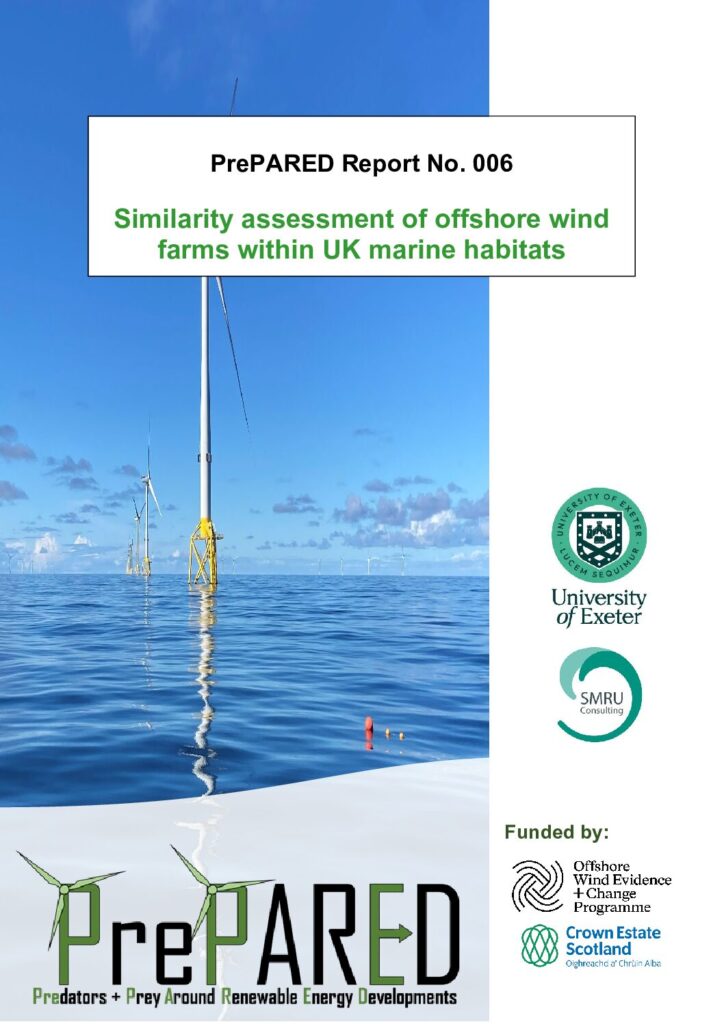
The University of Exeter team will host a webinar and live Q&A sessions following release of Report 006: similarity assessment of offshore wind farms within UK marine habitats – found here.
This webinar will summarise findings from the report, including transferability of PrePARED findings to wider UK marine areas. Stakeholders are welcome to attend this 30 minute webinar and ask any questions.
Please register for the webinar here.

February 2025

New Outputs!

Peer-reviewed paper

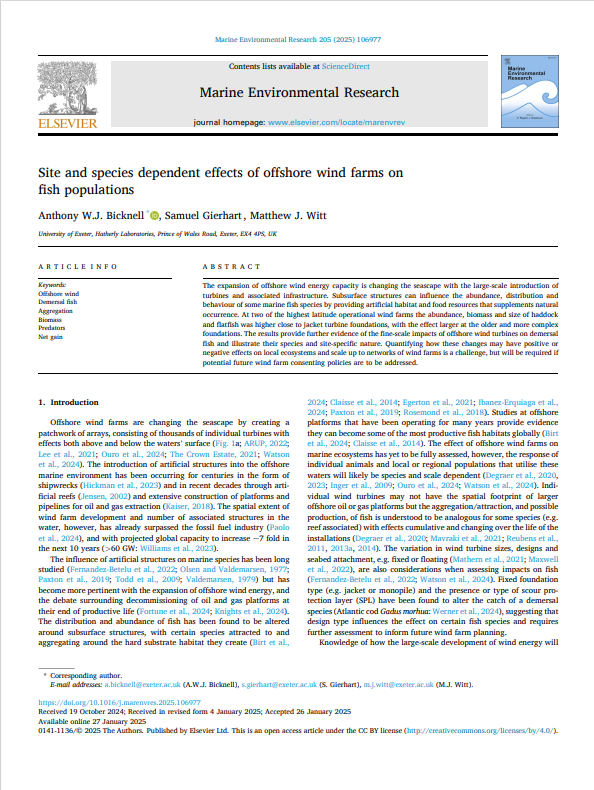
Site and species dependent effects of offshore wind farms on fish populations (Anthony W.J.Bicknell, Samuel Gierhart, Matthew J. Witt)

This peer-reviewed paper is an output from Task 3.2

You can read the paper here


Peer-reviewed paper

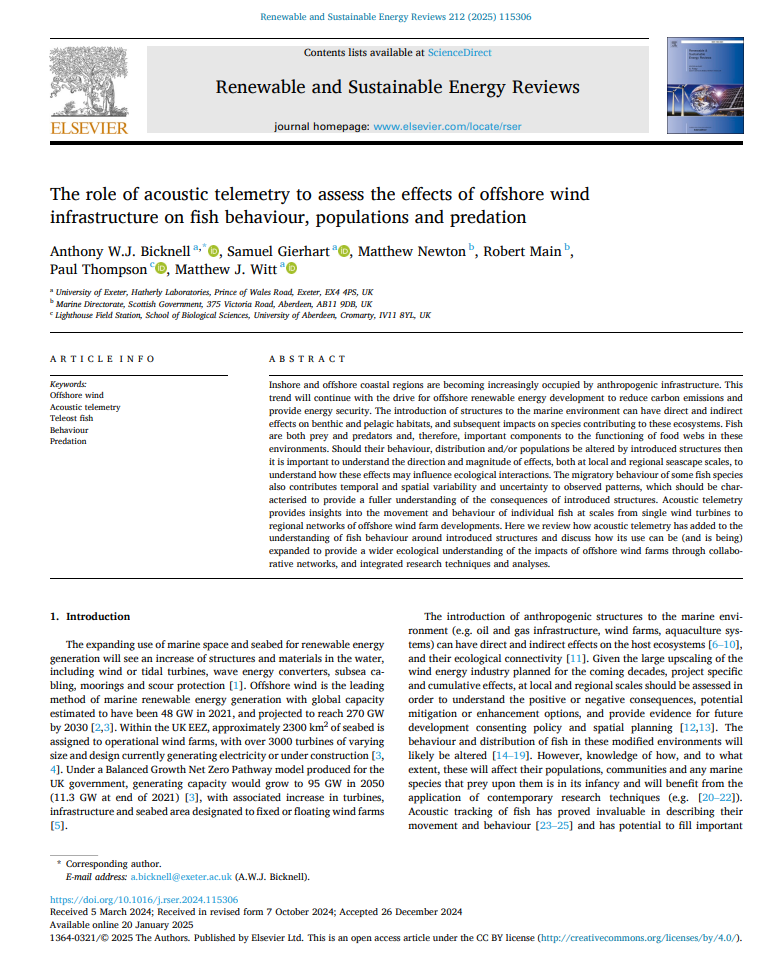
The role of acoustic telemetry to assess the effects of offshore wind infrastructure on fish behaviour, populations and predation (Anthony W.J. Bicknell, Samuel Gierhart, Matthew Newton, Robert Main, Paul Thompson, Matthew J. Witt)

This peer-reviewed paper is an output from Task 3.3

You can read the paper here


Report 006

Similarity assessment of offshore wind farms within UK marine habitats

This report is an output from Task 6.3

You can read the report and accompanying narrated presentation here


Engagement

PrePARED colleagues presented the following at the ScotMER symposium.

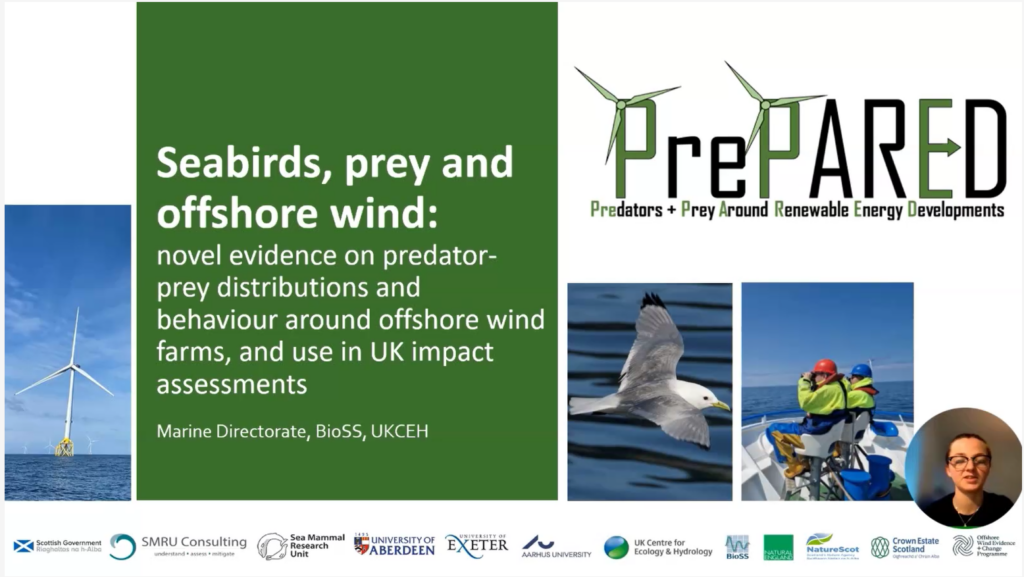
  • Seabird, prey and offshore wind: novel evidence on predator-prey distributions and behaviour around offshore wind farms, and use in UK impact assessments. Charlie Cooper (SG Marine Directorate), Katherine Whyte (BioSS), Christopher Pollock (UKCEH)
  • Prey energetics calculations and energy mapping (PrePARED). Gordon Hastie & Philippa Wright (University of St Andrews)

Recorded versions of the presentations will be available on YouTube in the coming weeks and will be linked to from our Outputs page.


December 2024

2024 Recap

This year, the PrePARED project has delivered a number of reports and output summaries with many more coming soon in 2025!

Report 1 investigated whether spatio-temporal variations in harbour porpoise occurrence and foraging were related to sandeel density predictions.

The report found that:

  • Sandeel density predictions can inform predictions of harbour porpoise occurrence and foraging behaviour, with limitations.
  • There is a consistent positive predator-prey relationship in the Moray Firth area, matching seasonal presence of prey
  • The installation of wind turbine structures may have modified predator-prey interactions, with further research needed.

Read the full report here.


Report 2 aimed to assess broad-scale changes in the occurrence of porpoises in relation to the operational windfarms in the Moray Firth and assess fine-scale reef effects around turbine foundations.

The report found that:

  • Porpoises were not displaced from operational windfarms.
  • There was no evidence of reef effects. This was unexpected and further investigations are taking place

Read the full report here.


Following the PrePARED Annual Knowledge Exchange Meeting (AKEM) in February, the team created Report 3.

This report summarises project results from 2022 and 2023, how these can or will be used, the impact of these findings and the next steps.


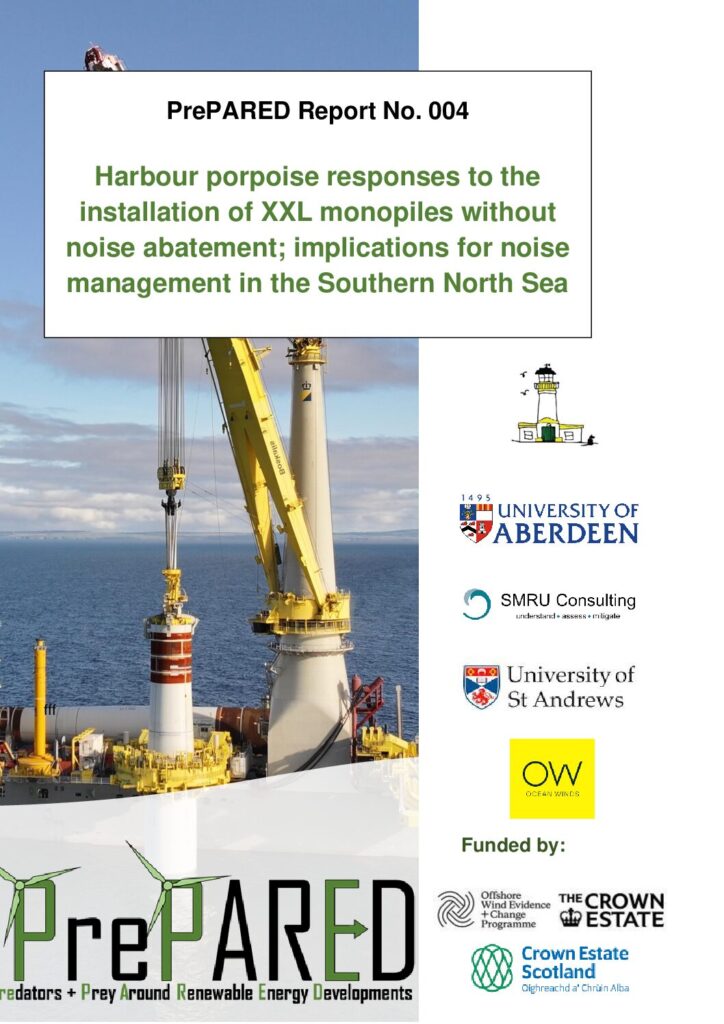
Report 004 aimed to assess the responses of harbour porpoises to pile-driving at the Moray West Offshore Windfarm and directly estimate an Effective Deterrent Range (EDR) for the installation of monopiles without noise abatement.

The findings in this report were that;

  • The PrePARED project delivered new evidence in support of reducing the current EDR recommendations for monopiles (currently 26km). This new evidence is delivering impact, improving OWF consenting by feeding into new guidance in development by JNCC and DEFRA.
  • Further investigation is required to explore contextual factors such as seasonal variation, vessel traffic and use of acoustic deterrent devices.

Following these findings, PrePARED task leads from the University of Aberdeen met and discussed the results with key stakeholders across the UK, specifically to support discussions around the Southern North Sea SAC.

Read the full report here.


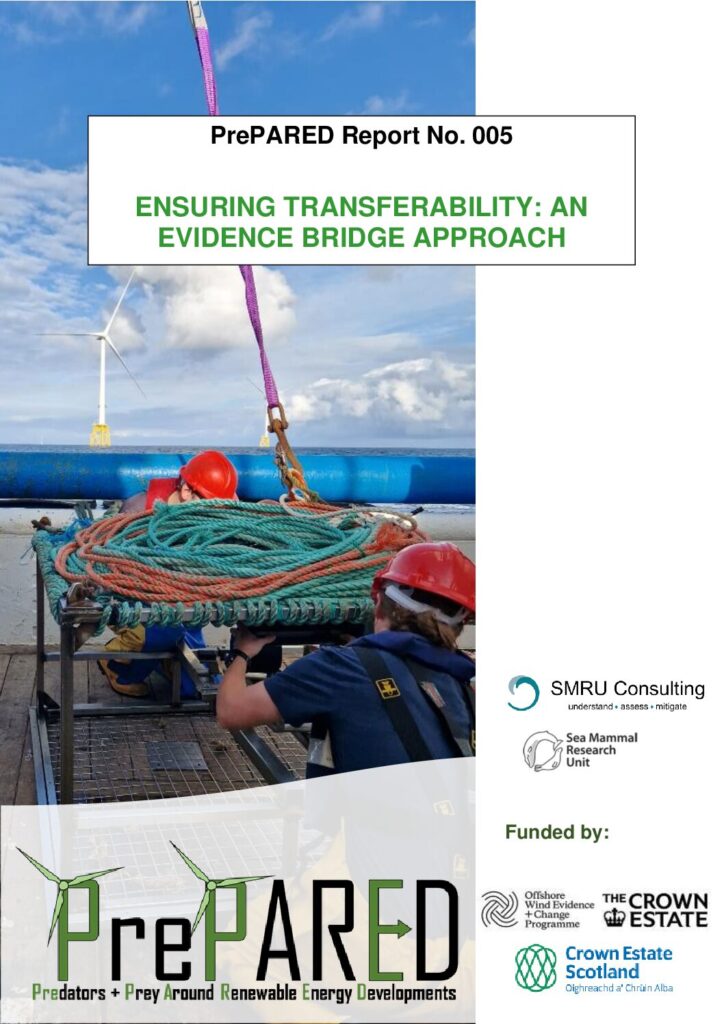
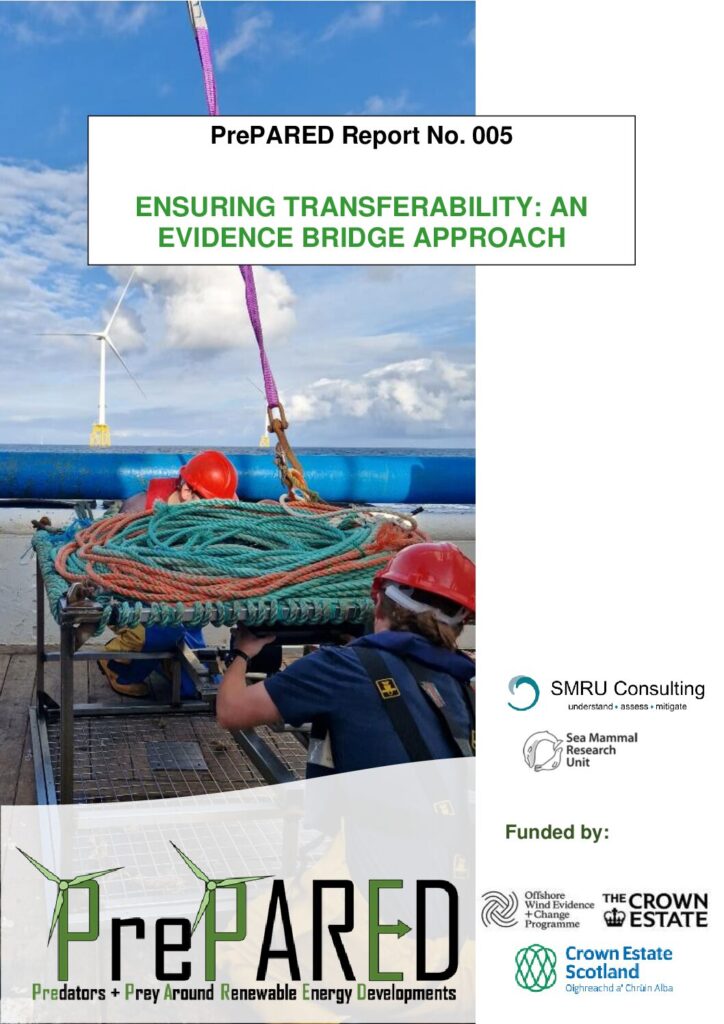
Focussing on transferability, SMRU Consulting released Report 005 discussing how Evidence Bridges can support advisors and decision makers.

Noting the importance of evidence-based decision making, this approach brings together researchers and key stakeholders to ensure that the best available science is utilised to support sustainable development of offshore wind.

Read the full report here.


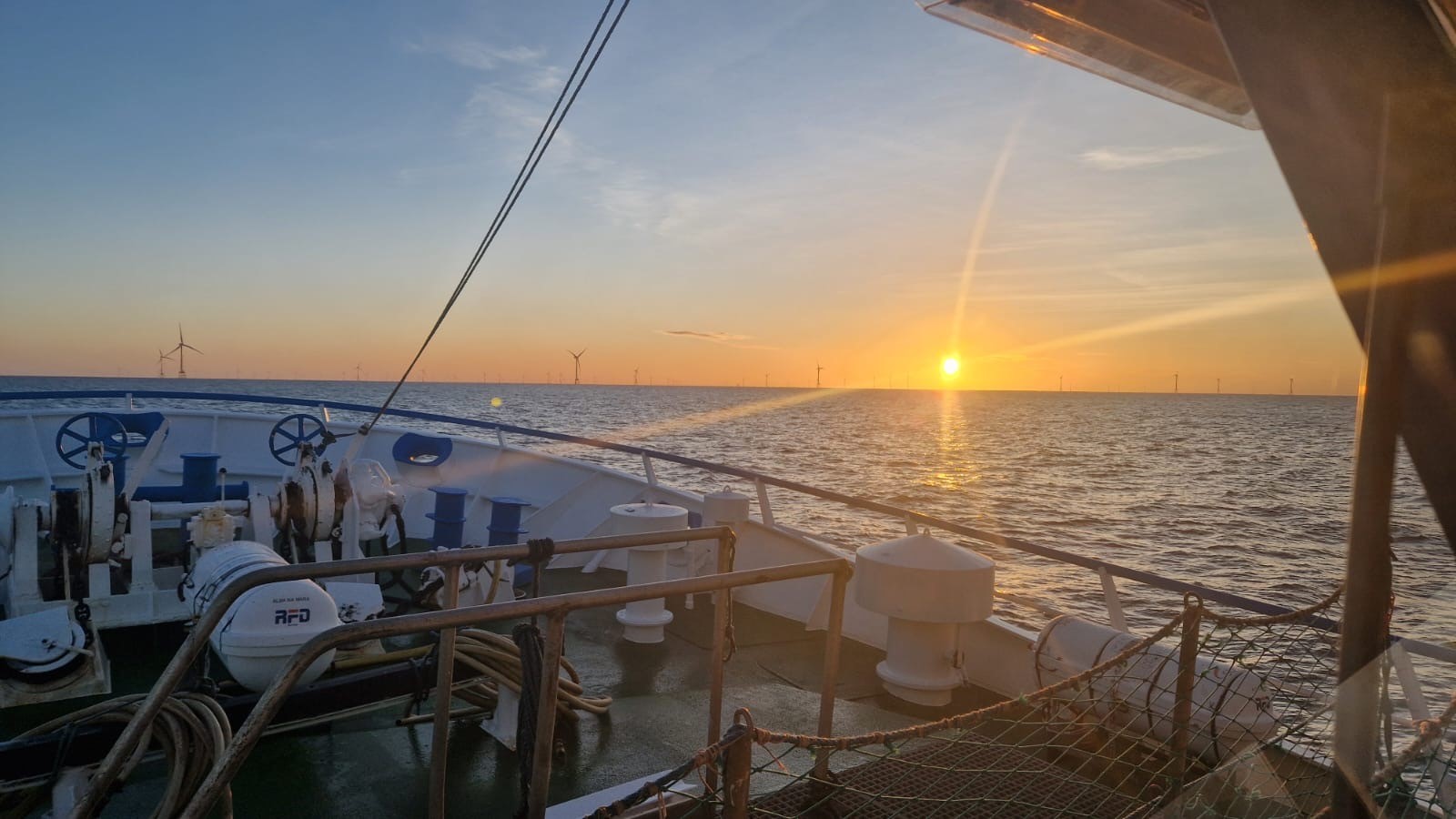
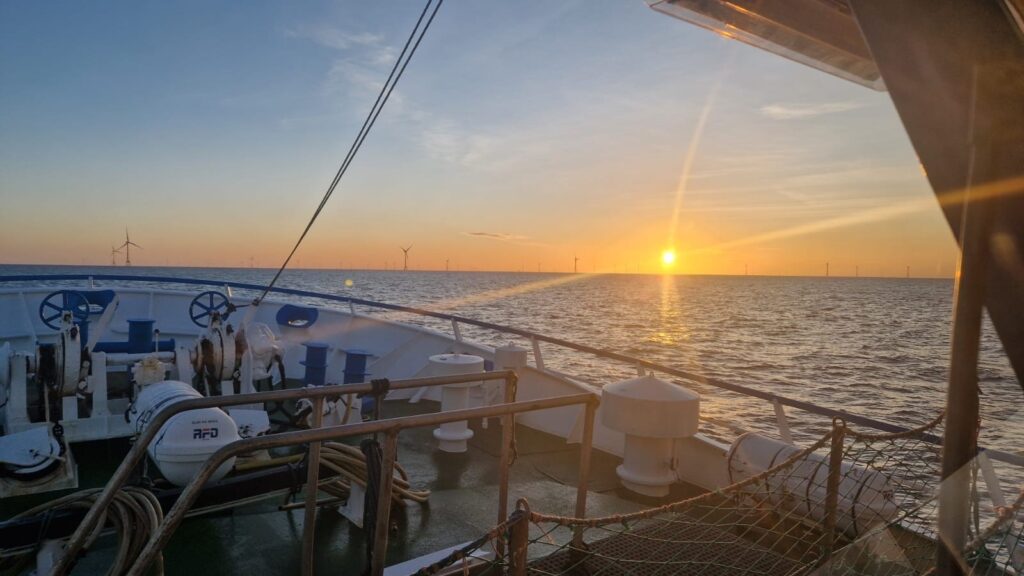
Photo of sunset in Seagreen OWF during sandeel survey.

November 2024

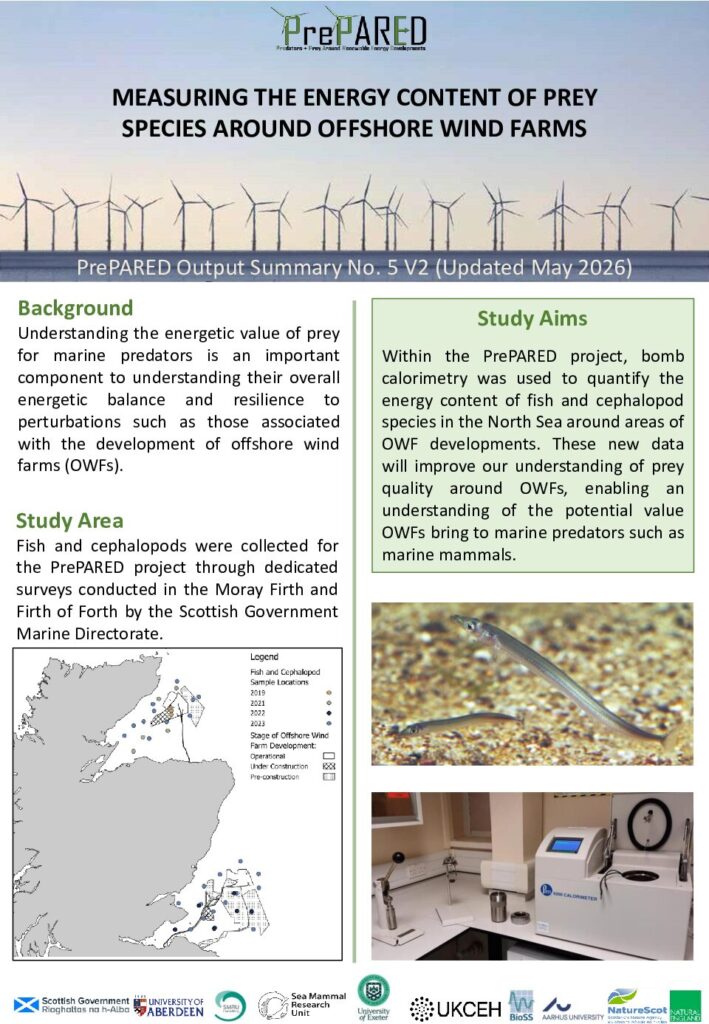
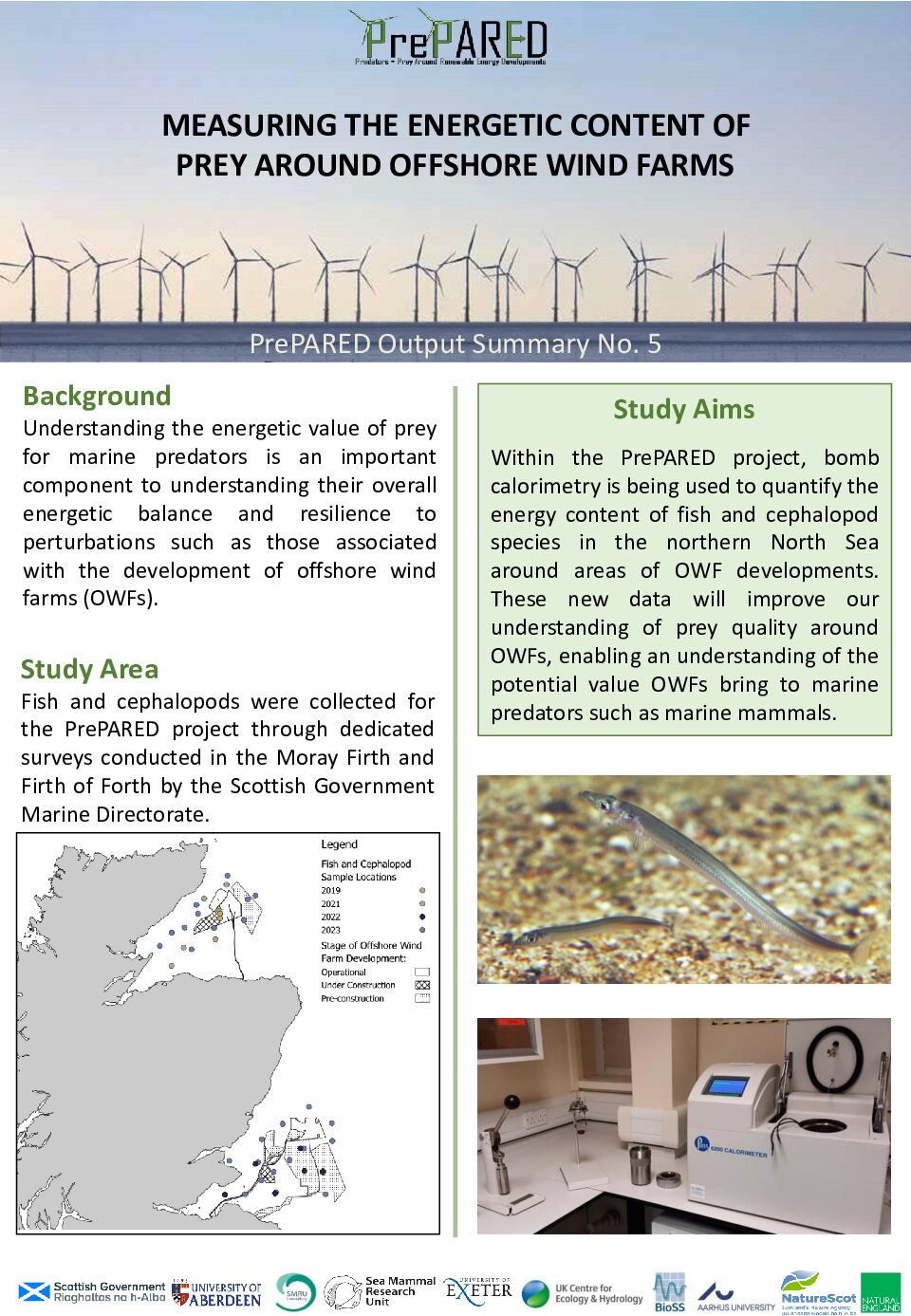
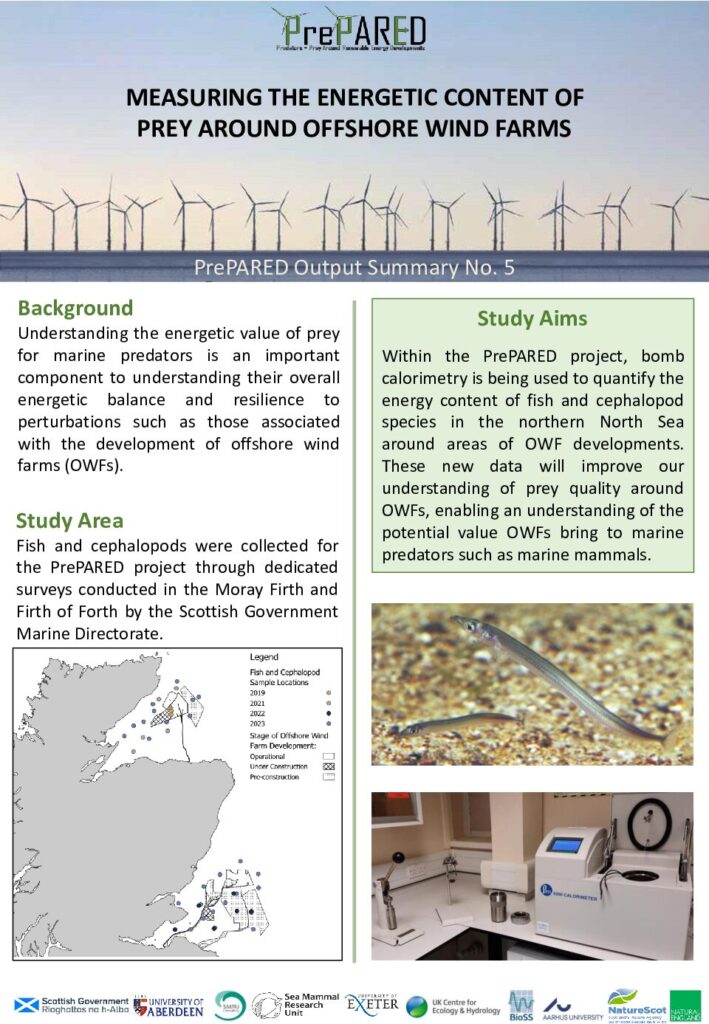
NEW: Output Summary 5

Colleagues from University of St Andrews and SMRUc have prepared an informative output summary describing current work being undertaken to measure the energetic content of prey around offshore wind farms.

New data on energetic content will allow better understanding on prey quality around offshore wind farms and, therefore, the potential value offshore wind farms bring to marine predators e.g. harbour seals, porpoises.

You can read the output summary here.


Baited Remote Underwater Video (BRUV) – Firth of Forth

Video of a seal taken around offshore wind farms in the Firth of Forth

The SG Marine Directorate team are currently undertaking BRUV analyses to compare fish abundance and distribution in and around offshore wind farms. The footage here is from 2023 in Seagreen OWF.

Video of a red gurnard at Seagreen Wind Farm in Firth of Forth

Engagement

MASTS Annual Science Meeting

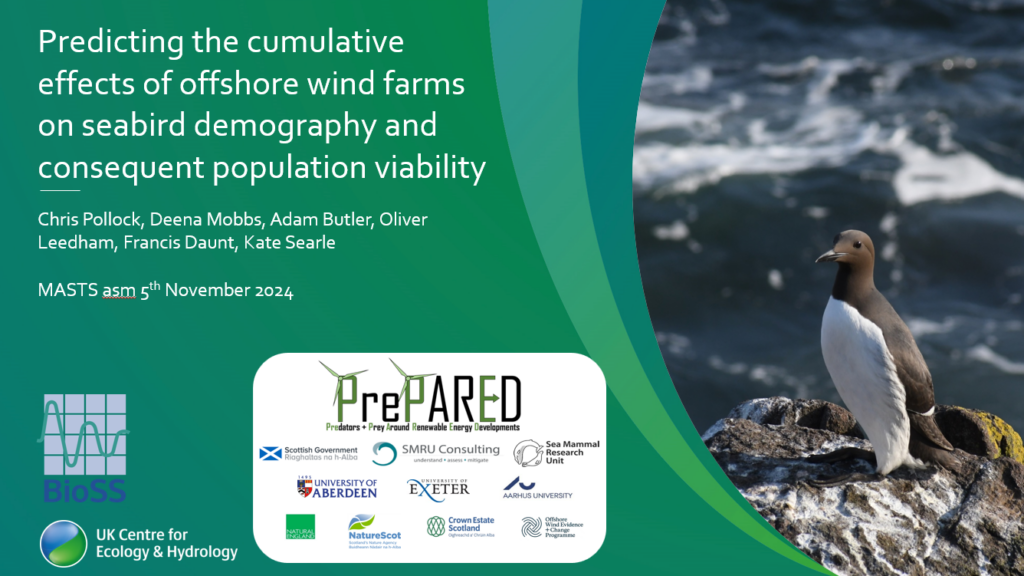
Chris Pollock (UKCEH) presented at MASTS on 5 November on ‘Predicting the cumulative effects of offshore wind farms on seabird demography and consequent population viability.


Katherine Whyte (BioSS), and Chris Pollock also attended a workshop at the MASTS conference on “Tracking top predators in marine renewable energy development areas”


Society for Marine Mammalogy (SMM)

Several PrePARED colleagues attended SMM24 in Perth, Australia and presented on:

  • PrePARED Report 004
  • PrePARED Report 005
  • Task 4.2 investigating how windfarm presence affects fine-scale distribution of prey and marine mammal foraging behaviour
  • Summarisation of lessons learned from designing monitoring programmes for Scotland/UK OWF developments
  • Predictions of the impact of US OWF developments on North Atlantic right whale populations

October 2024

Conferences

North-East Scotland Ecology Network (NESEN)

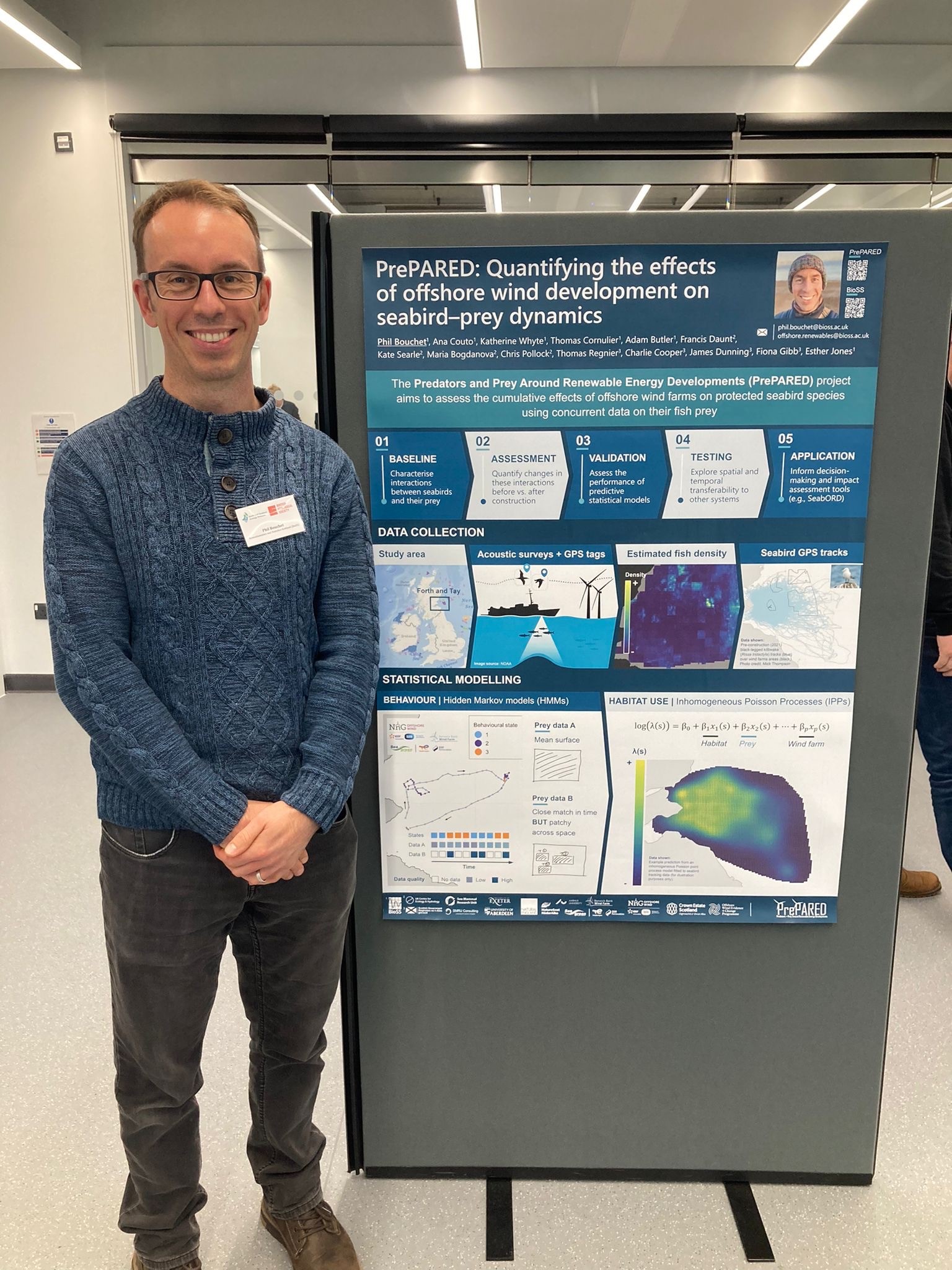
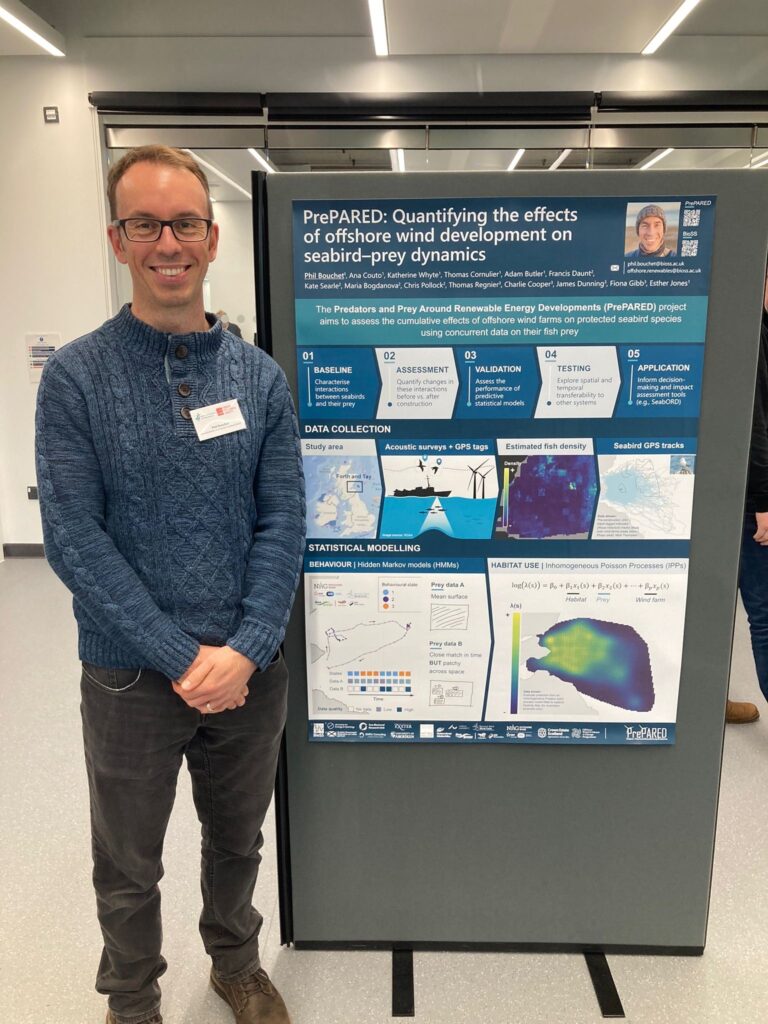
Phil Bouchet (BioSS) attended the NESEN Annual Science Day in Aberdeen on 8th October, and presented a poster on “Quantifying the effects of offshore wind development on seabird-prey dynamics”.


BOU Birds and Net Zero conference

Several members of the PrePARED team attended the BOU autumn conference in York on 24th October. The meeting theme was “Birds and net zero: mechanisms, impacts and solutions in the transition to clean energy”.

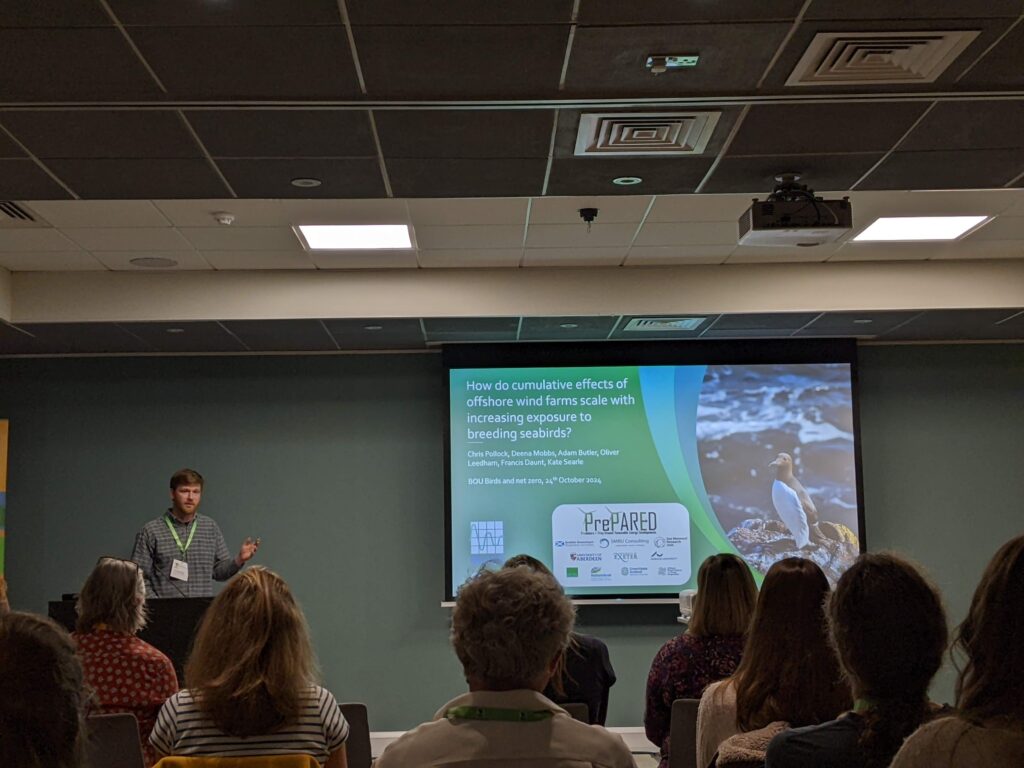
The team gave two presentations on PrePARED: Christopher Pollock (UKCEH) on “How do cumulative effects of offshore wind farms scale with increasing exposure to breeding seabirds?” and Katherine Whyte (BioSS) on “Understanding predator-prey interactions in the context of offshore wind farm development”. Kate Searle (UKCEH) also co-organised the meeting and chaired a session.


Ensuring Transferability: An Evidence Bridge Approach

Report 005, prepared by SMRU Consulting and SMRU, was released this month looking at evidence-based decision making in environmental conservation and management.

The report summarises a process using ‘evidence bridges’ to support decision making, noting the current challenge of differing pressures, drivers and timelines between researchers and key stakeholders.


September 2024

Data Analyses

The team are now working on analysing data collected during summer fieldwork including:

  • Fish and seabird distribution data to be used to a) refine species distribution models necessary to predict both prey and predator distributions and b) assess the quality of current species distributions models by confronting newly acquired data with model predictions
  • RoxAnn data to be used to update models of seabed roughness and hardness and spatial resolution of seabed models
  • Fish length frequency analyses to discriminate juveniles from adults based on size for all target species
  • Post processing of acoustic data to determine broadscale fish distribution
  • Review of fish trap and BRUV (Baited Remote Underwater Video) data to refine species distribution models and understand the effects of offshore windfarms on fish distributions.
  • Processing of fish tag ‘ping’ data showing fish movement in and around offshore windfarms
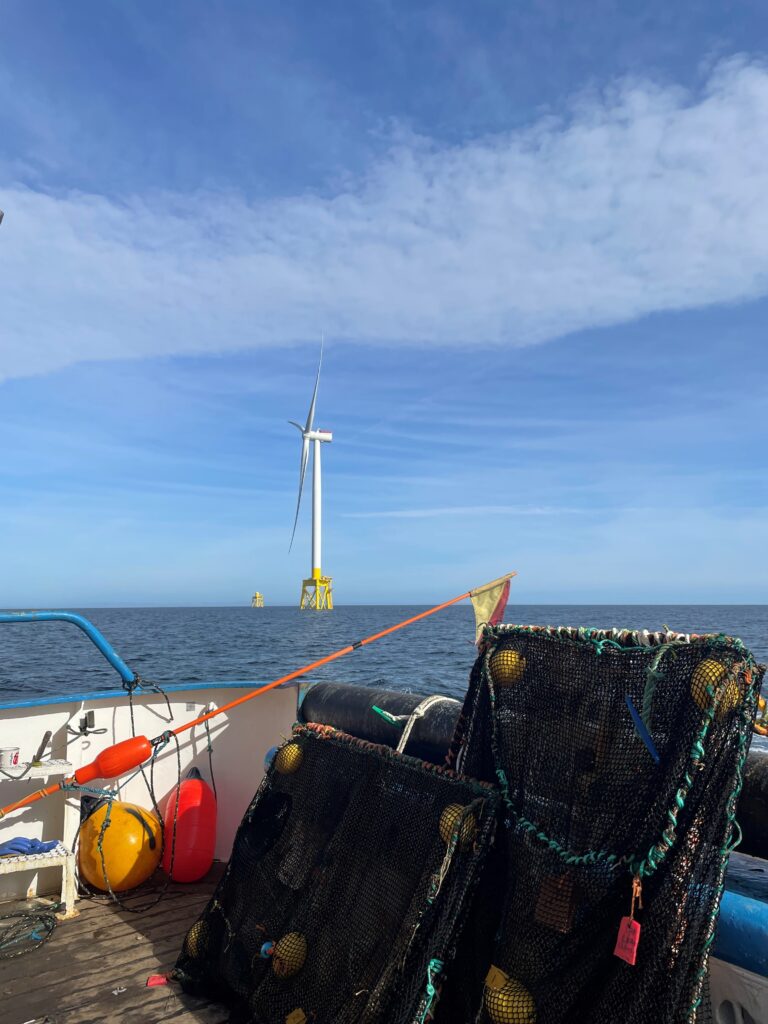
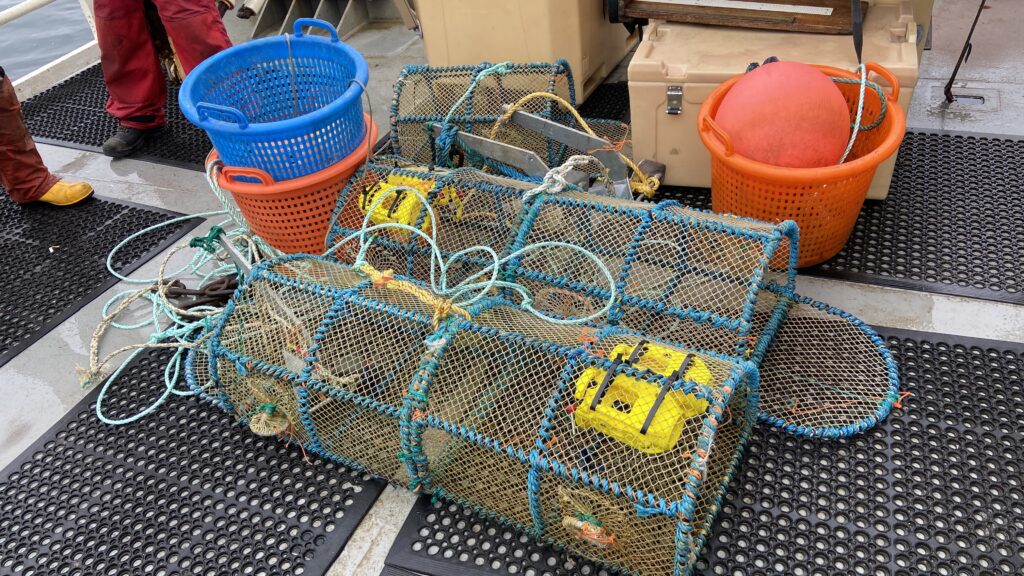
Fish Traps in NnG Offshore Windfarm

Engagement

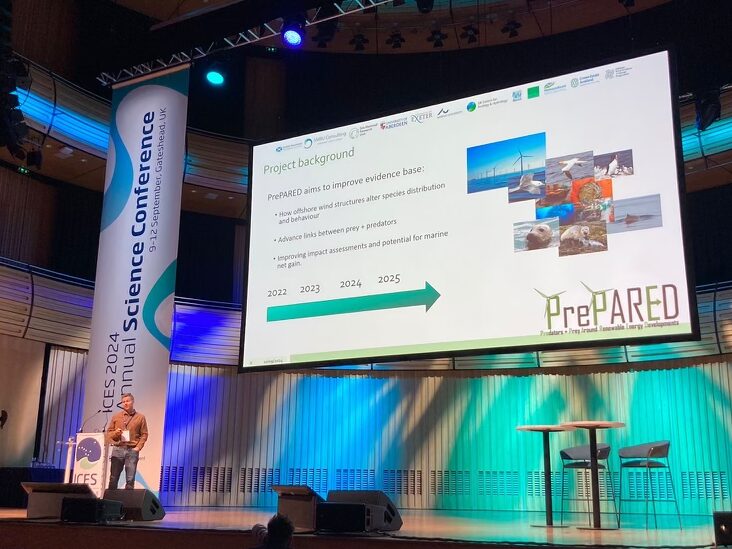
ICES Annual Science Conference

The ICES ASC conference was held in Gateshead, UK from the 9-12th September.

Several members of the PrePARED team attended and presented at the conference including Tony Bicknell (University of Exeter), Aude Benhemma-Le Gall (University of Aberdeen) and Philippa Wright (University of St Andrews).

Tony Bicknell presented on ‘Effects of offshore wind farms on distribution and behaviour of fish with potential consequences for predation’

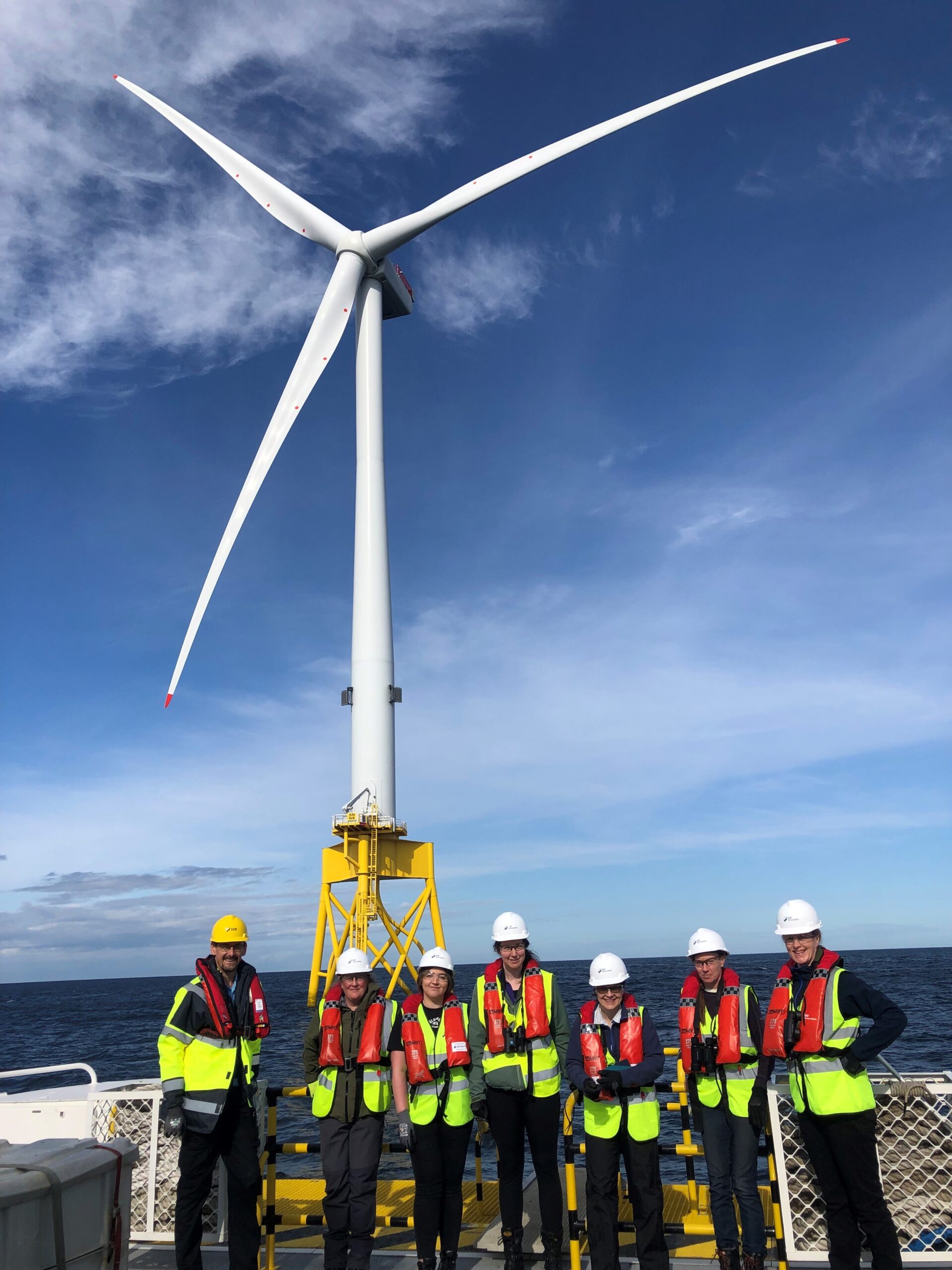
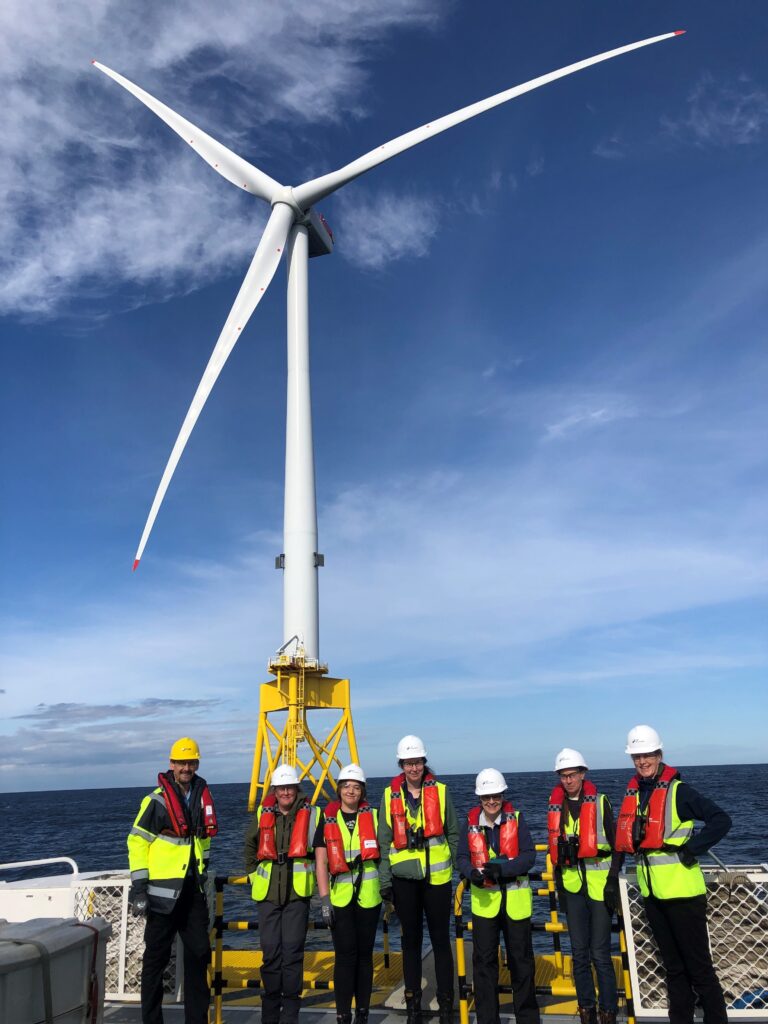
Site Visit – Seagreen Offshore Wind Farm


NYSERDA State of the Science meeting

In the August blog we highlighted Cormac Booths presentation at the NYSERA meeting in the USA.

This talk is now available to watch online – see here with presentation starting at 39:04


OWEC Programme Steering Group (PSG)

Paul Thompson, University of Aberdeen, attended the September PSG meeting in London to lead one of their impact workshops focussing on the topic of Effective Deterrence Ranges (EDRs) following the recent PrePARED report 004.


The Seabird Group Conference

Members of the PrePARED project team also attended the Seabird Group Conference in Portugal this month presenting on ‘How do cumulative effects of offshore wind farms scale with increasing exposure to seabird breeding colonies?’.


2nd ENRA Science, Evidence and Policy Conference

Colleagues from BioSS presented on ‘Building an evidence base for offshore renewables’ in Edinburgh on 23 September.


August 2024

New Report

The University of Aberdeen have released a new report on harbour porpoise responses to the installation of XXL monopiles without noise abatement.

This report follows discussions from the PrePARED Annual Knowledge Exchange Meeting (AKEM) on how PrePARED data can be used by different regions.

Alongside the report, we have created a 2-page report summary for easy digestion and reference which can be found here.

For any queries regarding the report, please contact us at PrePARED@gov.scot


Surveys

Moray Firth Camera Survey

Baited remote underwater video (BRUV) surveys were conducted during two weeks of July to follow up the 2022 surveys in assessing the abundance and biomass of demersal fish around the Beatrice wind farm turbine jacket foundations. The survey this year was designed to assess how far the aggregation effect found in 2022 was observed from the turbine jackets, and whether density of turbines influenced the size of the aggregation effect. The weather was kind to the University of Exeter team and the survey was completed in full during the first week, resulting in 24 turbines sampled with a total of 96 BRUV deployments.

During the second week the team deployed new un-baited camera systems (‘Cuttlefish’) that can continuously record footage for up to 2 days (or more if scheduled), so can observe day and nighttime animal activity. These were deployed in pairs at 6 turbine foundation and reference sites for 24 hours, to assess whether there are diel changes in fish abundance and community structure. These data will also be useful to compare to the baited camera data to assess how the use baited can influence species and/or the abundance observed.  

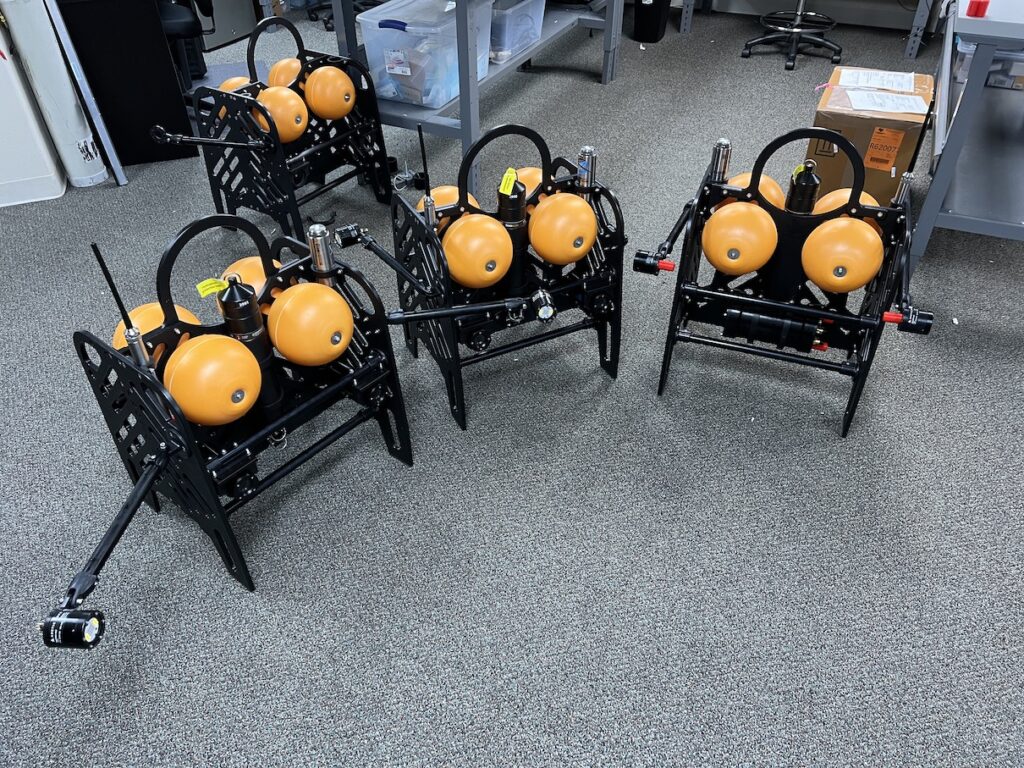
Picture of camera landers

Firth of Forth Camera Survey

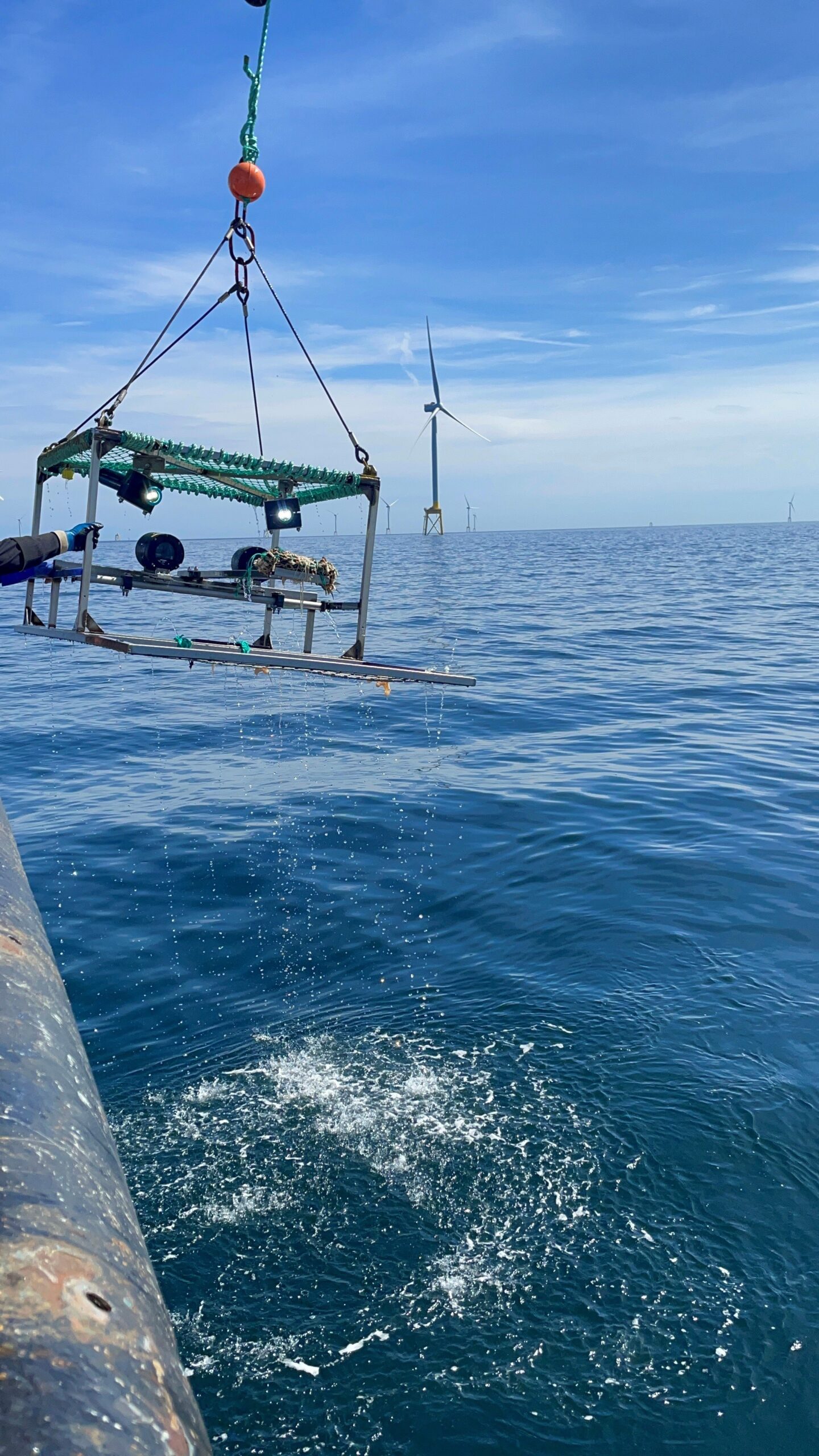
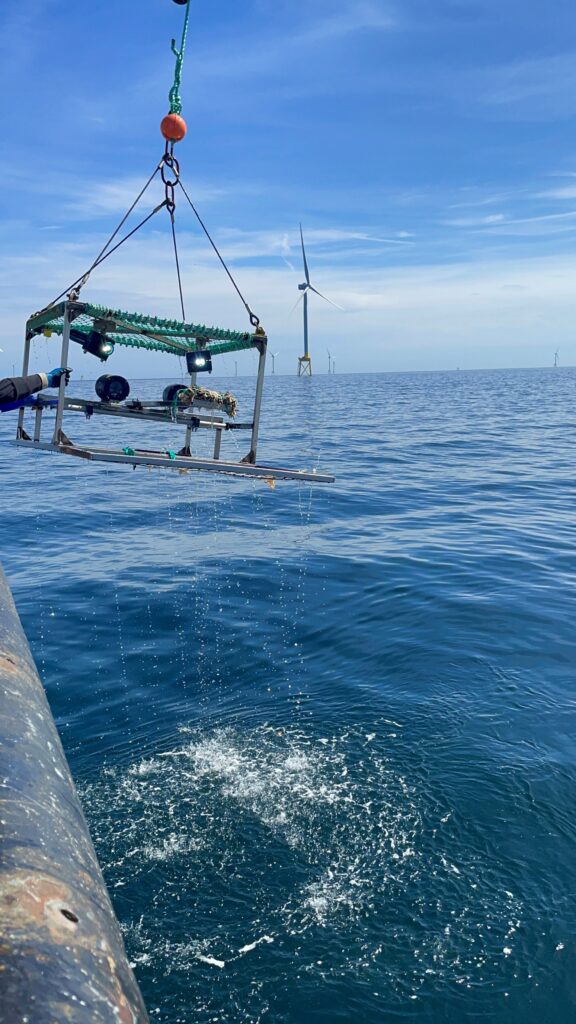
Baited Remote Underwater Video (BRUV) retrieved within offshore wind farm.

In support of Task 1.2, the third year of fine-scale fish distribution data collection took place in the Firth of Forth from 29th July until 16th August. Scientists on the Alba na Mara deployed Baited Remote Underwater Video (BRUV) stations and fish traps to investigate fish distributions within and around Seagreen, Inch Cape and Neart na Gaoithe (NnG) offshore wind farms.

Over the survey period a total of 68 BRUV deployments were successful, generating 102 hours of video footage within and around wind farm sites.

A total of 47 fish trap deployments were successful with fish samples collected for further analyses on fish energetic content (Task 4.4 – Fish Nutritional Value) and 1320 fish and benthic species measured.

A RoxAnn survey of the substrate was conducted throughout the whole survey which will be used to update the current seabed roughness and hardness layers for the region of interest.

A total of 13 CTD casts were realised during the survey, producing important information on temperature, salinity and primary productivity at depth within and near OWF sites.

The team wish to express their deepest gratitude and appreciation to the crew and captain of the Alba na Mara and to the scientific crew from SG Marine Directorate.


Engagement

NYSERDA State of the Science Workshop

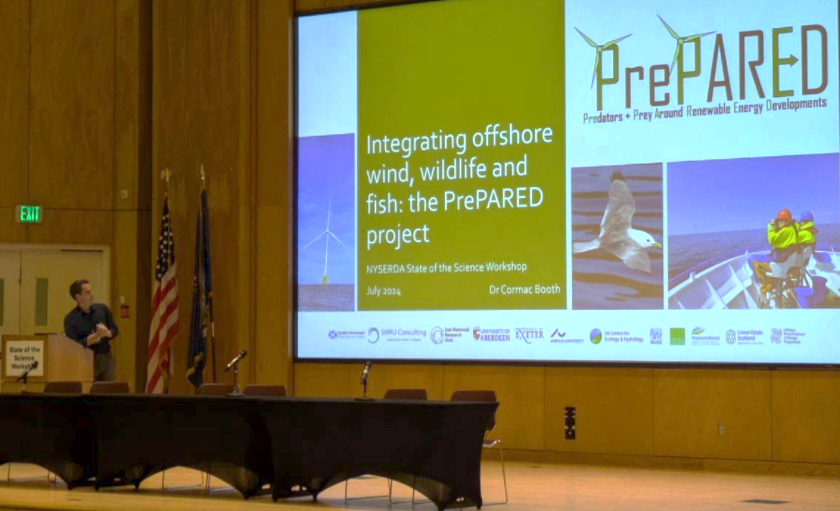
The PrePARED team from SMRU Consulting attended the New York State Energy Research and Development Authority (NYSERDA): State of the Science workshop hosted at Stony Brook University, Long Island, New York in late July 2025.

Cormac Booth presented highlights of the PrePARED project to the audience (hybrid), which comprised researchers, offshore wind developers, consultants, management and conservation groups. The talk was entitled: Integrating offshore wind, wildlife and fish: the PrePARED project”.

During the week, Cormac met with our US counterparts who run the Wildlife and Offshore Wind (WOW) project (focused on baseline characterisation and response of marine taxa to construction phase) & attended and contributed to various talks and technology sessions (led by the Marine Technology Society). There were many great talks in concurrent sessions spanning the work being done around the US on offshore wind – such as primary productivity, forage fish, fisheries, seabirds and marine mammals.


July 2024

Survey Updates

The Marine Directorate team successfully completed their survey work for Task 1.1 in the Firth of Forth as per figure 1, with seabird at sea surveys undertaken along acoustic transect lines.

Undertaking seabird at sea surveys during acoustic transects provides predator (seabird) and prey (fish) contemporaneous data to be used in future modelling.

A RoxAnn survey of the substrate was also conducted along the acoustic transects allowing the production of seabed maps which show the detailed material composition of the seabed. This will support fish distribution model predictions.

The team are currently offshore undertaking the second summer Firth of Forth survey, focussing on Baited Remote Underwater Video (BRUV) and fish traps for fine-scale fish distribution.

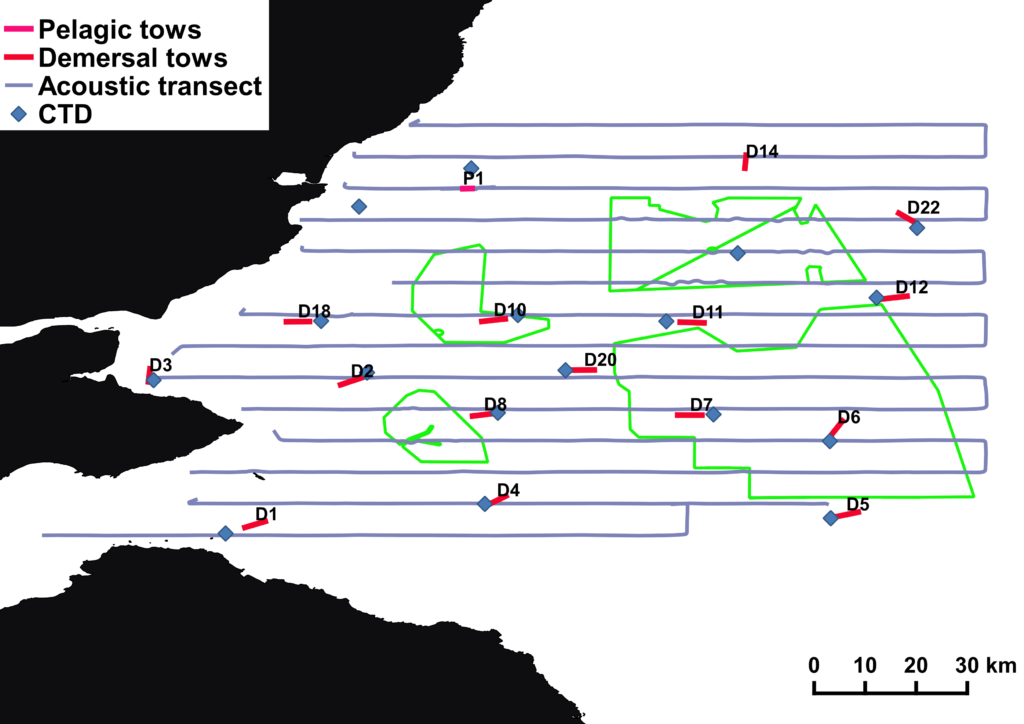
Map showing transect lines in Firth of Forth
Map of transect lines completed in Firth of Forth survey

Engagement

Katherine Whyte presenting at ISEC 2024

The PrePARED team from BioSS attended the International Statistical Ecology Conference (ISEC) 2024, which was hosted in Swansea, Wales.

During the week, they attended and contributed to various talks and discussions on spatial modelling (how to best map and predict animal distributions over space), movement modelling (how to best use animal tracking data to understand animal movement and behaviour), software development, and integrating statistics with conservation and management decisions.

Katherine Whyte presented in one of the conference sessions, with a talk entitled “Using movement modelling to understand predator-prey interactions at multiple scales”.


ICES Annual Science Conference

Aude Benhemma-Le Gall (University of Aberdeen) will present PrePARED research on harbour porpoise and prey behaviour around operating windfarms at the ICES Annual Science Conference in Gateshead, UK.

This conference takes place between 9-12 September 2024.


Looking Forward

Keep your eyes peeled over the next month for:

  • An update on survey works within the Moray Firth
  • An update on survey works within the Firth of Forth
  • A report on Monopile Effective Deterrent Ranges (EDR)

With more reports due by the end of September!

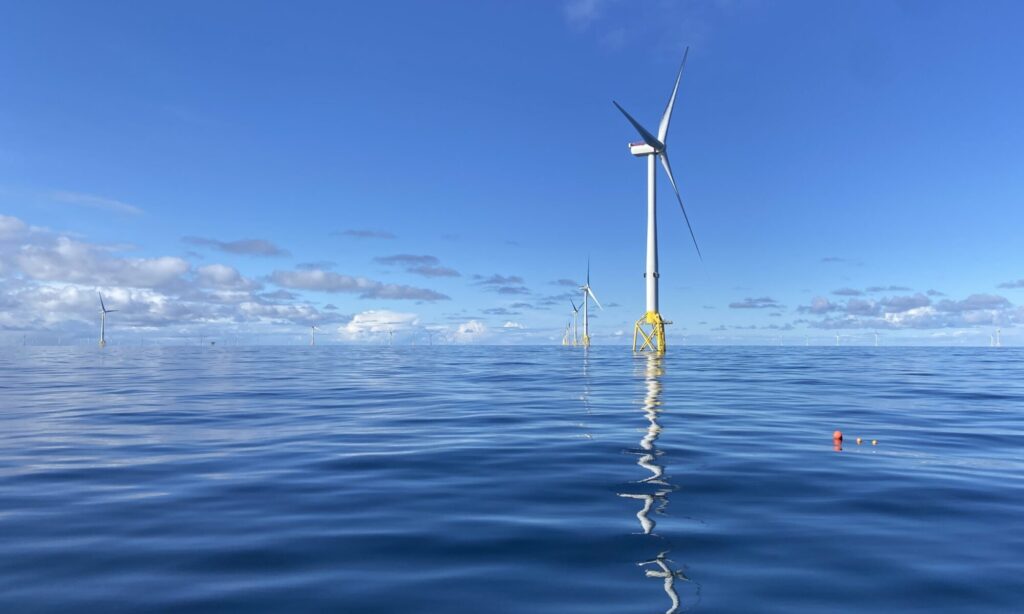
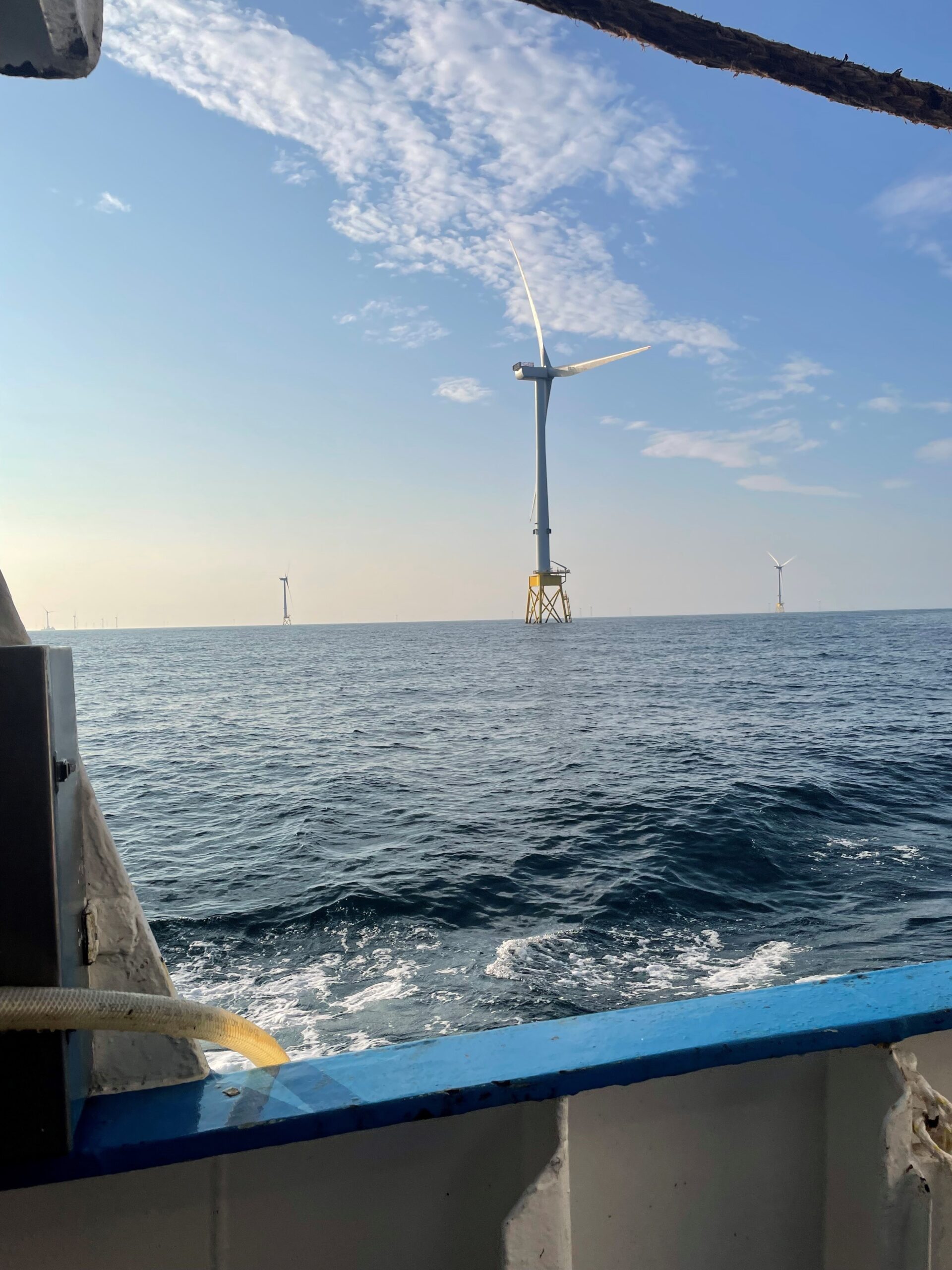
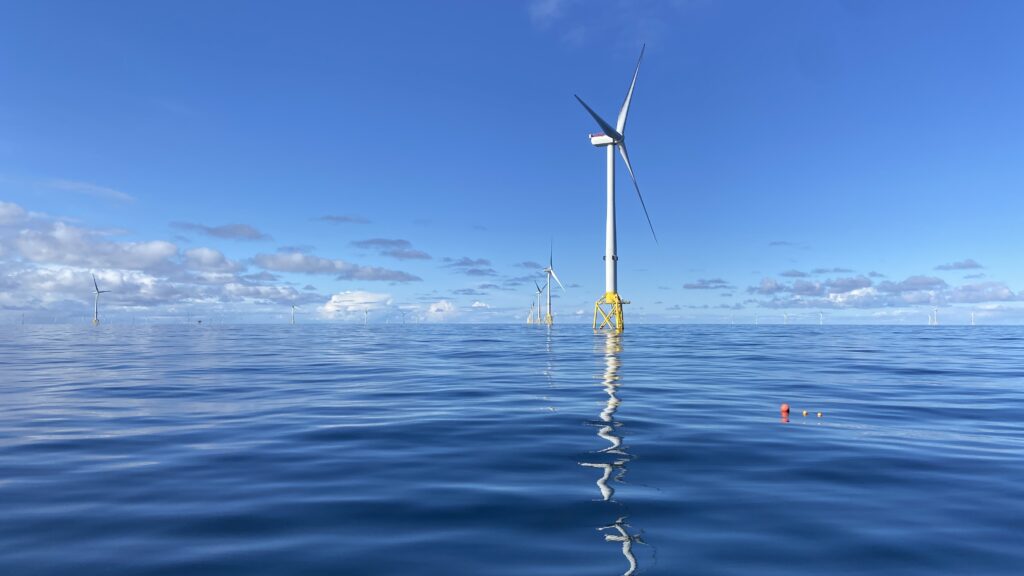
Seagreen Wind Turbine

June 2024

Summer Surveys

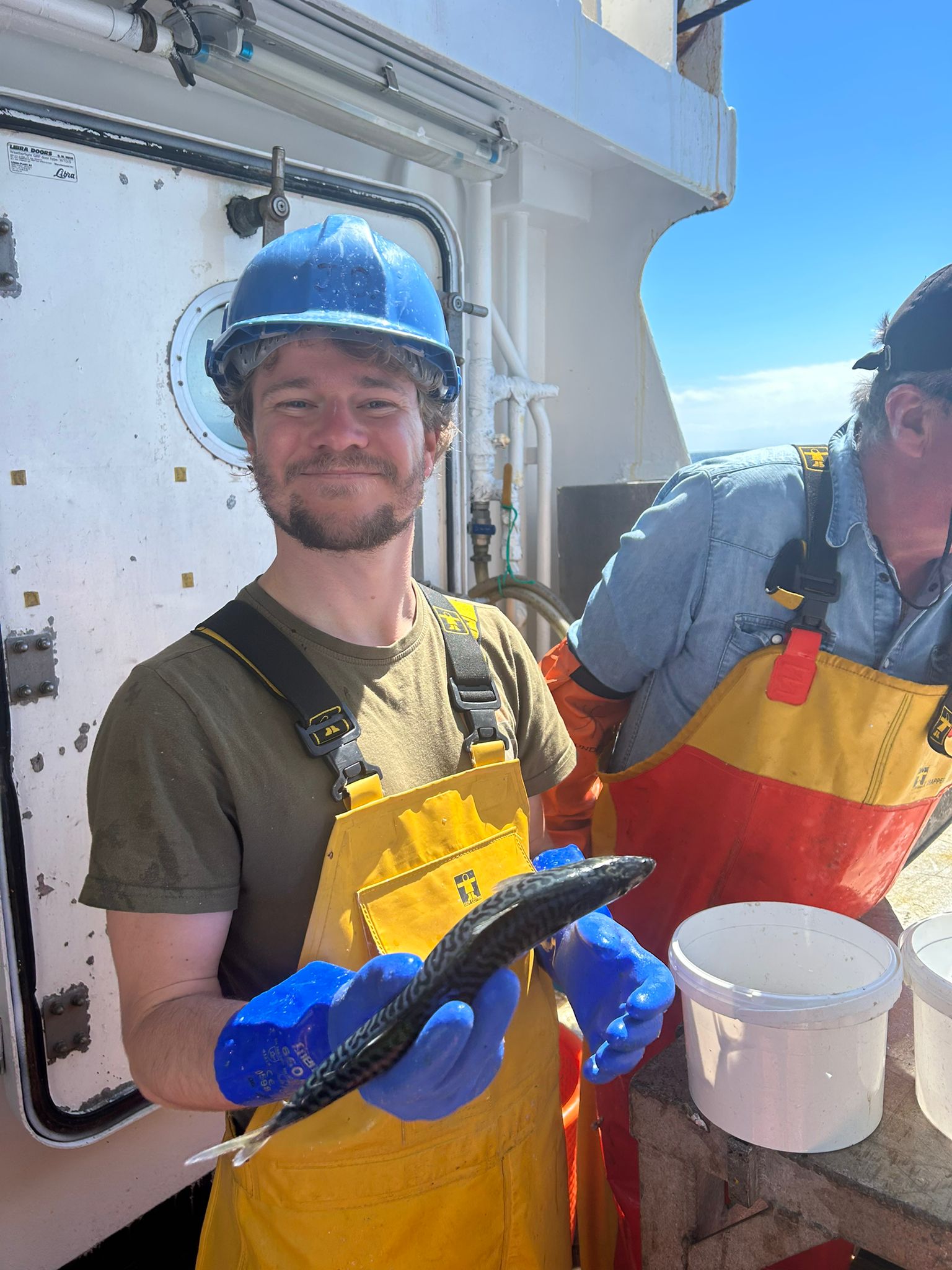
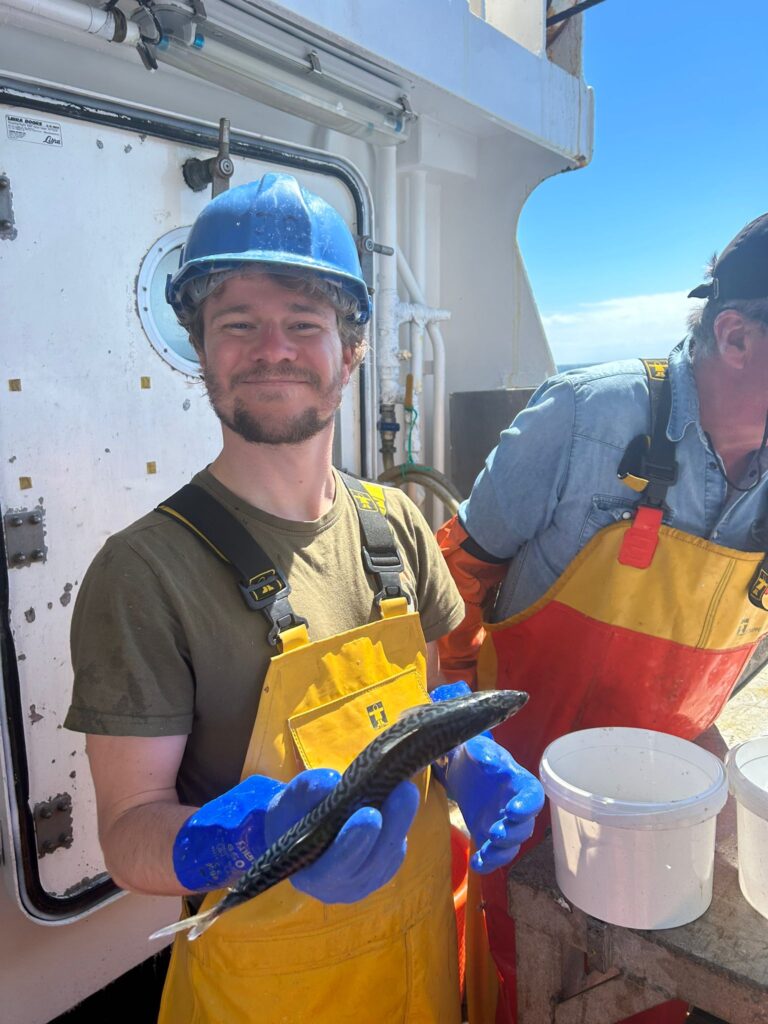
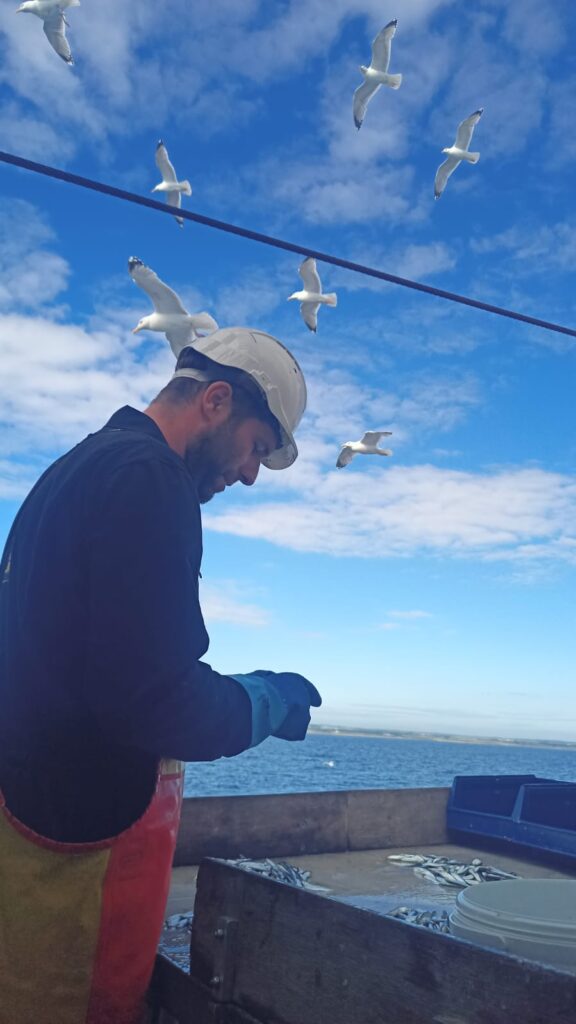
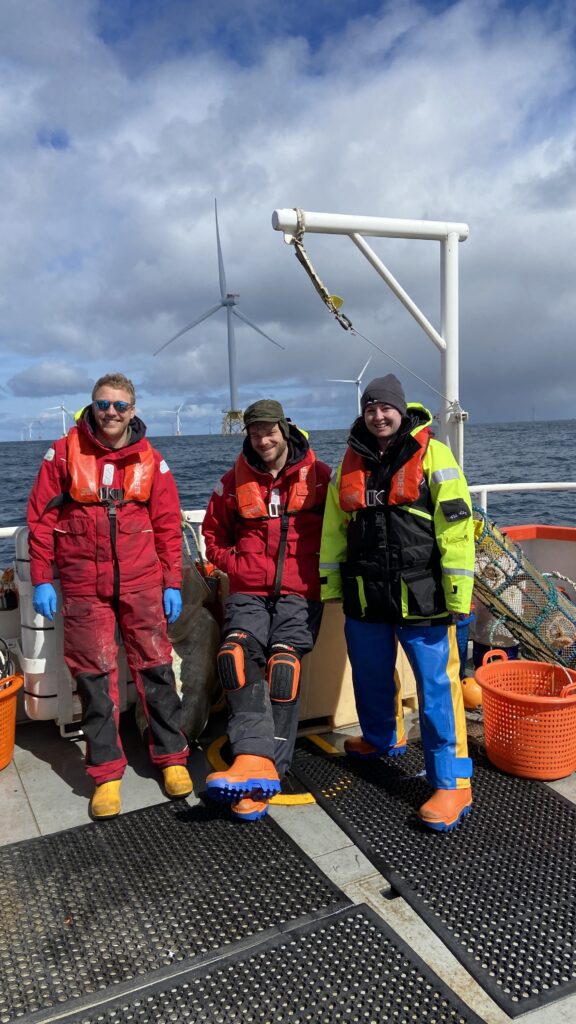
PrePARED Acoustician, James Dunning, measuring fish sample.

Our fish and seabird survey in the Firth of Forth is going well having completed 6 out of 7 acoustic transects passing through the active OWF at Seagreen and NnG and the future sites at Berwick Bank and Inch Cape.

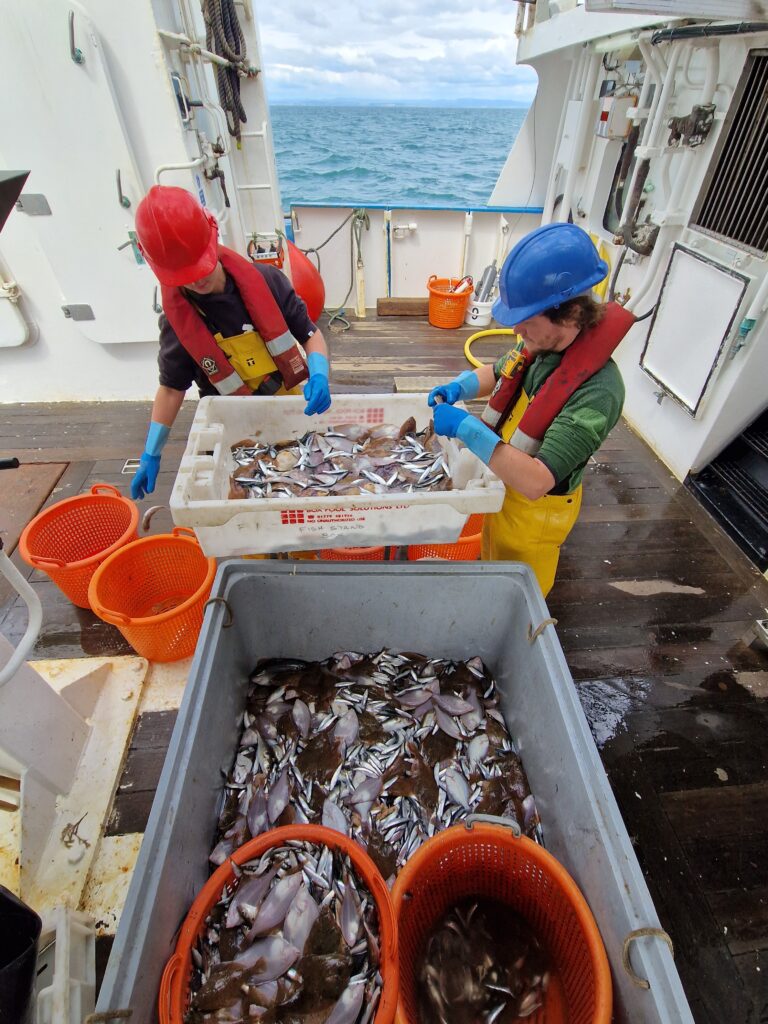
The team swapped their pelagic net for a demersal net in Leith and since have managed to sample 12 demersal stations.

The team have measured over 12,000 fish so far, including sandeel, sprat, herring, whiting, haddock, diverse flatfish and many others.

Seabird at sea survey during acoustic transect through OWF

The seabird at sea survey conducted during the acoustic transect have identified over 23,000 seabirds, most of which being guillemots though a lot of data was also collected for kittiwake, puffin, razorbill and gannet.

At time of writing, the team are expected to finish their last acoustic transect and remaining demersal stations in the next few days before heading back to harbour in Fraserburgh, taking a rest and getting ready for the next Firth of Forth PrePARED survey at the end of July.

Information provided by Thomas Regnier, SGMD


Stakeholder Engagement

Paul Thompson, University of Aberdeen, gave a briefing on the effect of piling noise on marine mammals to a range of key stakeholders including:

  • UK Government – Defra, Energy Security, DESNZ, MMO, MoD

  • SNCBs – JNCC, NRW, NatureScot

  • Devolved Administration – DAERA-NI, SG-Licensing

  • Industry – Renewables UK

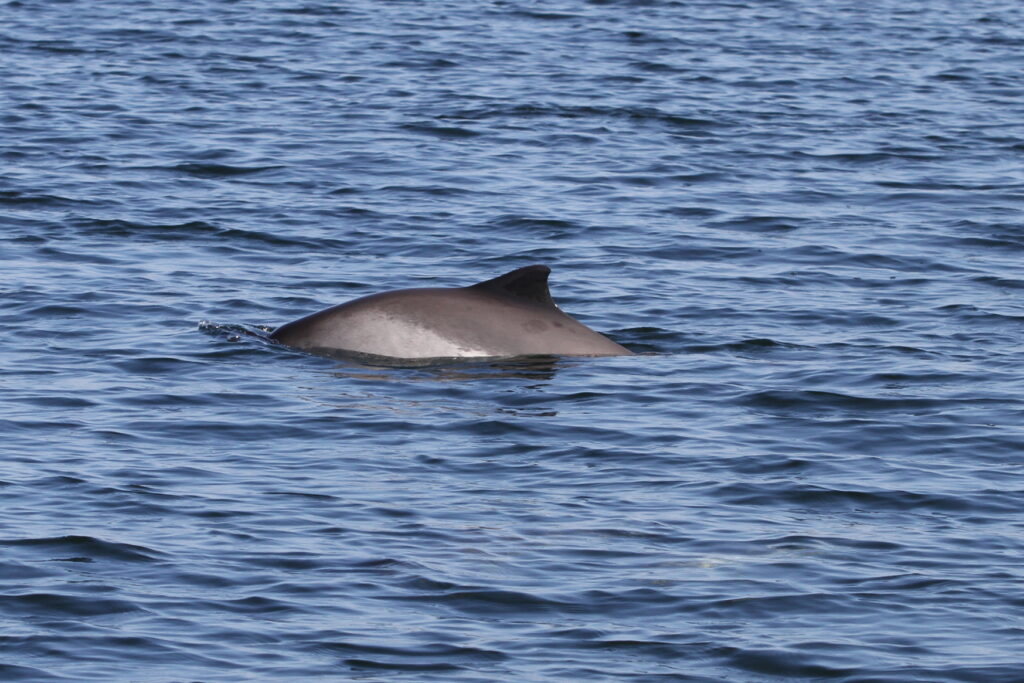
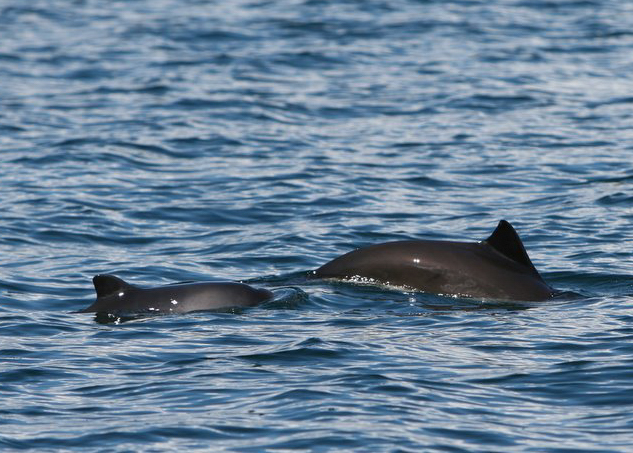
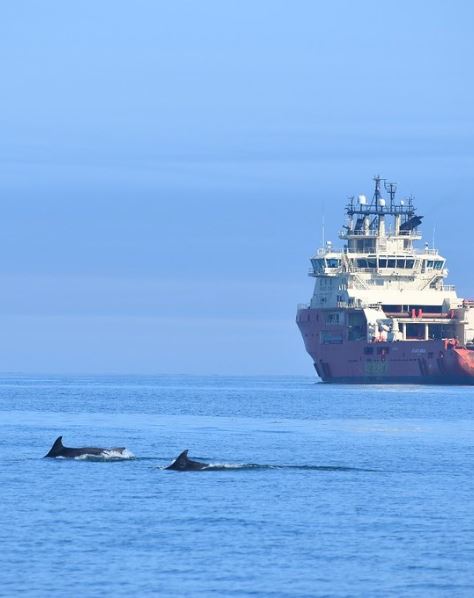
Harbour porpoises

The aim of the meeting was to discuss how PrePARED results could be used to reduce the uncertainties associated with EDRs (Effective Deterrence Range) which is the potential range of temporary disturbance as defined in JNCC Guidance for offshore wind developers. This value (between 0 and 50 km) can be set manually by the user for each noise source in the Disturbance Tool. JNCC requested further discussions on how PrePARED may help with southern North Sea questions and how to maximise the use of resources, and ensure PrePARED results are entered into the system quickly (in time for 2025 consenting).

PrePARED will continue these discussions to ensure that outputs are effective for key stakeholders.


Quarter 2 Progress

We are pleased to provide Q2 (April-June) highlights below which have been included in our formal Q2 reporting process:

  • Fisheries acoustic transect, trawl survey and fish tagging completed in the Moray Firth
  • Initial results for Moray Firth BRUV research and Moray Firth fine scale marine mammal distribution where presented at the EIMR conference in Orkney
  • Passive Acoustic Monitoring (PAM) data has been processed and deterrence functions estimated for marine mammal dose response curves
  • PrePARED colleagues at the University of Exeter have conducted habitat similarity assessment for OWF sites with a final report expected in Q3 (July-September)

April 2024

The month of April brings new opportunities and challenges for the Predators and Prey Around Renewable Energy Developments (PrePARED) project as we continue our important work to study the impacts of renewable energy developments on marine life.

Throughout April, our dedicated team focused on conducting field research, collecting data, and analysing the effects of renewable energy projects on predator and prey species. A short summary of our fish tracking work can be found below.

We have also been engaging with stakeholders, including renewable energy developers, conservation organizations, and government agencies, to raise awareness of the project and share our current findings.

As we continue our research and outreach efforts, we are grateful for the support of our stakeholders and the dedication of our team members.


PrePARED acoustic fish tracking 

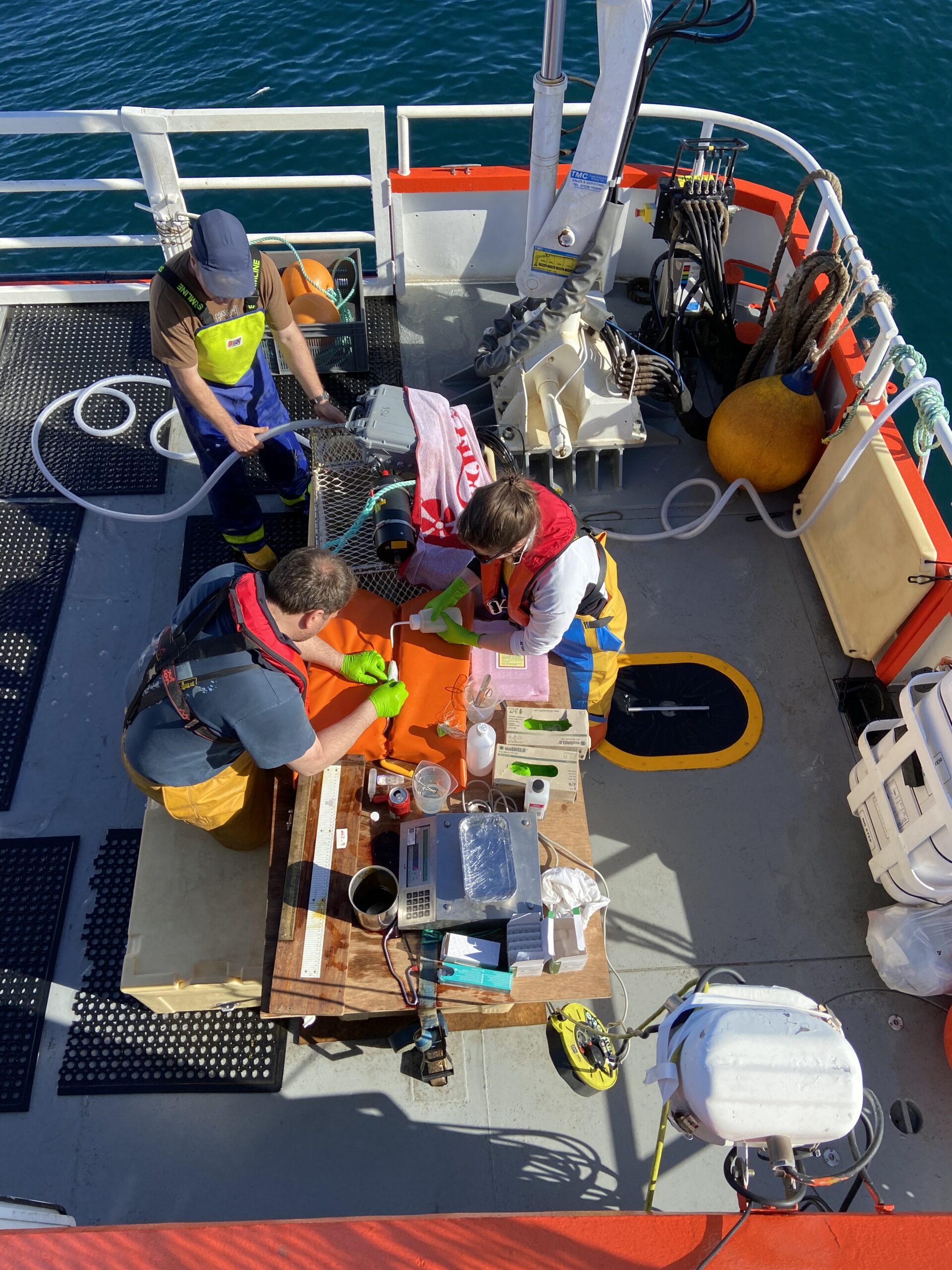
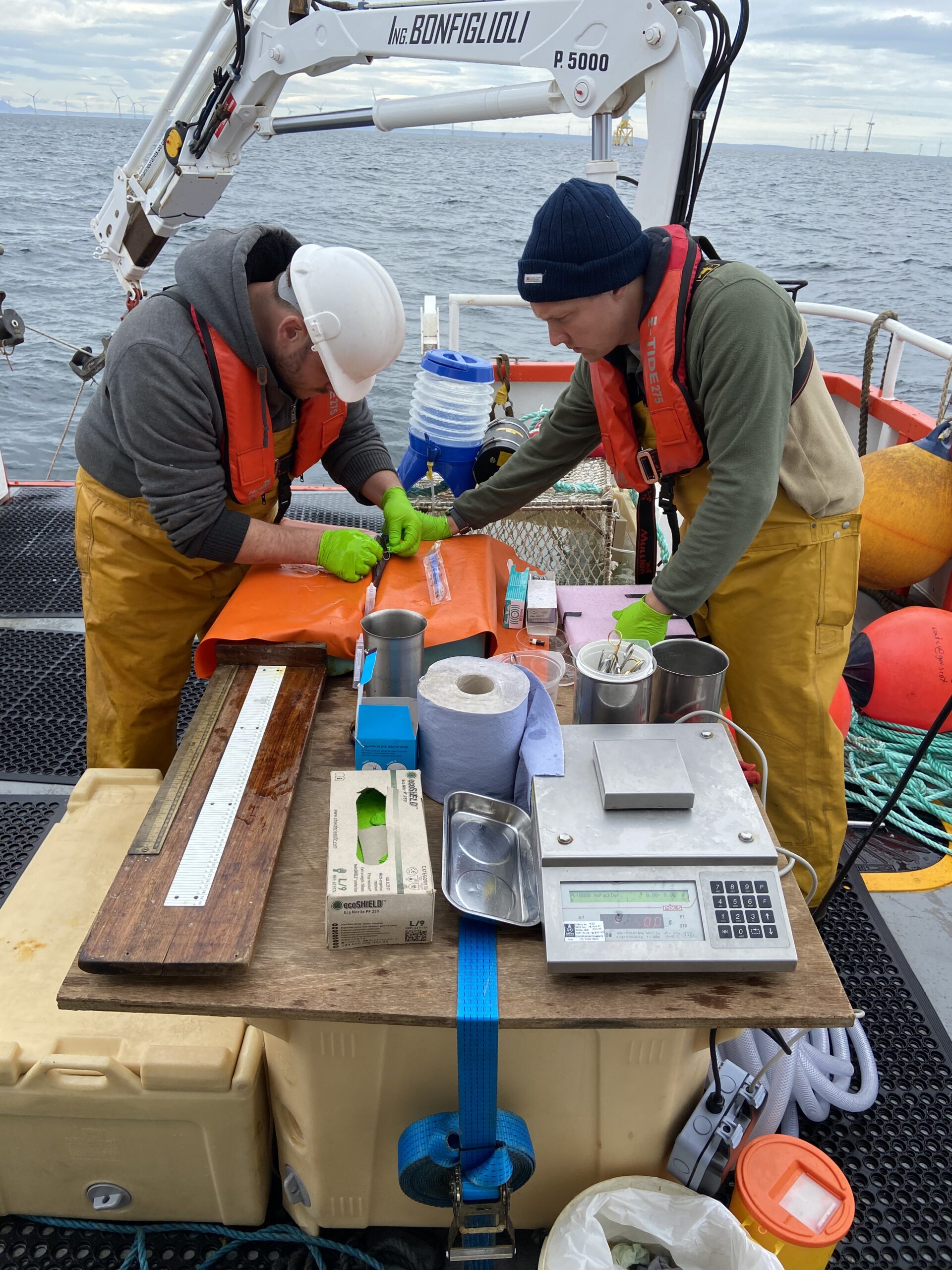
To assess how turbine foundations at the operational Moray Firth wind farms may alter the behaviour of demersal fish, the PrePARED project has deployed and been maintaining a large array (>80) of underwater acoustic receivers (hydrophones) across the two sites. By implanting tags that acoustically ‘ping’ into fish that are caught and released within the wind farms, they can be tracked by where their detections occur on the receiver array.  

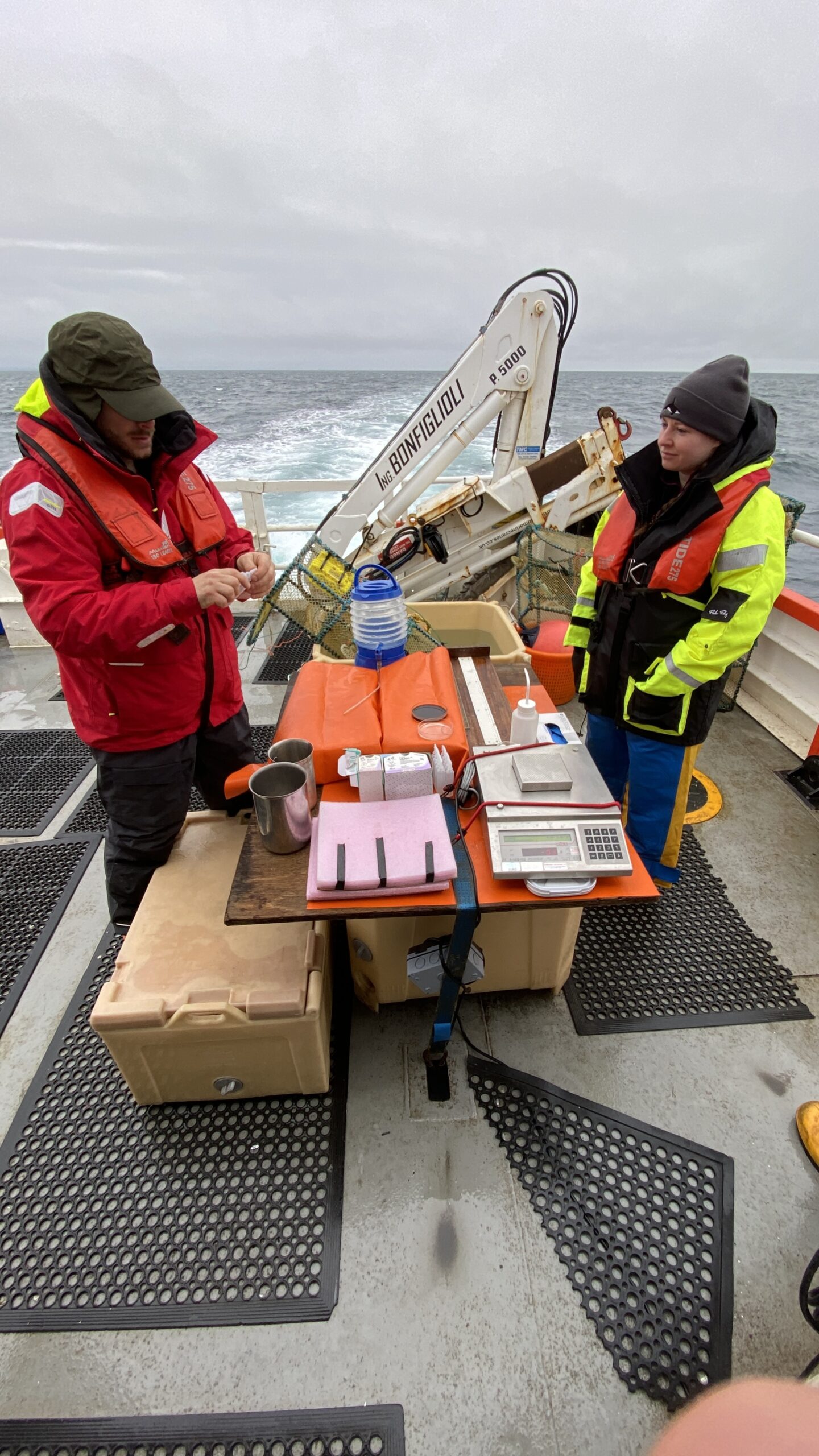
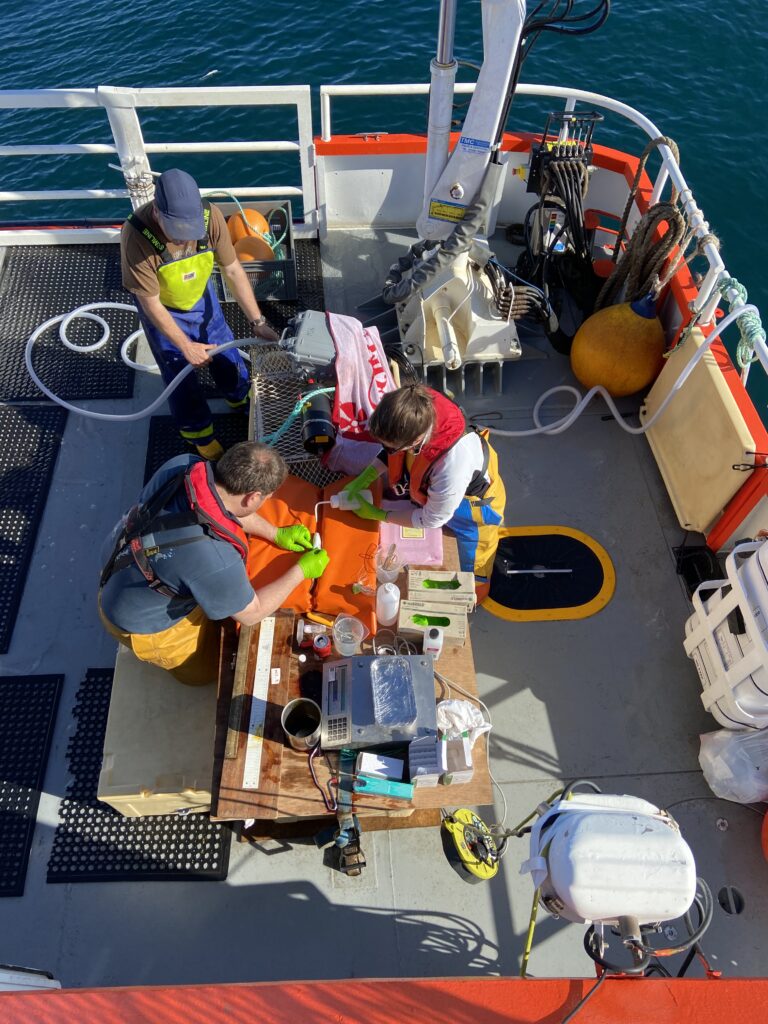
The Marine Directorate and University of Exeter team spent two weeks in April completing the servicing of receivers and tagging fish to be tracked over the coming year. Bad weather is always the bane of boat based fieldwork, and this period has been no exception, but it was still a very successful trip when weather allowed with 193 fish tagged. Both haddock Melanogrammus aeglefinus and Atlantic cod Gadus gadus were tagged and released bringing the total to over 250 fish tagged during the project.  

2024 Survey Team
Cages with timed door releases

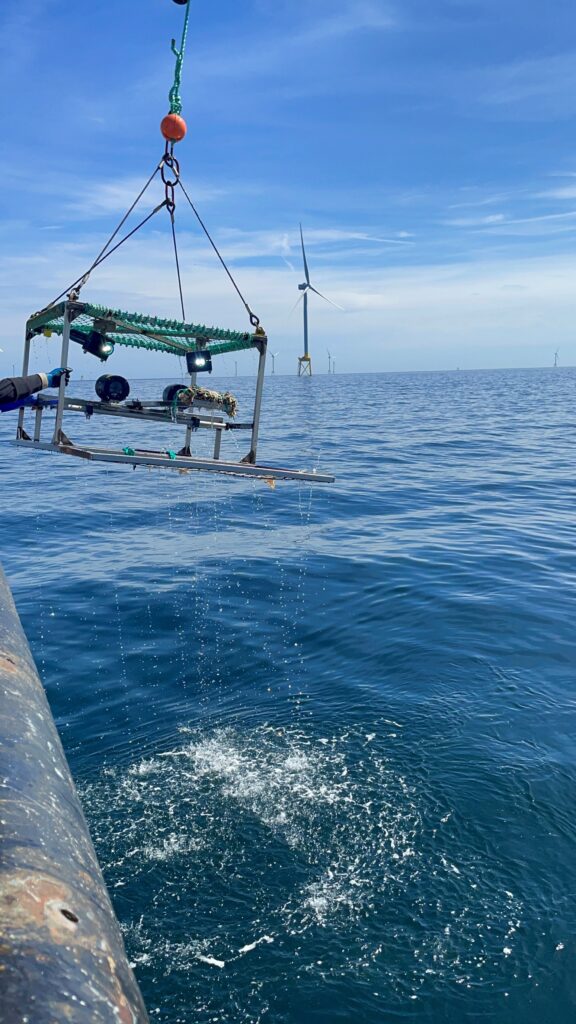
A new method of releasing fish was applied on this trip, where the fish were returned to their catch depth rapidly after surgery using cages with timed door releases. Getting them back to depth quickly aids with their recovery and helps alleviate the barotrauma they may have experienced on ascent after being caught. Cameras in the cages provided some supporting footage of the fish recovering and swimming around before being released at the seabed when the cage doors opened.

Anthony Bicknell, University of Exeter


Engagement

Aude Benhemma-Le Gall presenting at EIMR 2024

PrePARED colleagues Aude Benhemma-Le Gall (University of Aberdeen) and Anthony Bicknell (University of Exeter) presented PrePARED research at the EIMR 2024 in Kirkwall, Orkney

Philippa Wright (University of St Andrews) attended the event to present a poster on her PhD work within PrePARED.

Anthony Bicknell presenting at EIMR 2024

Chris Pollock (UKCEH), Kate Searle (UKCEH), and Katherine Whyte (BioSS) attended a collaborative workshop with NINA (Norwegian Institute for Nature Research) on “Using agent-based models for conservation biology”.

As part of the project, PrePARED is developing improvements to an agent-based model: SeabORD.

March 2024


PrePARED Outputs

The University of Aberdeen have released two PrePARED reports as part of Task 4.1 and Task 4.2 – read more about these Tasks here.

The reports have been delivered with 1-2 page report summaries in an effort to aid dissemination.

You can find the reports and report summaries on our webpage here.


Annual Knowledge Exchange Meeting (AKEM) Feedback

We spent time this month gathering and reviewing feedback from our AKEM held in February 2024.

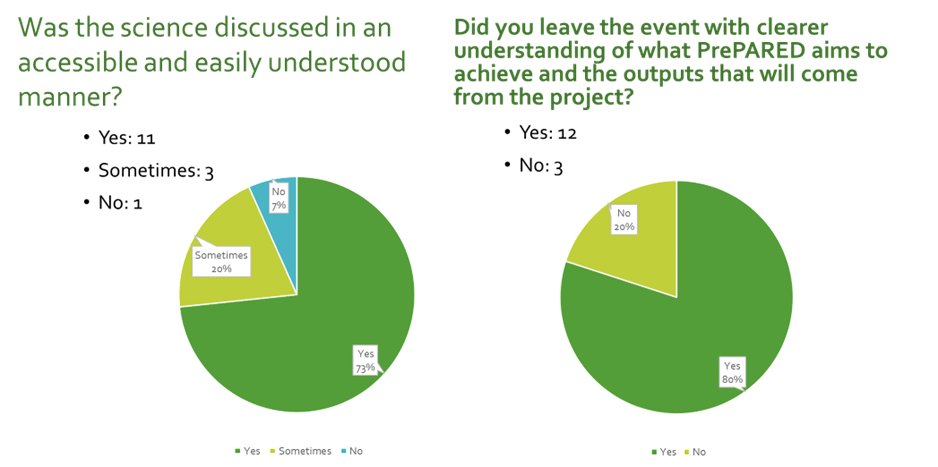
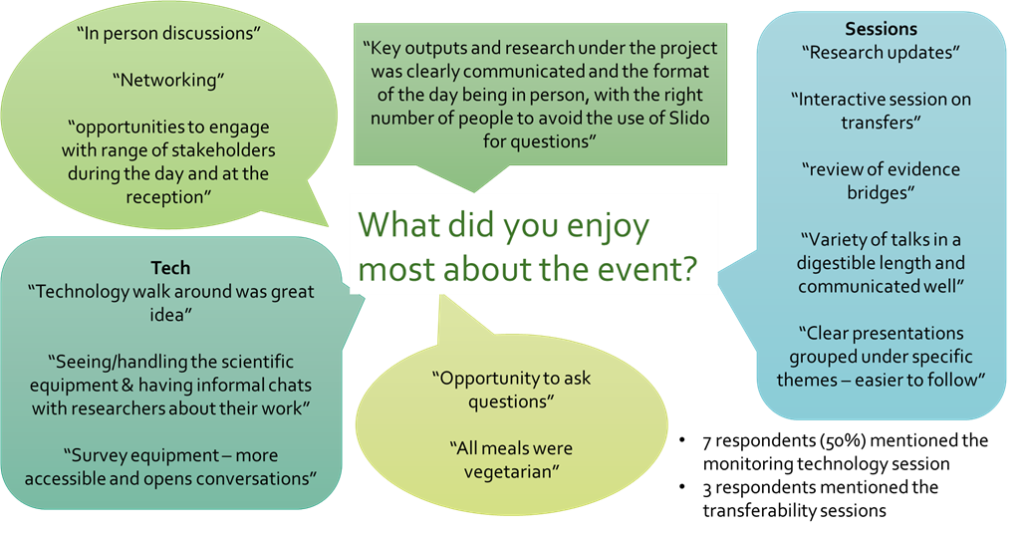
A feedback survey was completed by ~27% non-project attendees with the following key feedback received:

  • Rated the event an average of 4.3 out of 5 (1 low – 5 high)
  • 80% attendees confirmed that the AKEM met their expectations
  • Attendees provided information on their highlights of the day – see photo

If you missed the event you can review the slide decks here


Survey Preparations

This month colleagues have been preparing for survey work being undertaken in the coming months.

In the Moray Firth the PrePARED team will conduct another season of fish tagging in an effort to understand fish movement in and around wind farms.

Following this in the Moray Firth and Firth of Forth, PrePARED science colleagues will conduct acoustic transects through and around wind farms providing important information on pelagic fish distributions around wind farms at varying stages of development.


Other Q1 Activity

  • Quarter 1 progress meeting allowed full project team to meet and provide updates on their tasks
  • Quarter 1 progress report submitted to The Crown Estate – OWEC and will be uploaded here in due course.
  • PrePARED colleagues arranging to present at EIMR 2024 in April.

February 2024

Annual Knowledge Exchange Meeting (AKEM)

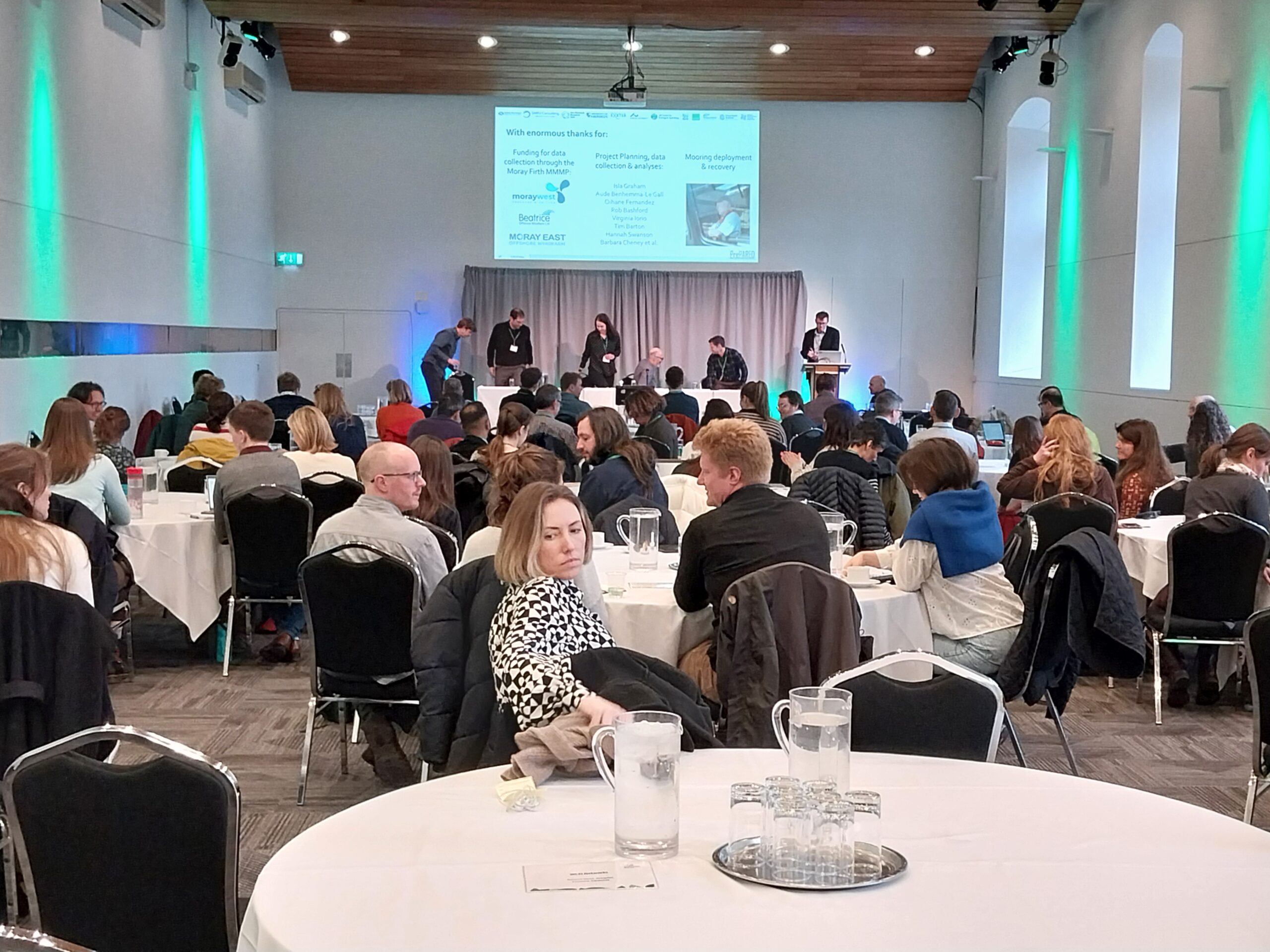
This month the PrePARED Team hosted our second AKEM at Dynamic Earth in Edinburgh.

The AKEM hosted ~100 key stakeholders to provide research updates and facilitate discussion around transferability of outputs, the impact of external factors such as the marine heatwave and avian flu, and the planning and consenting of offshore wind.

Photo of key stakeholders attended the PrePARED event

Katherine Whyte from BioSS presenting on Movement Modelling within PrePARED

PrePARED Team members presented project activity updates as follows:

  • Foodscapes and how the PrePARED project will integrate Baited Remote Underwater Video data with bomb calorimetry to improve understanding of the value of offshore wind farms
  • Forth and Tay fish and seabird data collection, analyses and how these will feed into Environmental Impact Assessment tools such as SeabORD
  • Responses of marine mammals to piling noise and PrePARED’s work toward addressing uncertainty in dose-response studies

In addition to project updates we also discussed the impact of external effects and the potential to incorporate shock events into assessment tools before moving on to transferability in the evidence base, presenting work completed by PrePARED team on similarity assessments of OWFs within UK marine habitats and encouraging open discussion with attendees on their views for transferability.

Finally we welcomed Policy and Consenting colleagues to discuss Offshore Wind Farm development, the challenges within the consenting process and facilitated a panel discussion on stakeholder views.


A key element of the AKEM was an interactive session on monitoring technology used within the PrePARED project.

Attendees had the opportunity to view a range of equipment including;

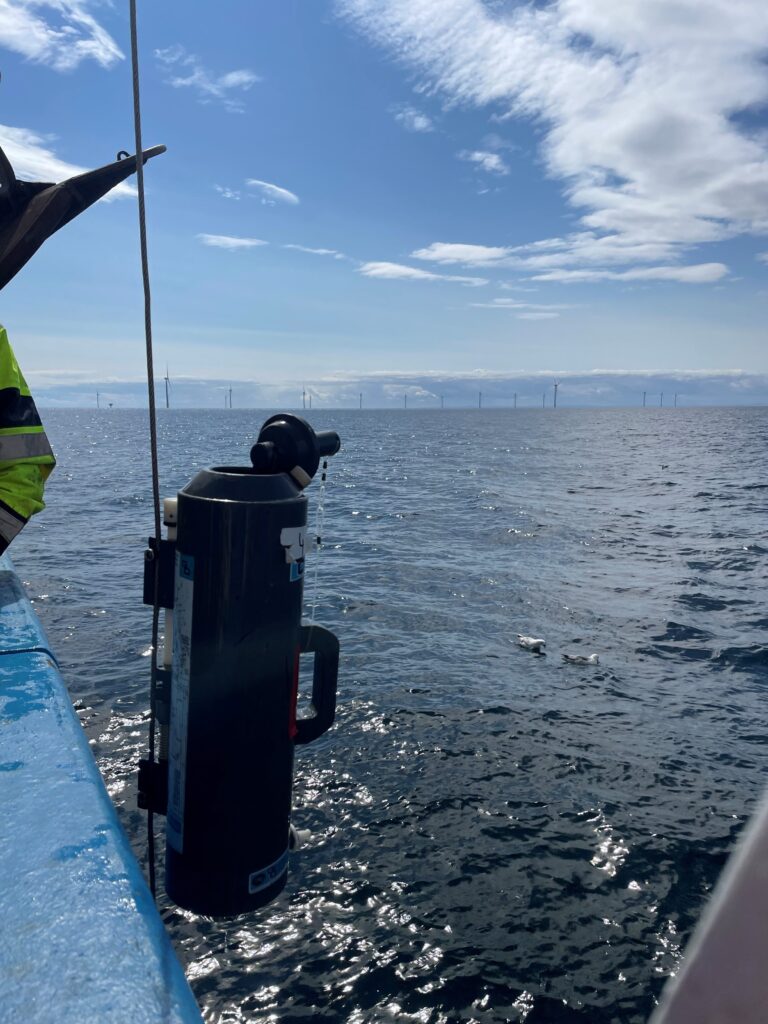
  • Acoustic Release Canister
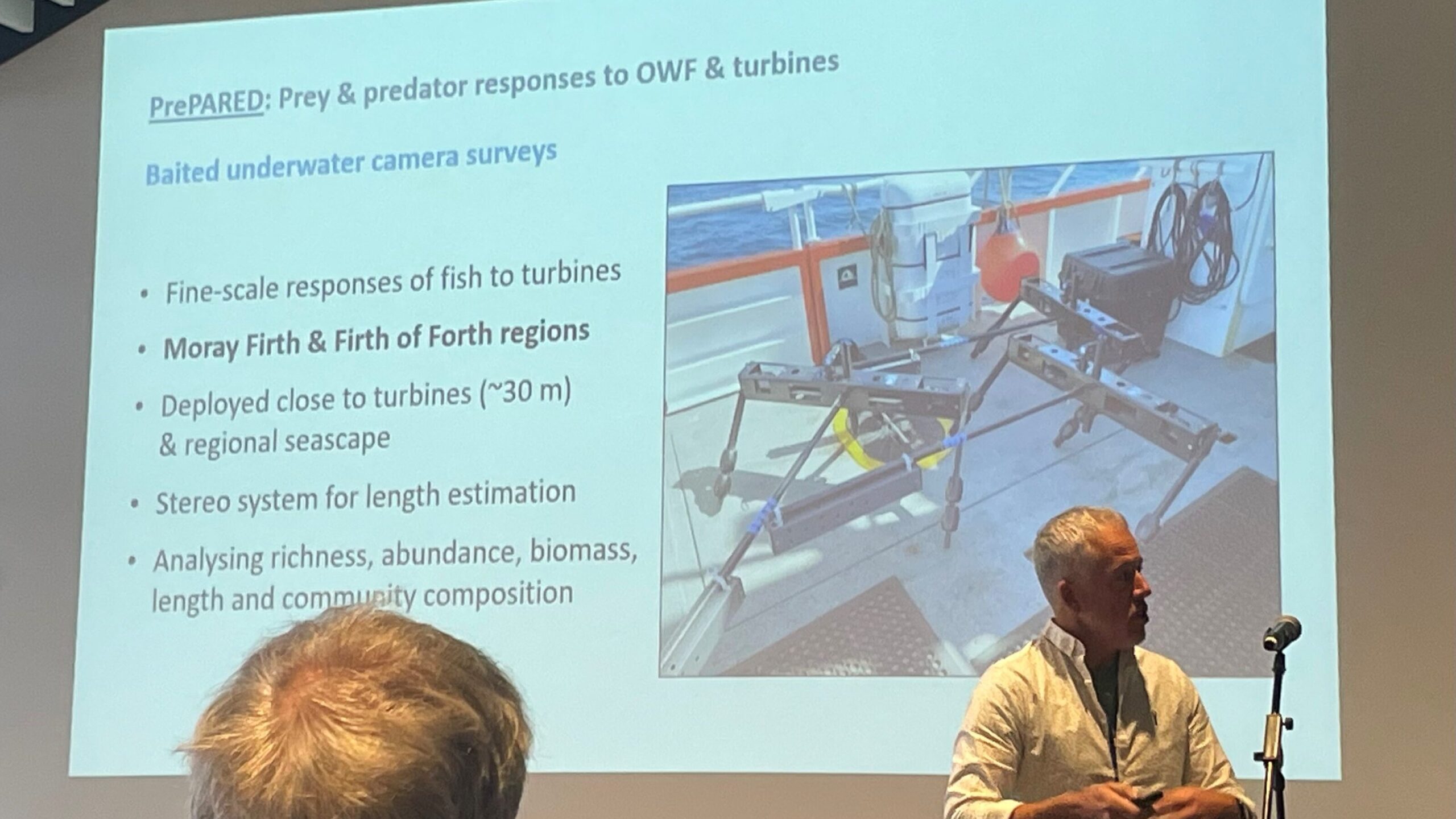
  • Baited Remote Underwater Video, CPOD (for detecting echolocation clicks)
  • SoundTrap (for recording broadband noise and animal vocalisations)
  • Bomb calorimetry equipment (for forming energy estimations)
  • Seal telemetry tags
  • Shiny app of spatial modelling and seabird tracking visualisations.
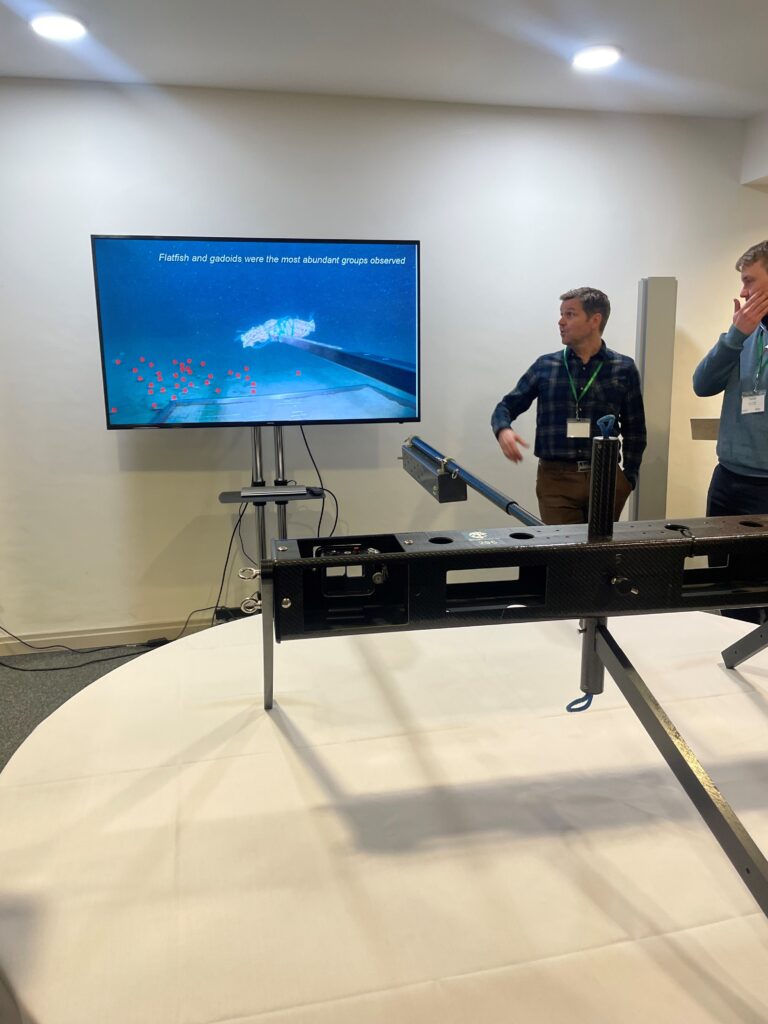
Baited Remote Underwater Video system and footage

Finally, the day ended with an evening reception at Brewdog Doghouse in Edinburgh which allowed for informal discussion between the project team and key stakeholders.

On Day 2 of the event, the Project Team and Project Advisory Group met to reflect on the event and feedback received, discuss project activity for the upcoming year and consider the dissemination of evidence.

We thank all those who attended the event and look forward to hosting our next AKEM in 2025!


January 2024

The PrePARED Team enjoyed a short break over the winter period and are now looking forward to more data collection and collation of findings in 2024.

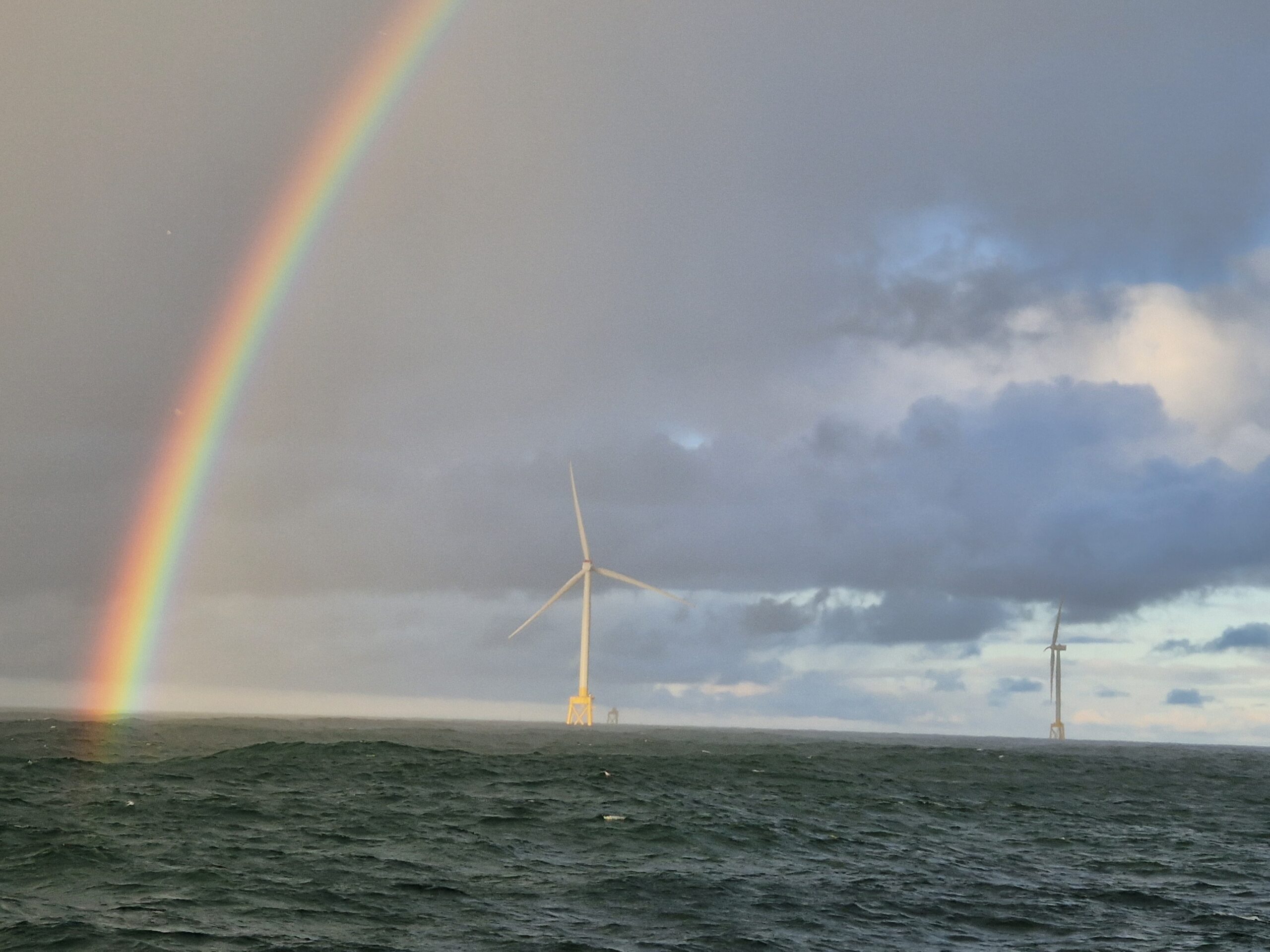
Rainbow over Seagreen offshore wind farm during December sandeel survey

Annual Knowledge Exchange Meeting 2024

During January the team have been focussing on preparations for our upcoming Annual Knowledge Exchange Meeting taking place on 27 February 2024 at Dynamic Earth, Edinburgh.

At this event we will focus on sharing PrePARED findings with key stakeholders, discussing transferability, exploring external factors and taking a look at Planning and Consenting processes and needs within offshore wind.


Data Collection

The past few months has seen several storms impacting Scotland resulting in a delay to our Moray Firth acoustic receiver servicing. We hope that, as the weather improves, we can service these, download the data and begin processing this as soon as possible.

Shortly we will recover our Passive Acoustic Monitoring (PAM) devices from offshore wind farms in the Moray Firth. This will allow our team to download data sharing marine mammal movement around wind farms.


University of Exeter task lead, Matthew Witt, will present on behalf of PrePARED at the ScotMER Symposium on the 8 February 2024. You can register to attend the online symposium here.

Questions?


May 2026

In May the PrePARED team released several outputs! Reports PrePARED Report 12: A framework for…

March 2026

Outputs Report 011: SeabORD v 2.0 This report summarises the updates and key developments in version…

January 2026

The PrePARED team are looking forward to releasing findings throughout 2026 as we near the end of…

November 2025

New report! In November PrePARED released Report 9: “Offshore Wind Farm Cumulative Effects…

September 2025

Conference on Wind energy & Wildlife impacts (CWW) 2025 Summary of summer fieldwork The team are…

July 2025

Effects of Noise on Aquatic Life Several PrePARED researchers attended the Seventh International…

June 2025

1 year extension We are pleased to announce that the PrePARED project has been granted a 1 year…

April 2025

New reports Report 007: Challenges and Solutions for Offshore Wind Farm Cumulative Effects…

February 2025

New Outputs! Peer-reviewed paper Site and species dependent effects of offshore wind farms on fish…

December 2023

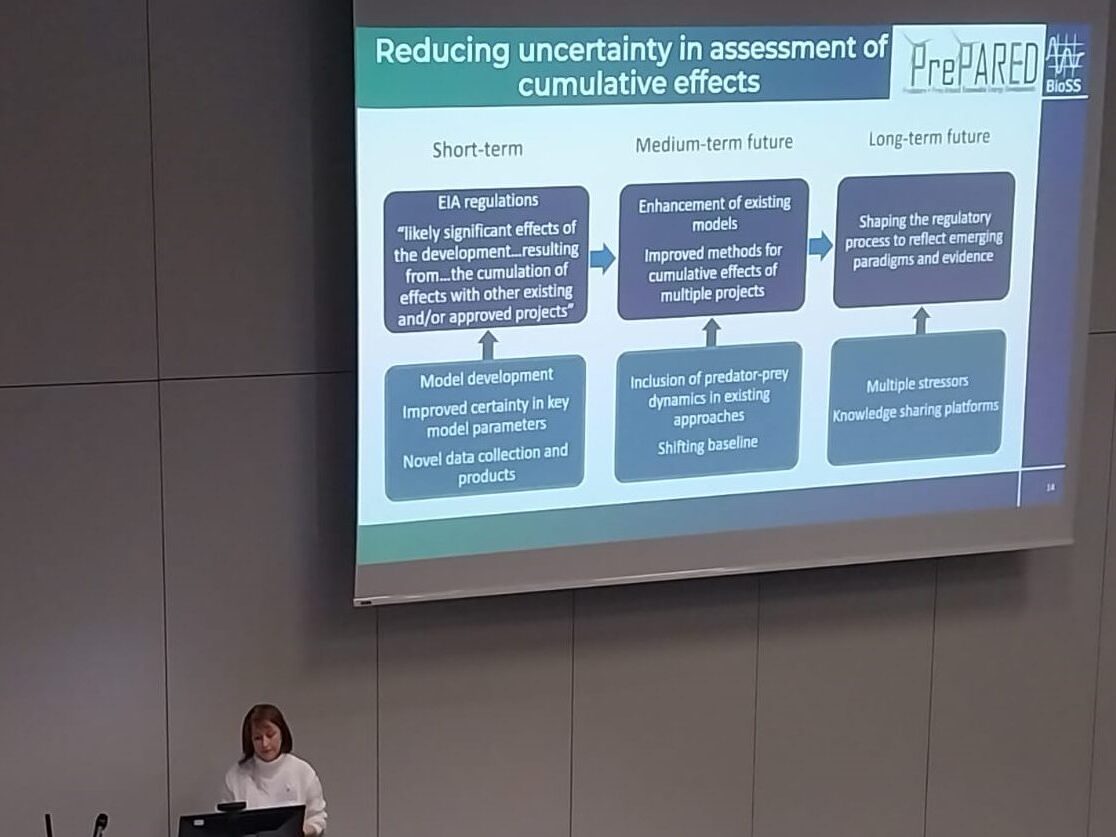
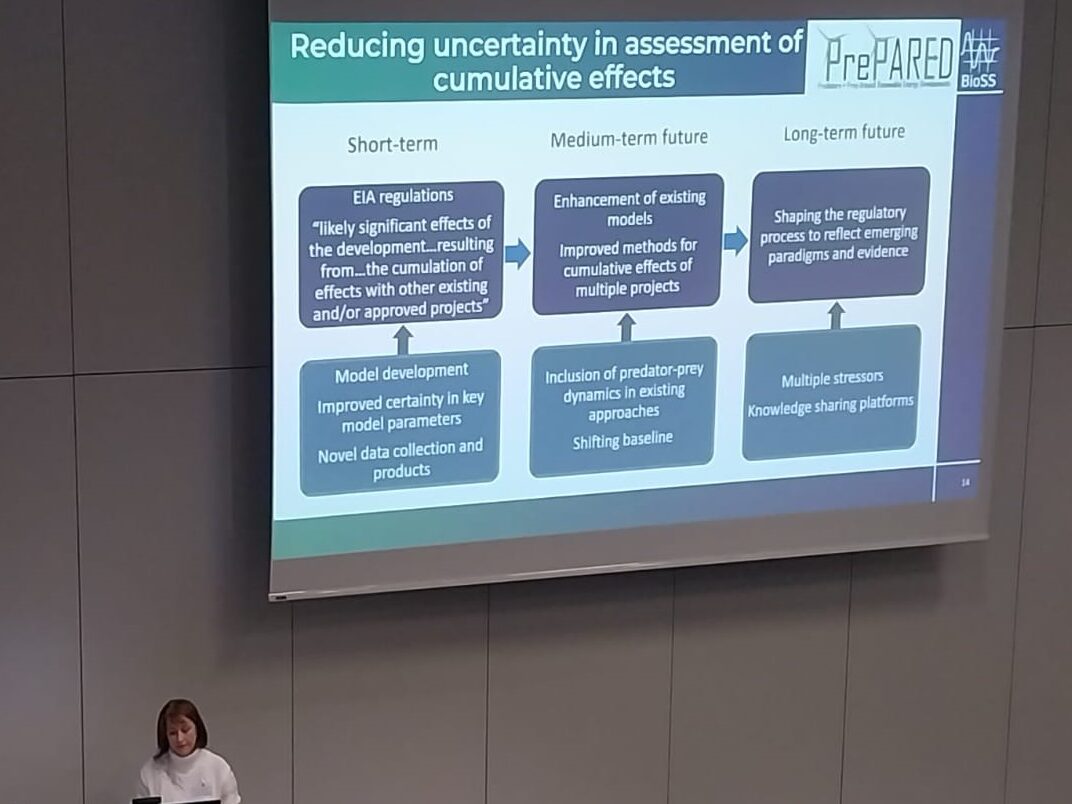
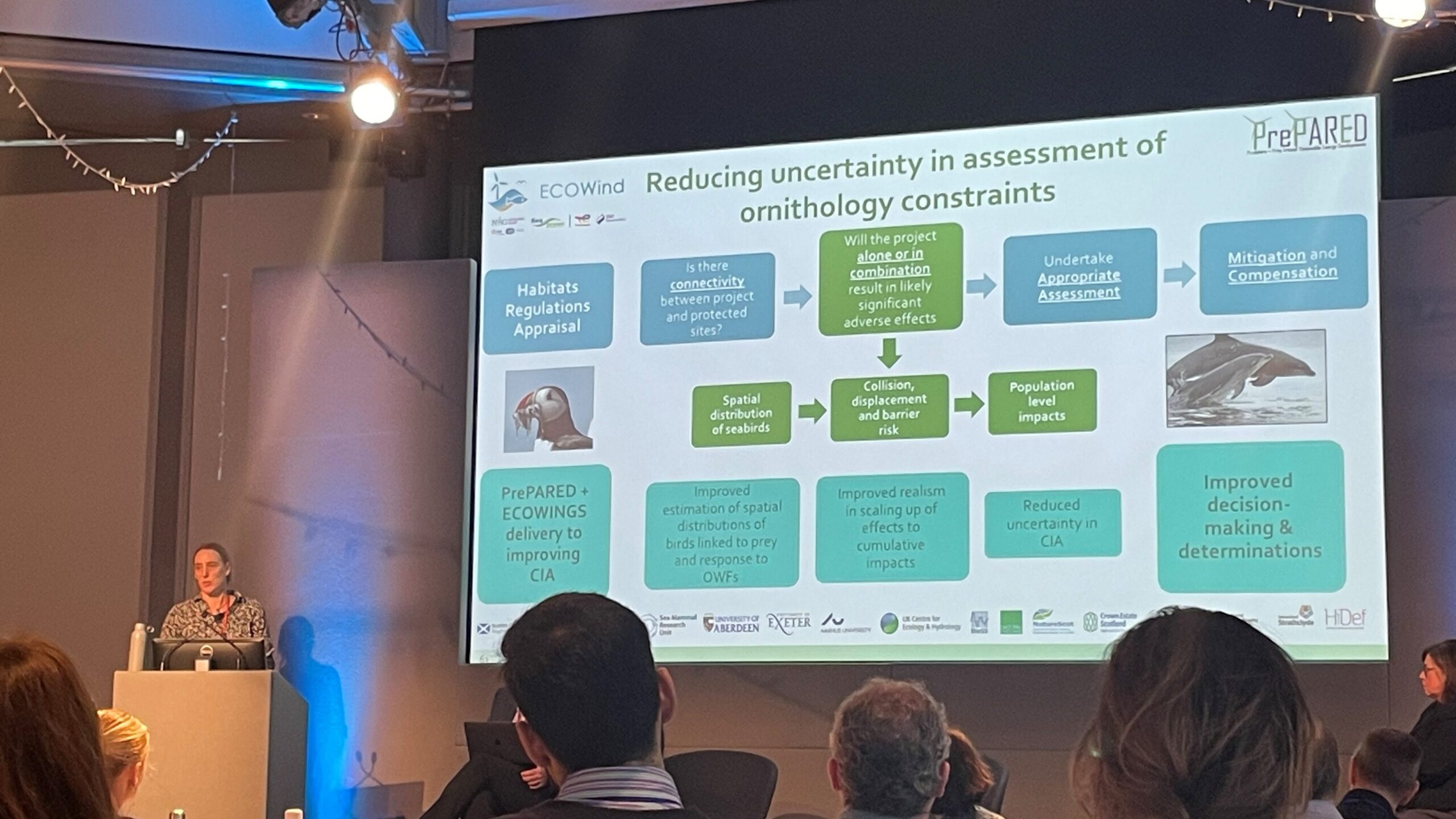
PrePARED colleague presenting at event. Presentation slides state "Reducing uncertainty in assessment of cumulative effects - Short term, Medium-term future and Long-term future"

Conferences

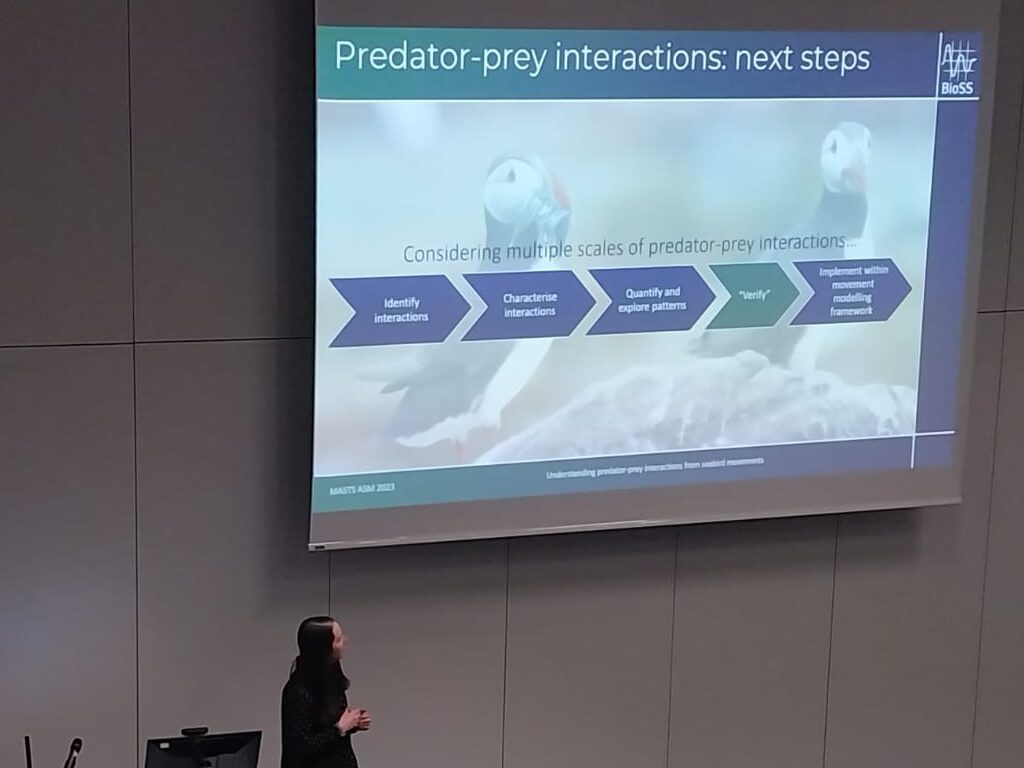
This month, colleagues from BioSS presented PrePARED work at the Marine Alliance for Science and Technology for Scotland (MASTS) Annual Science Meeting in Glasgow.

Dr Katherine Whyte

Dr Katherine Whyte presented on ‘Understanding predator-prey interactions from seabird movements’ and Dr Esther Jones presented on ‘Predator-prey dynamics in a changing marine environment.

Dr Esther Jones

Sandeel Survey

During December, Dr Thomas Regnier and his team from SG Marine Directorate undertook a winter sandeel survey in the Firth of Forth.

Data from sandeel grabs will be used to assess fish distribution during construction and operation of offshore wind farms.

Both broad-scale, changes in fish communities and prey landscapes, and fine-scale, changes in prey around individual turbine bases will be assessed throughout this project.


2023 Summary

The PrePARED team have been working hard this year with fieldwork and initial data analysis taking place. See a short summary below:

  • Held our first Annual Knowledge Exchange Meeting in February 2023
  • Undertook a number of fieldwork surveys in both the Moray Firth and Firth of Forth collecting data on fish, marine mammal and seabird distribution and behaviour.
  • Presented initial findings at multiple conferences and key stakeholder meetings including ICES Annual Science Conference, CWW, ECOWIND/OWEC Annual Impact Meeting and MASTS Annual Science Meeting

In 2024 there will be further fieldwork for data collection, our second Annual Knowledge Exchange Meeting and current papers under review will be published.


Thank you for your support during 2023, we look forward to sharing interesting results with you in 2024!

November 2023

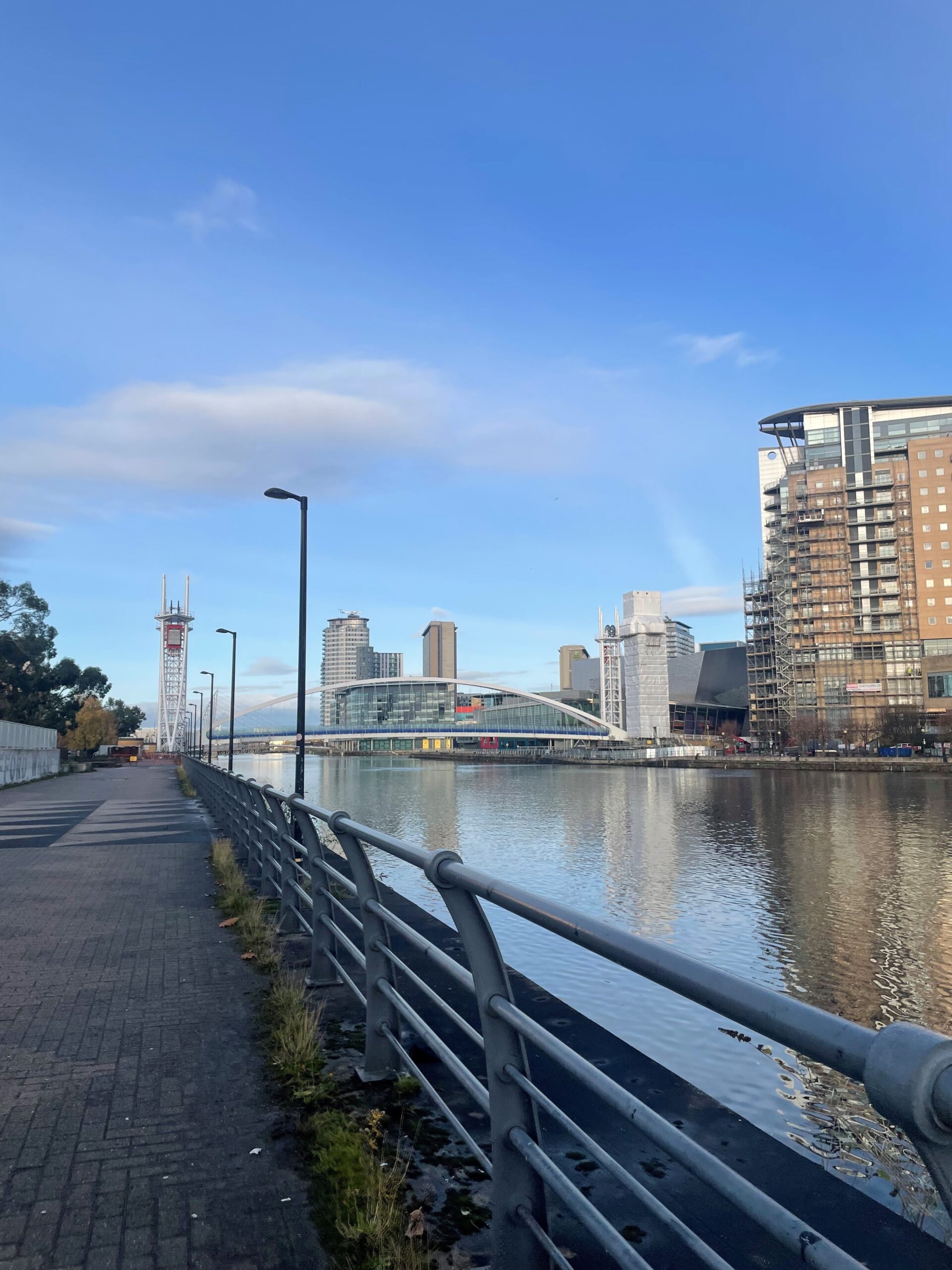
Photo of bridge over river in Manchester

ECOWIND & OWEC Annual Impact Meeting

PrePARED partners attended the ECOWIND & OWEC Annual Impact Meeting from 21-23rd November 2023.

.

Day 1 allowed PrePARED to investigate collaboration opportunities with other offshore wind projects and raise awareness of current research highlights and findings.

Dr Kate Searle, UKCEH, presenting on PrePARED Cumulative Effects research
Dr Matthew Witt, University of Exeter, presenting on fish effects in relation to offshore wind

Day 2 and 3 provided an opportunity to meet with key stakeholders and discuss the policy and delivery landscape, key challenge areas and research highlights.

.

PrePARED was represented in a number of areas at this meeting including research highlights on Ornithological effects, Fish effects, and Cumulative Effects Assessments.


Q4 General Updates

  • Prof. Paul Thompson, University of Aberdeen, recently met with our Aarhus University colleagues to discuss how PrePARED data can be integrated into the DEPONS framework.
  • Offshore activity currently underway to service acoustic receiver arrays in the Moray Firth to provide further data on fish activity in and around windfarms.
  • Preparations are currently underway for a winter survey on sandeel distributions within and around offshore wind farms in the Firth of Forth to provide essential data on the effect of prey distributions on marine top predators.

October 2023

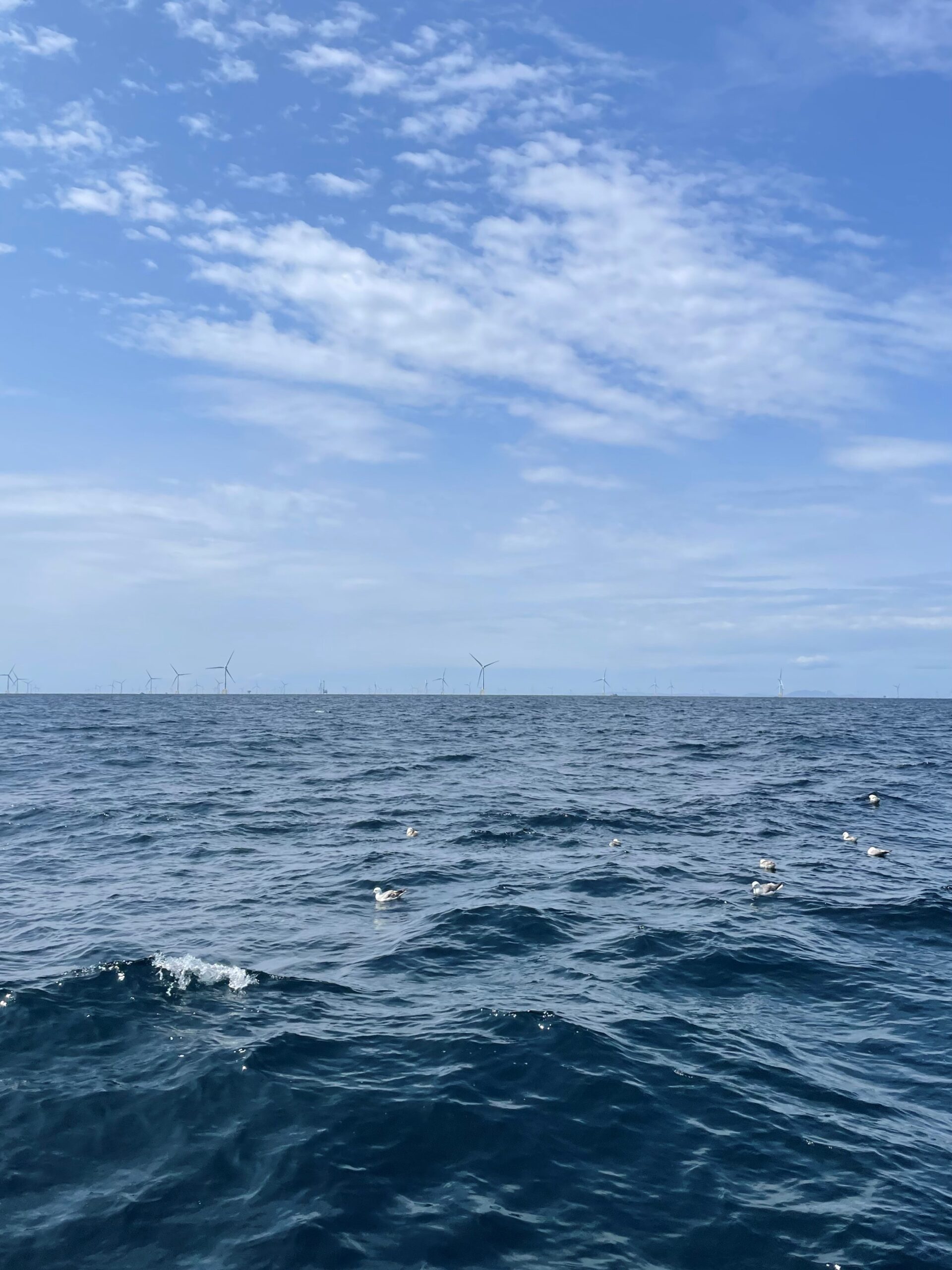
Sunrise over North Sea waves

Project Updates

  • Our PrePARED Fisheries Acoustician has prepared a video describing what their role within the project looks like on a daily basis. You can watch this here.
  • Preparations have begun for Workpackage 1 offshore sandeel survey in December 2023
  • Job Opportunity: BioSS is recruiting a Spatial Statistician to support PrePARED work and other renewable energy projects. Deadline 20th November. More information available here (https://www.bioss.ac.uk/vacancies/statistician-specialising-applied-spatial-statistics)

Project Manager

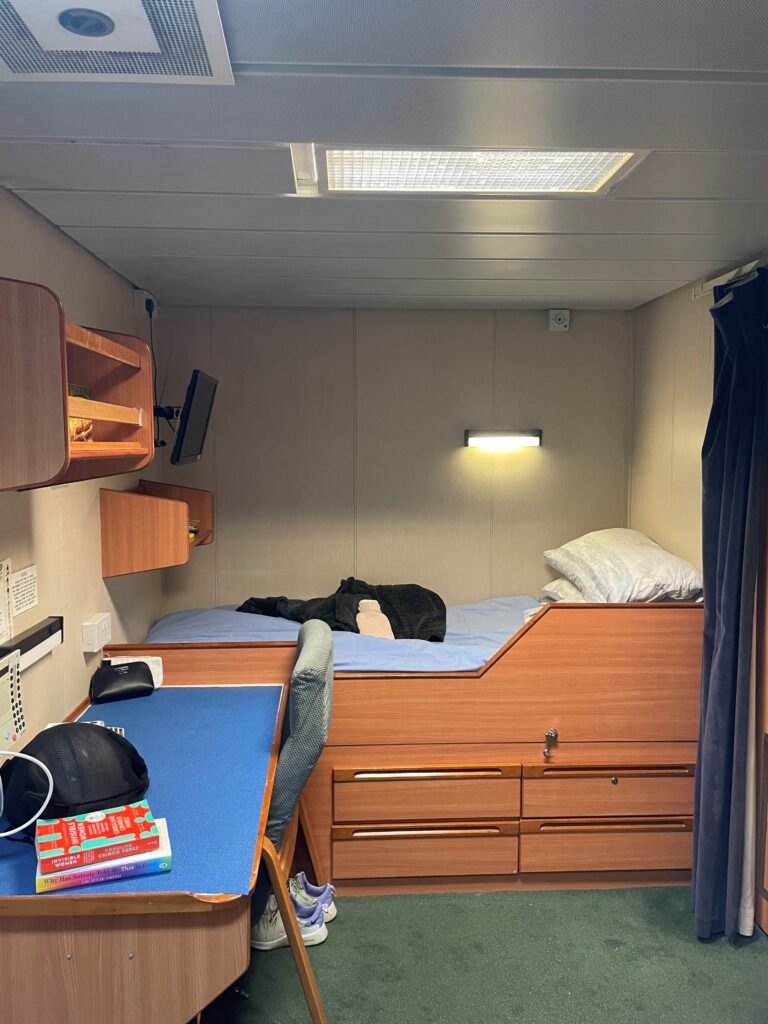
Cabin on

This month I was pleased to undertake my first offshore survey work in the North Sea on the MRV Scotia.

Despite poor weather conditions, spirits remained high and the survey was an overall success!

For those undertaking an extended offshore trip for the first time, I have listed my top 5 packing essentials below:

  • Well-fitted PPE. You are likely going to be in your PPE for extended periods of time, I recommend ensuring that this is comfortable and not ill-fitting to ensure maximum comfort.
  • Entertainment such as books and downloaded films to keep you busy during travel days.
  • Printed copy of the SOPs to write notes and ID guides to reference during and after survey work.
  • Cosy fleece – make sure you don’t catch a chill!
  • Seasickness tablets. I was fortunate to not feel the effects of seasickness, however, it is always better to have and not need!
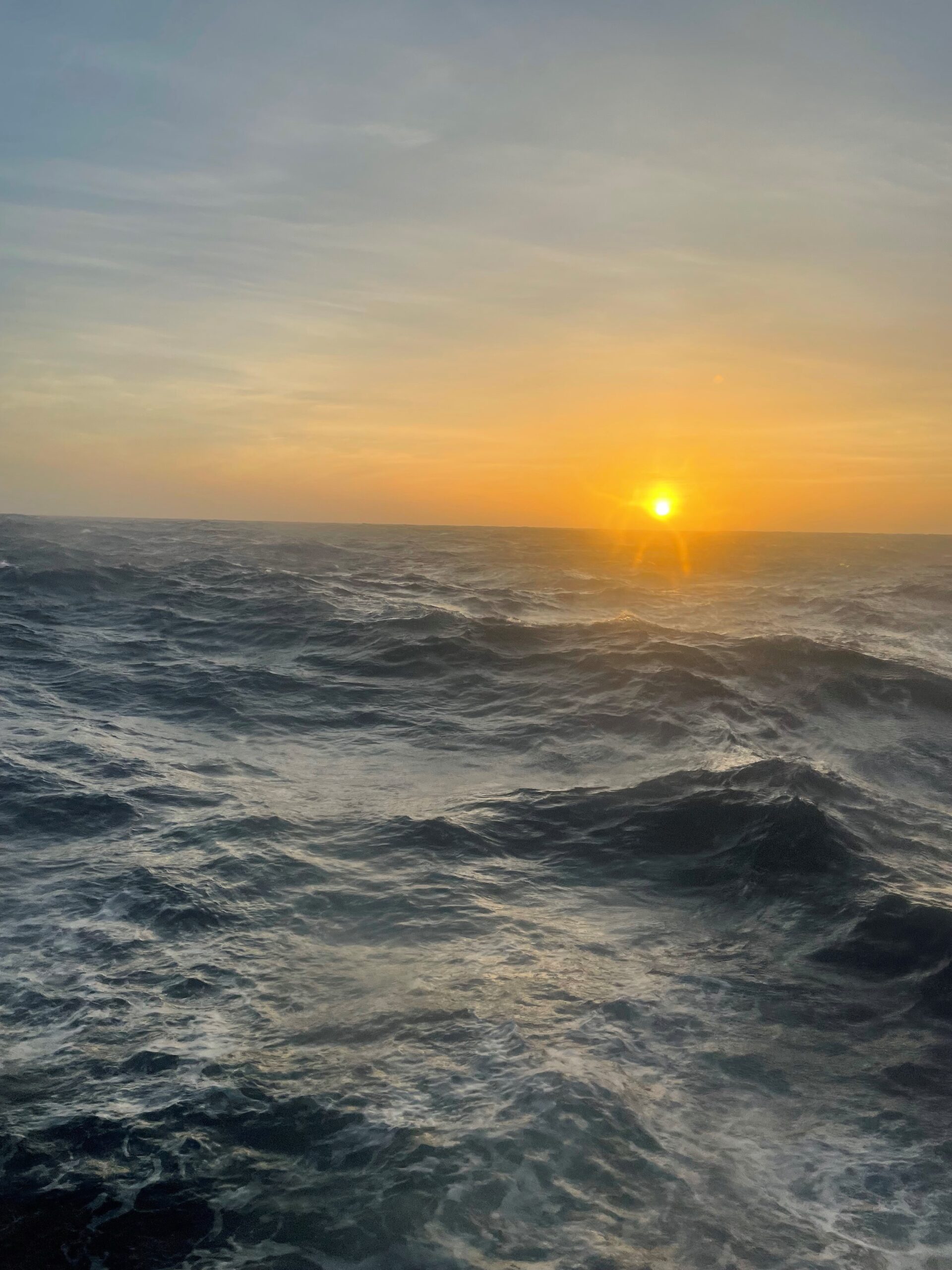
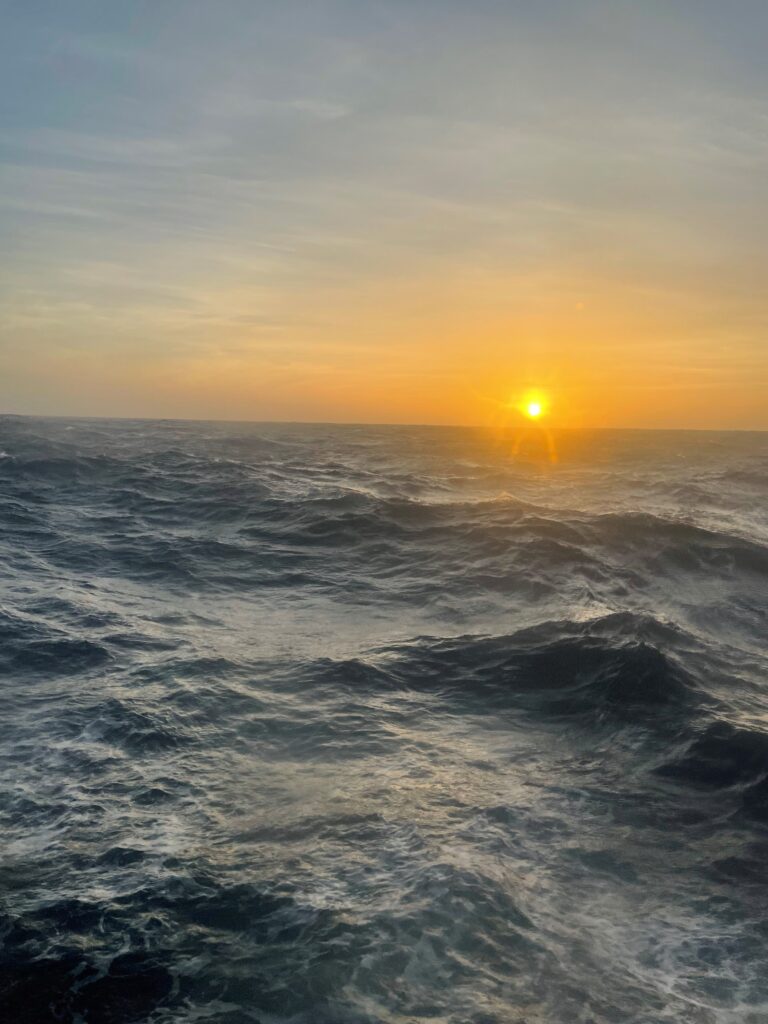
Sunrise in the North Sea

September 2023

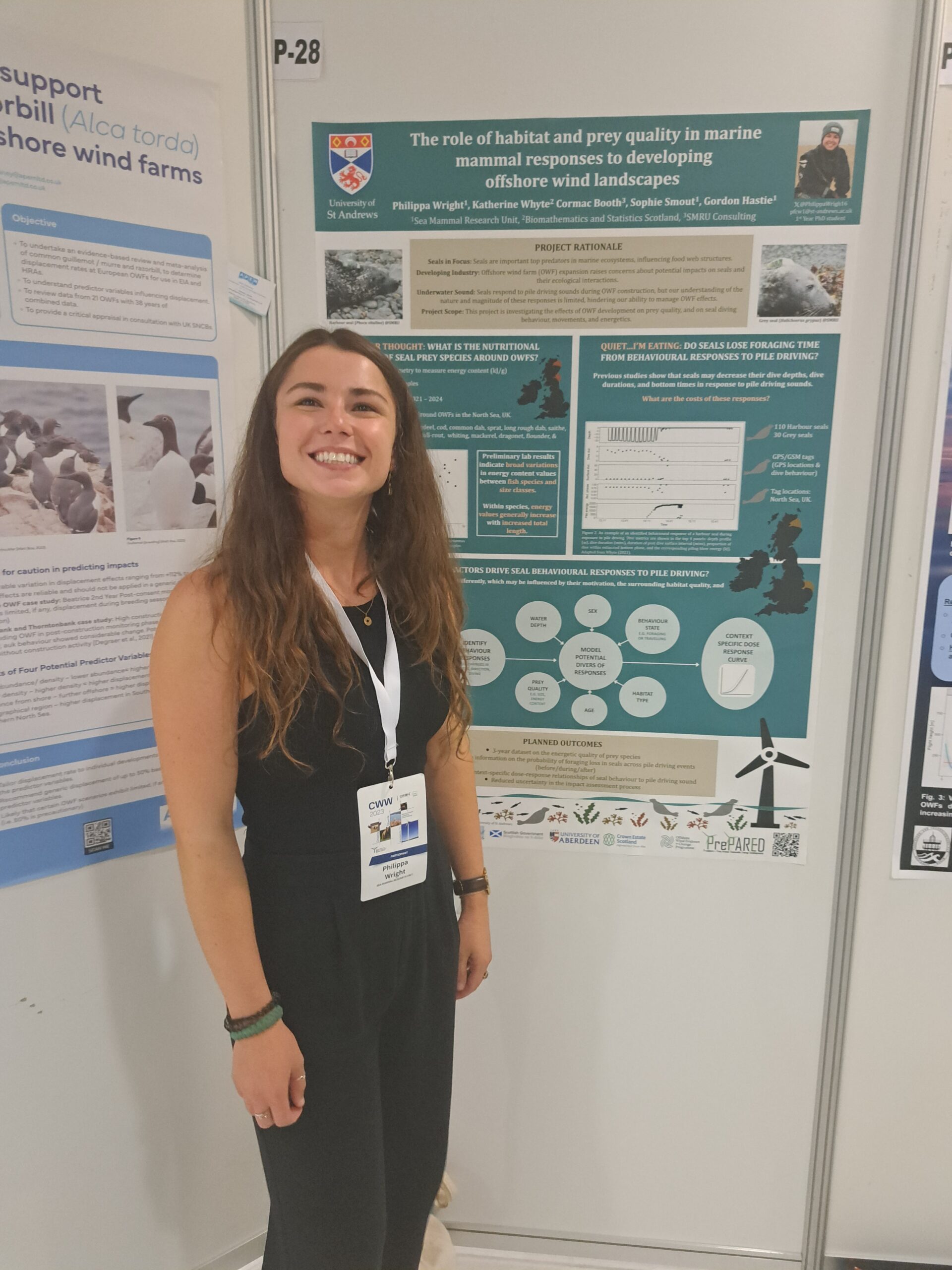
Project team member standing in front of poster on 'the role of habitat and prey quality in marine mammal responses to developing offshore wind landscapes'

September Conference Attendance

This month, PrePARED project members attended a number of conferences and workshops to inform stakeholders on project activities.

Oihane Fernandez-Betelu (University of Aberdeen) attended and presented at the International Council for the Exploration of the Seas (ICES) Annual Science Conference in Bilbao, Spain


Katherine Whyte (BioSS) and Christopher Pollock (UKCEH) presented PrePARED plans at the British Ecological Society’s Movement Ecology Conference in St Andrews.


The following project members attended the Conference on Wind energy and Wildlife impacts (CWW) 2023 in Sibenik, Croatia;

  • Josesph Onoufriou (SGMD) provided a PrePARED overview poster
  • Gordon Hastie (University of St. Andrews/SMRU) presented a poster on “Interactions between seals and offshore wind farm construction”
  • Philippa Wright (University of St Andrews/SMRU) presented a poster on “The role of habitat and prey quality in marine mammal responses to developing offshore wind landscapes”

Quarter 3 General Updates

  • Stakeholder and Network Analysis now complete with a report and communications plan delivered to the project team. The report establishes priority stakeholder groups complemented by the communications plan which outlines dissemination procedures for most effective dissemination per group.
  • Quarter 3 Progress Meeting allowed the entire PrePARED Project Team to come together and share task updates, highlights, challenges and planned activity for Quarter 4.

Project Manager

Screenshot of CWW2023 virtual welcome screen
  • I was pleased to attend The Crown Estate OWEC Programme Steering Group (PSG) meeting this month where there was focussed discussion around best practice in delivering impactful research.
  • Virtual attendance at the CWW23 allowed for insight into how experts from around the world are investigating the impacts and opportunities of wind energy on wildlife.
  • It is also time to submit our Quarter 3 Report (July – September) to the Offshore Wind Evidence and Change programme (OWEC) with project updates. You can see the report here once complete.
PrePARED Logo

August 2023

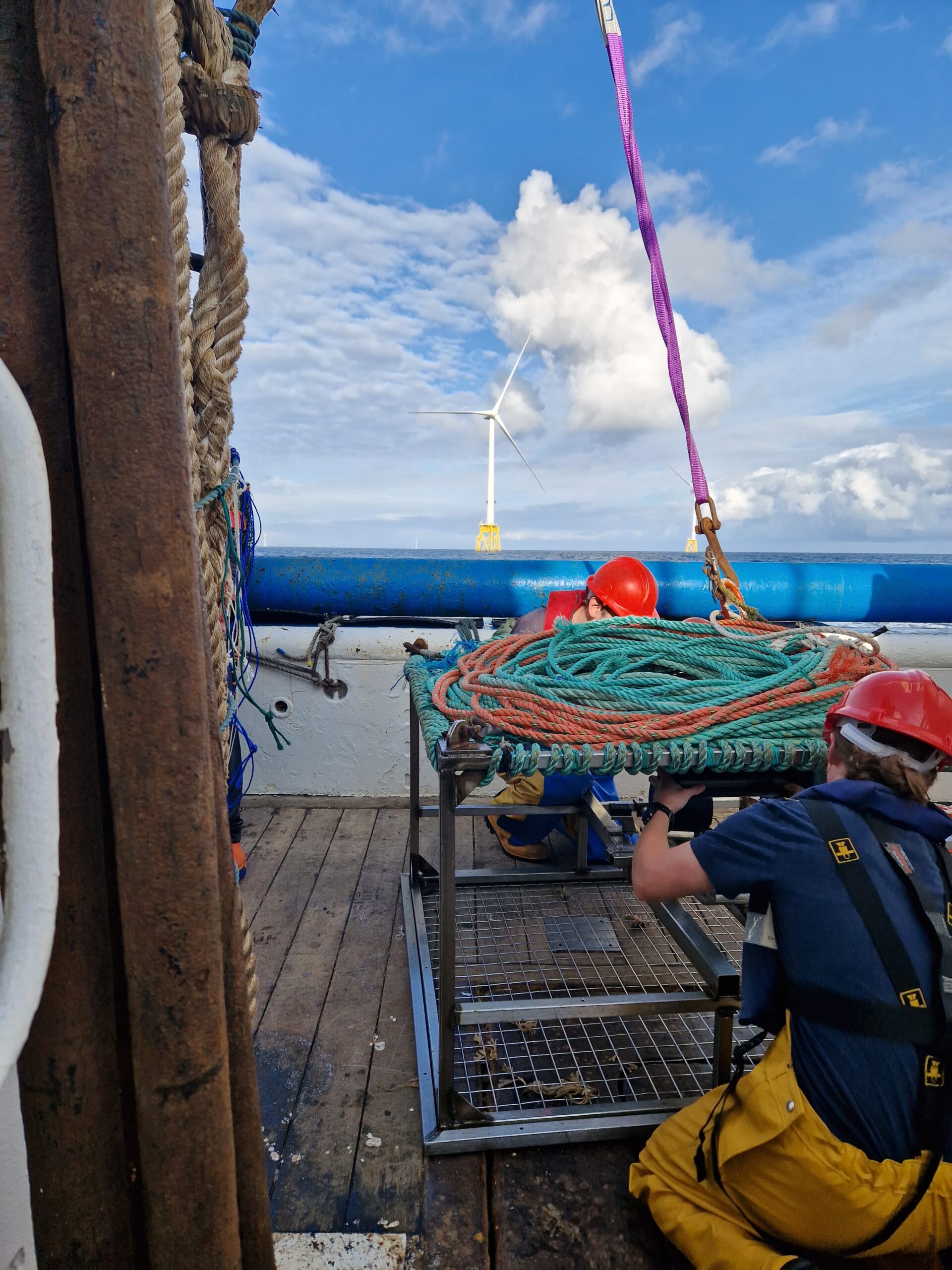
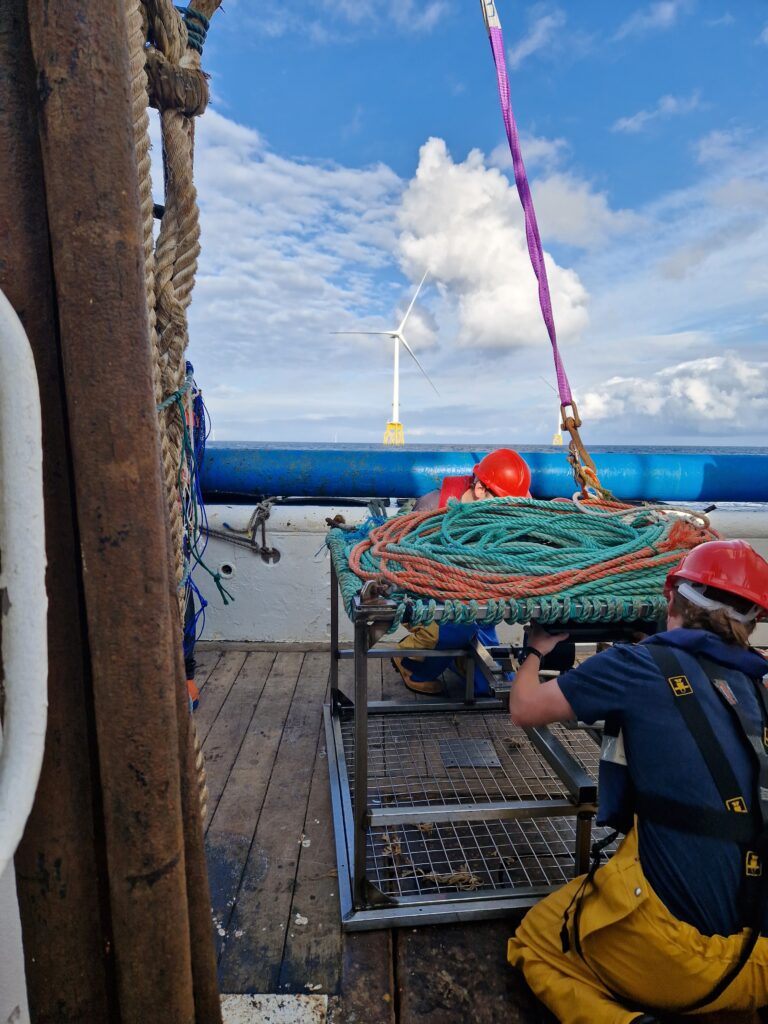
2 PrePARED team members crouching next to BRUV with windfarm in background

Summer Surveys

Following on from our successful June/July survey work, the following surveys were conducted this month:


In the Firth of Forth, successful Baited Remote Underwater Video and fish trap surveys were conducted to support Task 1.2 on how fine-scale fish communities change in relation to offshore wind farm development. In addition to the above, RoxAnn surveys of the substrate were conducted and Conductivity, Temperature and Depth (CTD) data at the sampling sites were collected. This cruise ran from 29 July to 14 August 2023.

Baited Remote Underwater Video (BRUV) set up

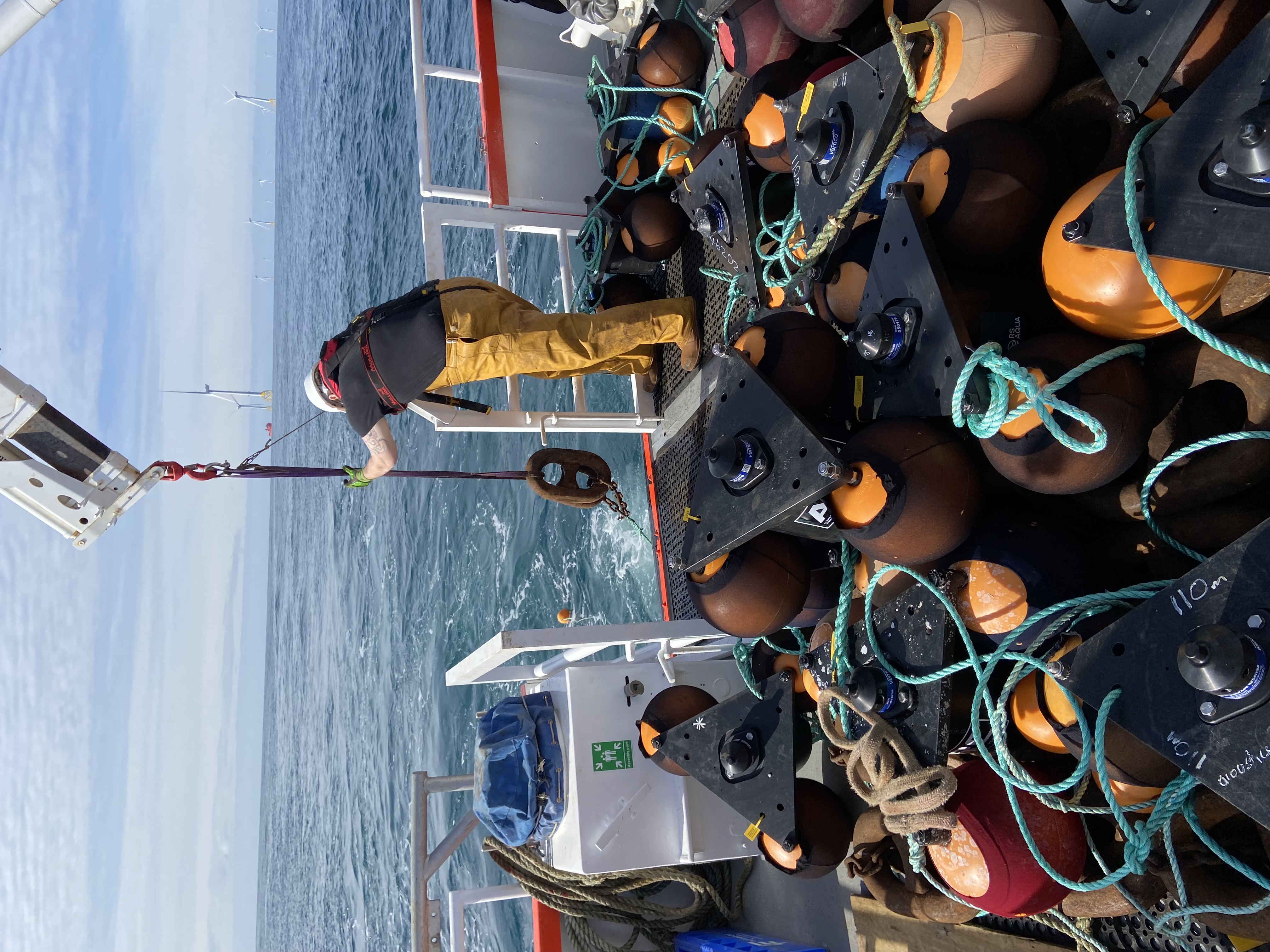
A total of 65 Passive Acoustic Monitoring (PAM) devices were deployed in the Moray Firth, at Moray East, Moray West and BOWL, to support data collection for Task 4.3 on how windfarm presence affects marine mammal responses to pile-driving and vessel disturbance. These devices use underwater microphones to detect and monitor vocalising marine mammals.

During this campaign, several acoustic release canisters (ARCs) already in position were recovered to support data collection for Task 3.3. These acoustic arrays will be serviced and the fish ping data downloaded to review the influence of wind turbines on the behaviour and movement of fish in the Moray Firth.

Snippet from BRUV of flapper skate in the Firth of Forth


Quarter 3 General Updates

      • The Stakeholder and Network Analysis is in the final stages of review which will ensure that key stakeholders are informed of project outputs in the most effective way.

      • A final date and venue for the 2024 Annual Knowledge Exchange Meeting have been identified and invitations to stakeholders will be sent in due course after agenda finalisation.


    Project Manager

    This month I completed my STCW Personal Survival Techniques course in Aberdeen. The course consisted of a theory element reviewing case studies of offshore accidents, preventative actions, first aid and lifesaving equipment such as flares, rafts, and personal locator beacons.

    There was also a practical element:

    Full PPE donned including boilersuit, floatation suit, life vest and hard hat. 

    Jump from height into a pool before swimming over to an upturned life raft. After a foothold is found, pull yourself up onto the raft (not an easy feat in a large floatation suit and life vest!) before standing, balanced, on the raft.

    Once balanced, hold a rope connected to the raft and use your weight fall backward and simultaneously pull the raft upwards until it flips, and you fall back to the water.

    Again, after finding a foothold, pull yourself up into the safety of the raft and await rescue.

    This certification will allow me to support future PrePARED offshore survey work, increasing understanding and communication throughout the project.

    July 2023

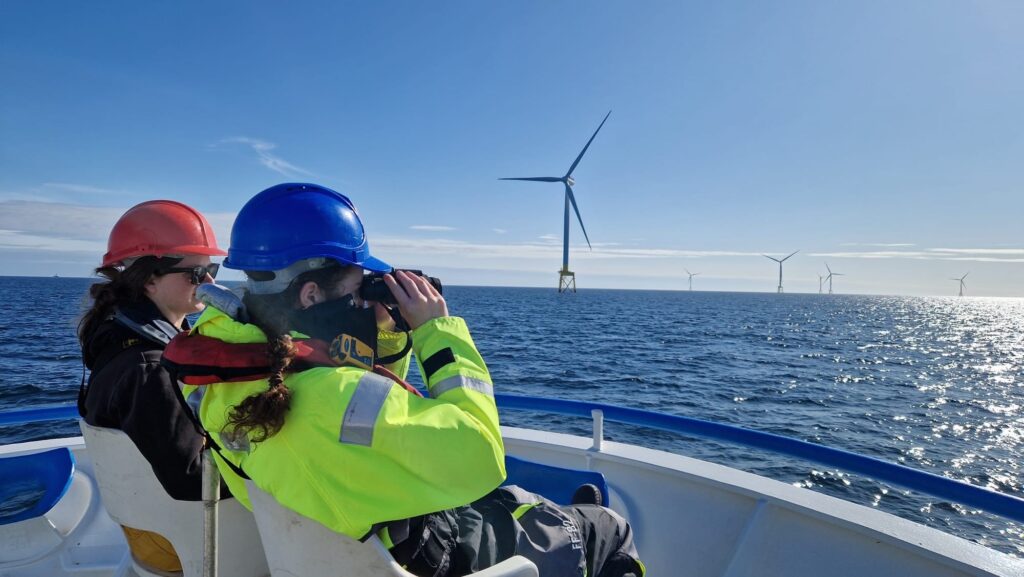
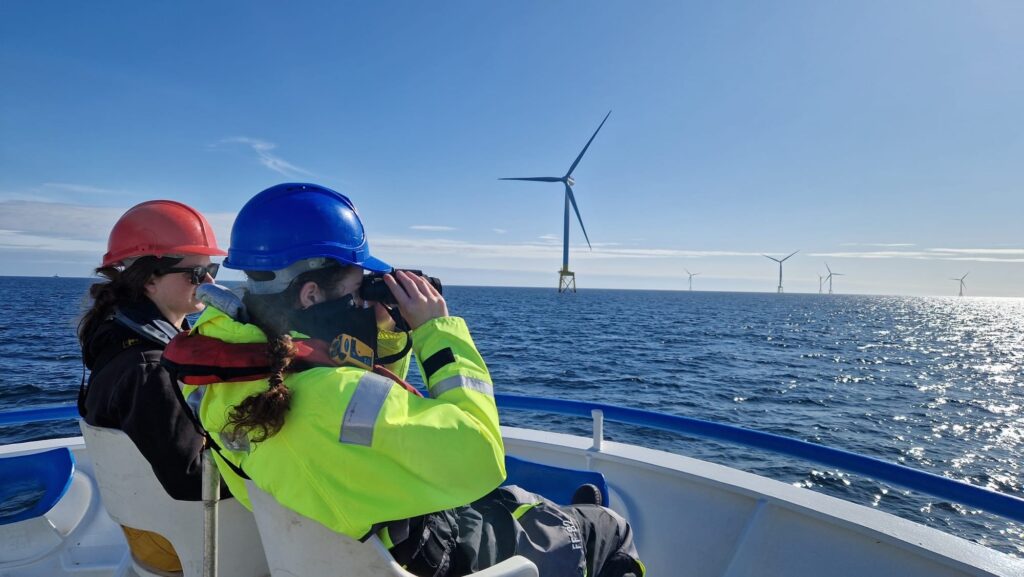
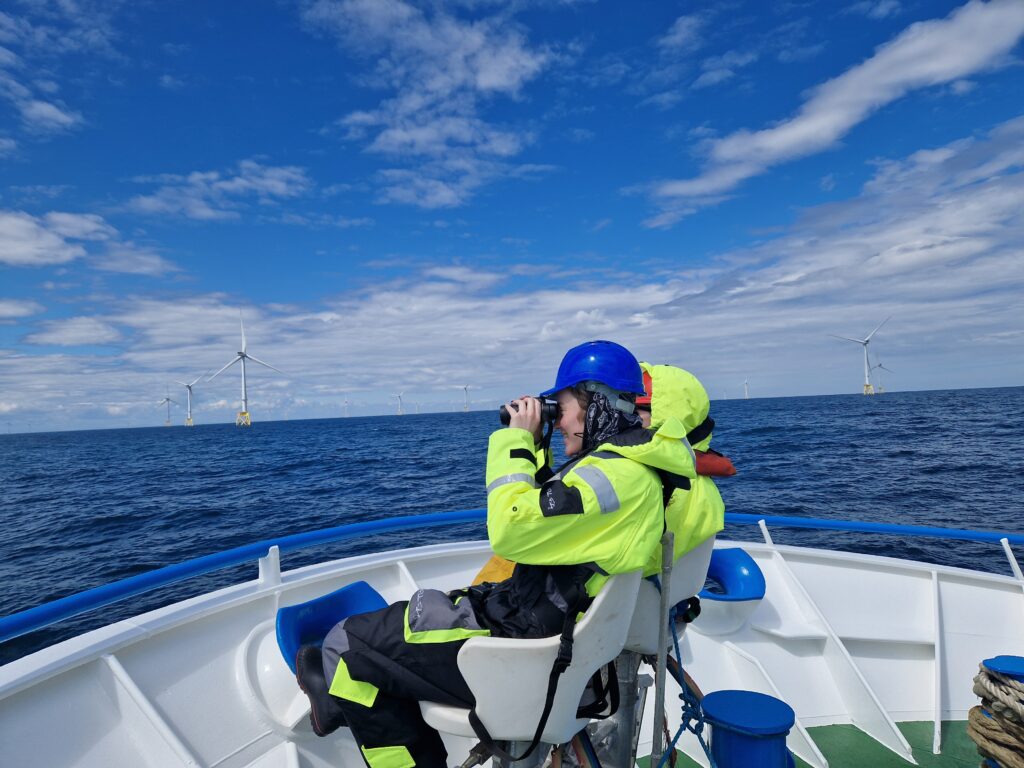
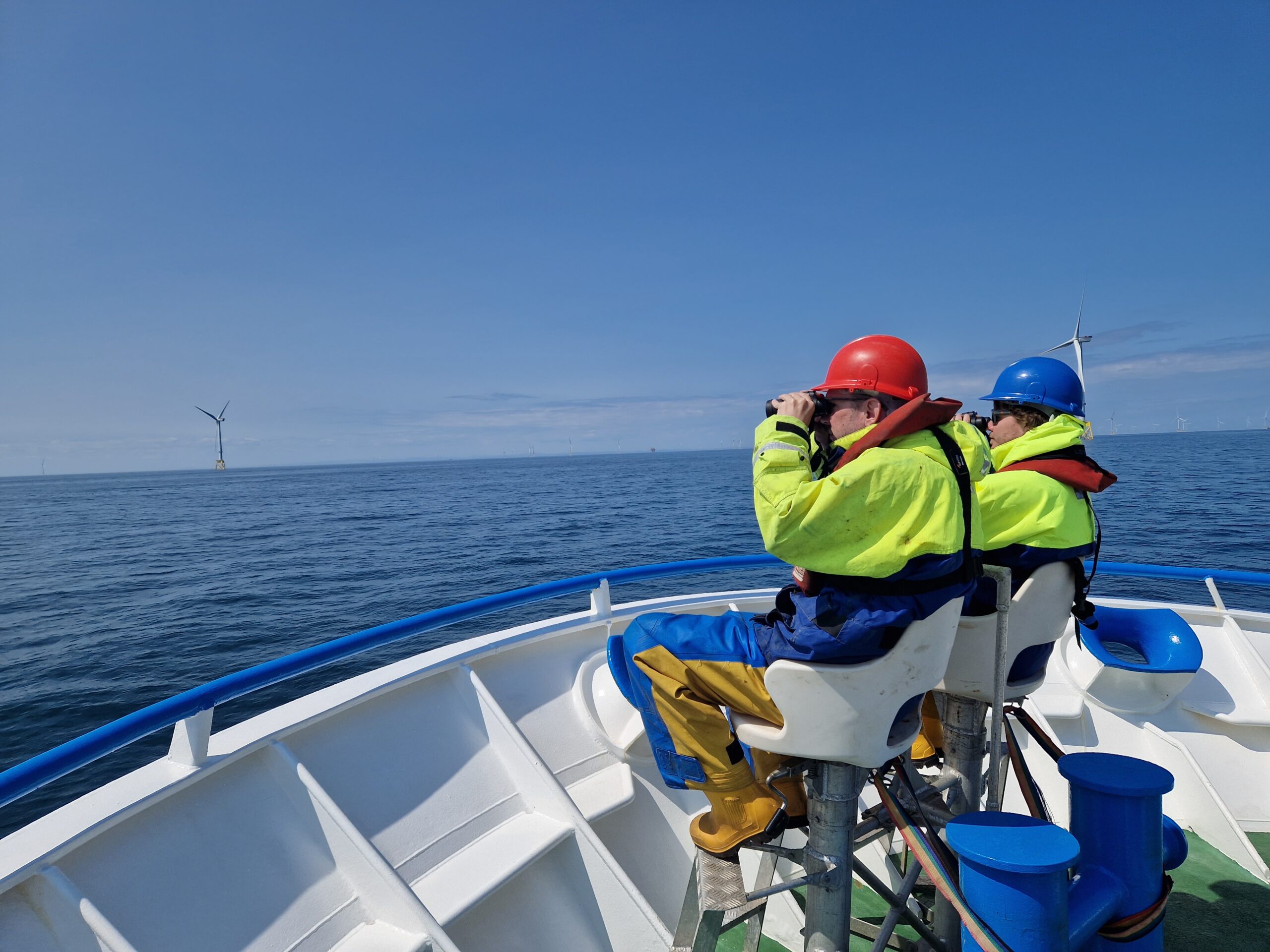
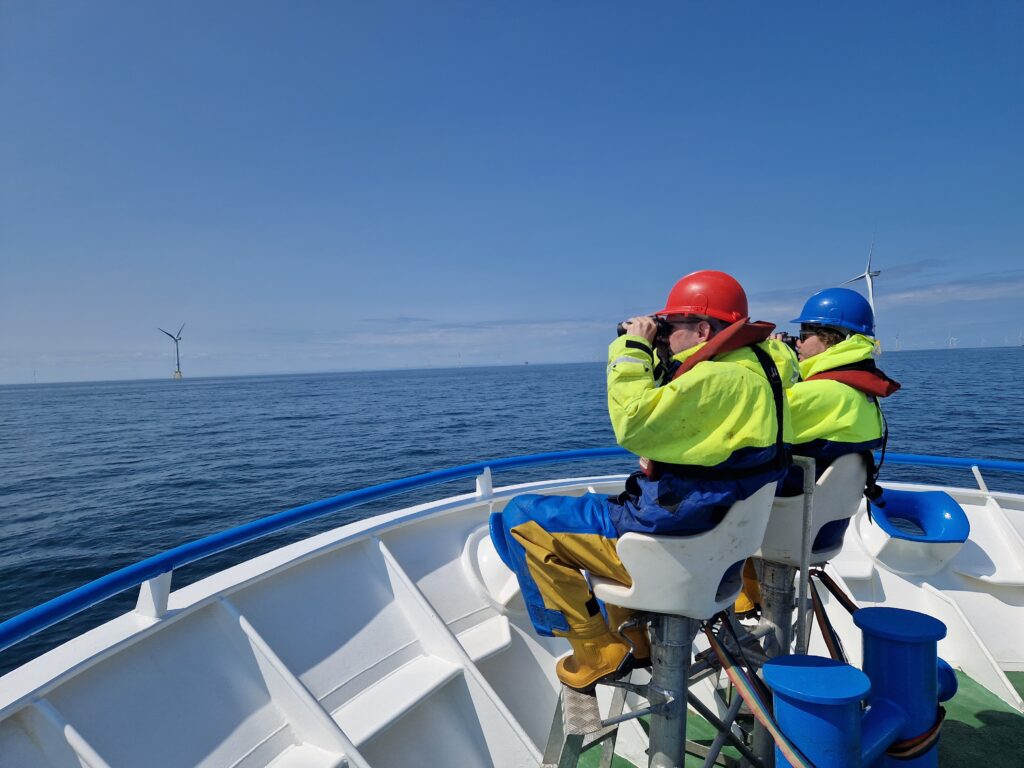
    2 scientists using binoculars on boat to undertake seabird surveys

    Summer Surveys

    This summer PrePARED have conducted several successful summer surveys. These include;

    • Data collection to support Workpackage 1 including surveys on broad-scale fish distributions in the Forth & Tay;
      • Fisheries acoustic survey of pelagic fish including pelagic tows
      • Seabird at sea survey
      • Demersal fish survey
      • CTD stations measuring conductivity, temperature, pressure, dissolved O2 concentration, chlorophyll a and salinity at depth
    2 scientists using binoculars on boat to undertake seabird surveys
    Seabird at sea survey
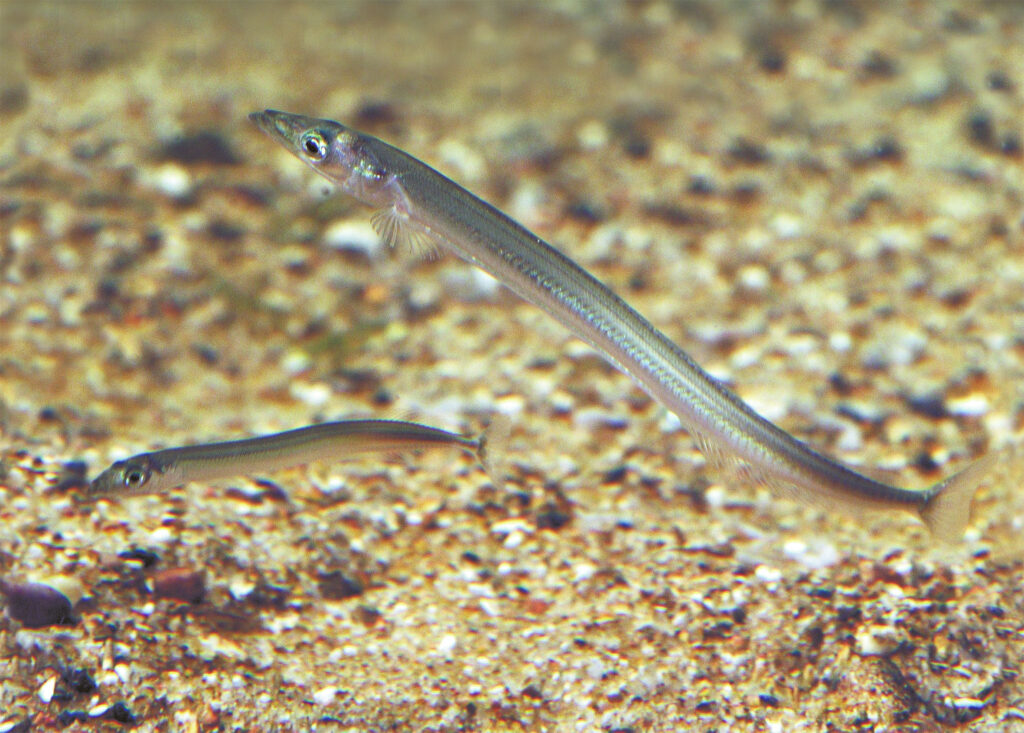
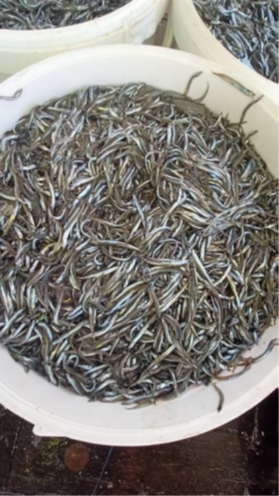
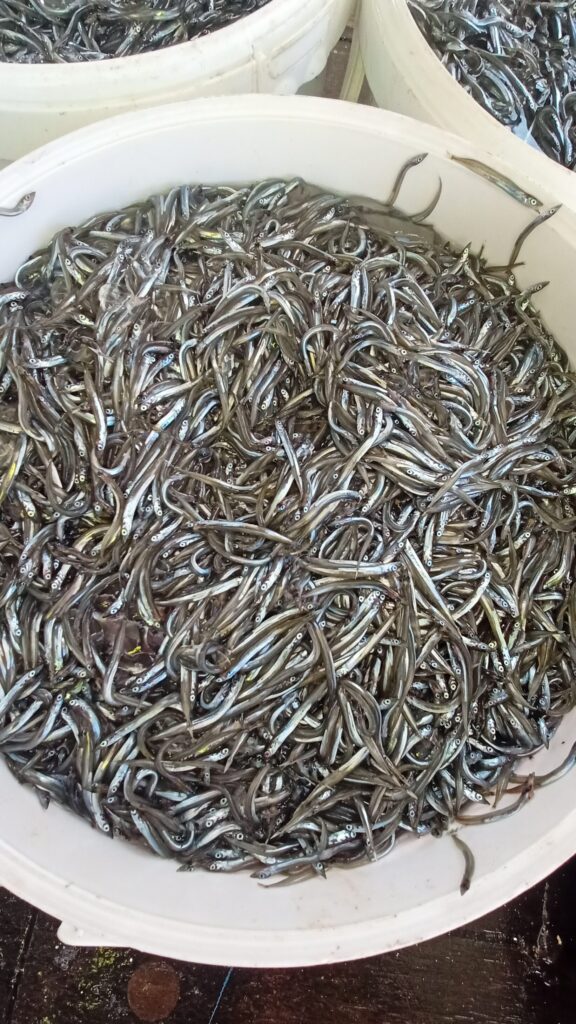
    Sandeel from tow
    Sandeel from pelagic tow
    Demersal fish survey
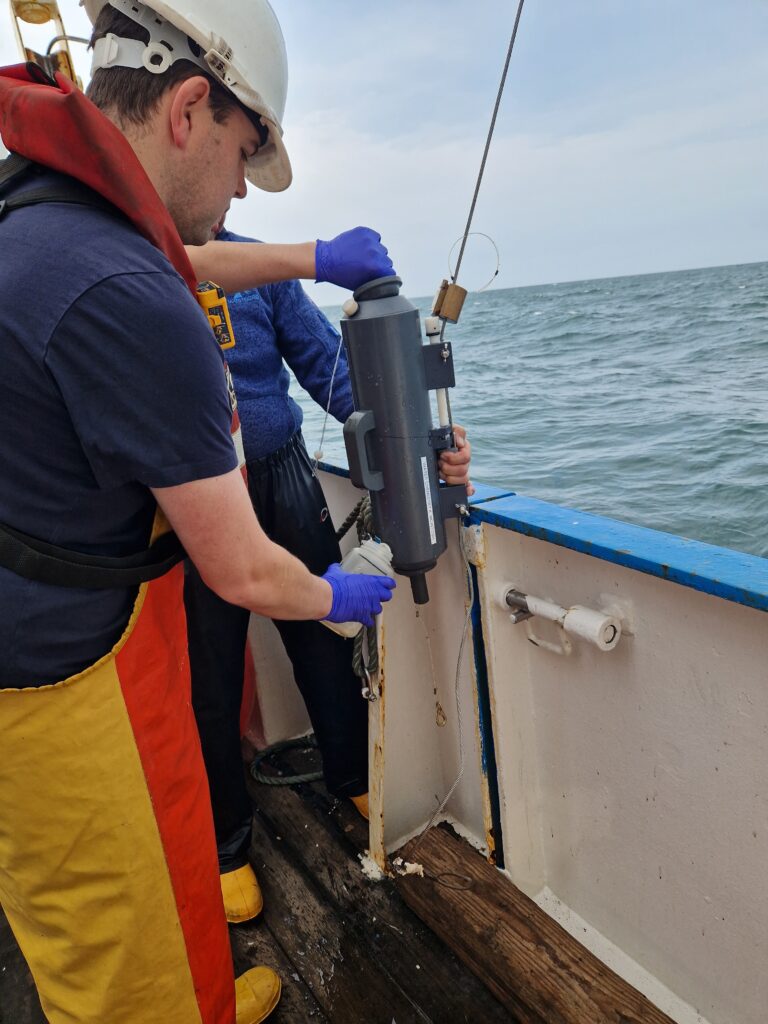
    CTD stations
    • Surveys to support research on fine-scale fish distributions in the Forth & Tay by mapping predatory/demersal fish abundance. At the end of July, a survey will commence conducting Baited Remote Underwater Video (BRUV) and trap surveys.
    • Data collection supporting Workpackage 3 including fisheries acoustic transects, pelagic and demersal trawls and CTD casts in the Moray Firth to support large-scale and fine-scale fish distribution research (Tasks 3.1 and 3.2)
    • To support Task 3.3 on fish acoustic telemetry in the Moray Firth, 2 x 1 week boat surveys were undertaken to Moray Firth windfarms with acoustic receiver arrays serviced and data downloaded. Fish tagging also took place with 1 cod and 4 whiting being tagged.
    Acoustic transects
    Fish Tagging

    Quarter 2: General Updates

    PrePARED ECR attending Royal Society event
    • The project management team have allocated a contract for a Stakeholder and Network Analysis to ensure that there is a clear understanding of who has an influence over the project, would be impacted by project findings, or have interests related to offshore wind farm development and their effects on seabirds, marine mammals, and fish. The findings from the analysis will be used to inform impact plans and ensure effective engagement with key stakeholders.
    • PrePARED have established a Management Group to focus on delivery of the project moving forward and allow for discussion and solving of any project challenges as and when they arise.
    • A few of the project team early career researchers (ECR) attended an event organised by Royal Society on “Ocean and marine science policy”

    Project Manager

    • Since assuming the project management role, I have taken advantage of opportunities to hold individual discussions with task leads to gain a better understanding of the project objectives, status, challenges, and highlights.
    • I have begun preparations for the 2024 Annual Knowledge Exchange Meeting, reviewing dates and venue options.
    • To support future surveys, I have also obtained my ENG1 Medical Certificate and have booked a Survival at Sea course in August which will allow me to join research cruises and support with data collection.
      • The ENG1 Medical took ~30 minutes and the doctor records your height, weight and BMI and conducts eyesight and hearing tests. In addition, the doctor also checks for kidney stones and reviews your flexibility for any joint or muscular pain.